QUESTION IMAGE
Question
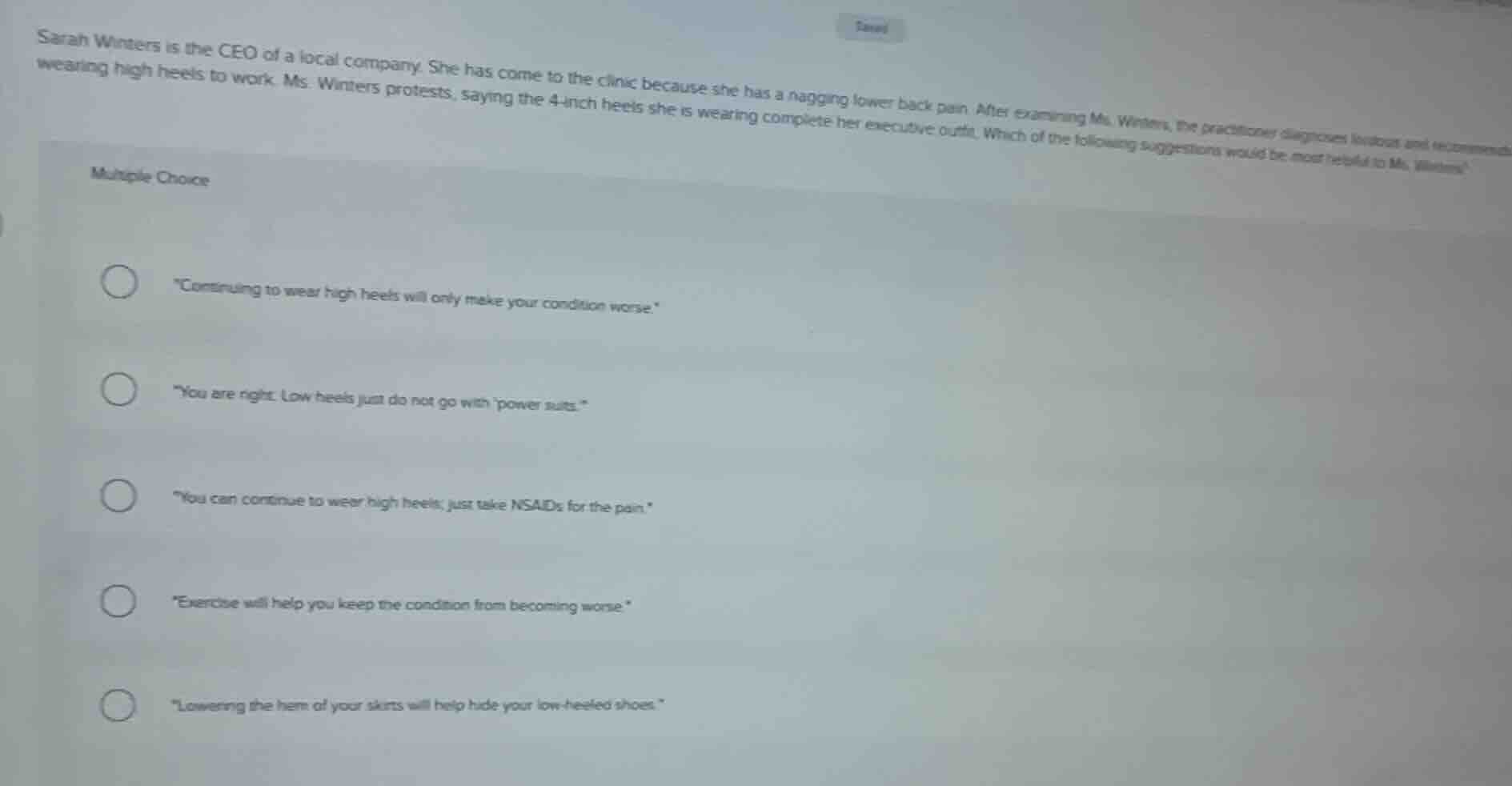
sarah winters is the ceo of a local company. she has come to the clinic because she has a nagging lower back pain. after examining ms. winters, the practitioner diagnoses lordosis and recommends wearing high heels to work. ms. winters protests, saying the 4-inch heels she is wearing complete her executive outfit. which of the following suggestions would be most helpful to ms. winters?
multiple choice
\continuing to wear high heels will only make your condition worse.\
\you are right. low heels just do not go with power suits.\
\you can continue to wear high heels; just take nsaids for the pain.\
\exercise will help you keep the condition from becoming worse.\
\lowering the hem of your skirts will help hide your low-heeled shoes.\
<pre_analysis>
{
"quality": "clear",
"question_count": 1,
"skills_matched": [
"direct_cot",
"multiple_choice_formatter",
"explain_then_answer",
"tutor"
],
"needs_drawing": false,
"concepts_used": [
"Communication Cycle",
"Feedback Loop"
],
"new_concepts": [
"Therapeutic Communication",
"Patient Compliance"
],
"current_concepts": [
"Communication Cycle",
"Feedback Loop",
"Therapeutic Communication",
"Patient Compliance"
]
}
</pre_analysis>
<reasoning>
Analyze the patient's situation and barrier to compliance
The patient, Sarah Winters, is a CEO diagnosed with lordosis linked to wearing 4-inch high heels. She protests against changing her footwear because she believes high heels are essential to complete her executive wardrobe ("power suits"). This represents a common barrier in clinical communication: a conflict between medical advice and the patient's professional identity or personal preferences.
Evaluate the communication strategies
To achieve patient compliance, a healthcare professional must use therapeutic communication.
- Directly telling her that continuing to wear heels will make her condition worse is medically true but dismissive of her concerns, which can lead to defensiveness.
- Agreeing that low heels do not go with power suits validates her fashion concern but fails to address the medical issue.
- Telling her she can continue wearing heels and just take NSAIDs is medically inappropriate and does not treat the root cause.
- Offering a practical, compromise-oriented solution that respects her professional image while addressing her health is the most effective approach. Suggesting "Lowering the hem of your skirts will help hide your low-heeled shoes" validates her need to look professional/executive while offering a practical way to comply with the medical recommendation of wearing lower heels.
Apply the Communication Cycle and Feedback Loop
Using the Communication Cycle and Feedback Loop, the practitioner must decode the patient's feedback (her protest about her executive outfit) and adjust the message. By offering a practical styling tip, the practitioner addresses her underlying concern (professional appearance) to facilitate a positive feedback loop and encourage compliance.
</reasoning>
<answer>
<mcq-option>(A) "Continuing to wear high heels will only make your condition worse."</mcq-option>
<mcq-option>(B) "You are right. Low heels just do not go with 'power suits.'"</mcq-option>
<mcq-option>(C) "You can continue to wear high heels; just take NSAIDs for the pain."</mcq-option>
<mcq-option>(D) "Exercise will help you keep the condition from becoming worse."</mcq-option>
<mcq-correct>(E) "Lowering the hem of your skirts will help hide your low-heeled shoes."</mcq-correct>
</answer>
<post_analysis>
{
"subject": "Others",
"question_type": "Multiple Choice",
"knowledge_point": [
"Others",
"Medical Assistant Certification",
"Communication Cycle"
]
}
</post_analysis>
Snap & solve any problem in the app
Get step-by-step solutions on Sovi AI
Photo-based solutions with guided steps
Explore more problems and detailed explanations
<pre_analysis>
{
"quality": "clear",
"question_count": 1,
"skills_matched": [
"direct_cot",
"multiple_choice_formatter",
"explain_then_answer",
"tutor"
],
"needs_drawing": false,
"concepts_used": [
"Communication Cycle",
"Feedback Loop"
],
"new_concepts": [
"Therapeutic Communication",
"Patient Compliance"
],
"current_concepts": [
"Communication Cycle",
"Feedback Loop",
"Therapeutic Communication",
"Patient Compliance"
]
}
</pre_analysis>
<reasoning>
Analyze the patient's situation and barrier to compliance
The patient, Sarah Winters, is a CEO diagnosed with lordosis linked to wearing 4-inch high heels. She protests against changing her footwear because she believes high heels are essential to complete her executive wardrobe ("power suits"). This represents a common barrier in clinical communication: a conflict between medical advice and the patient's professional identity or personal preferences.
Evaluate the communication strategies
To achieve patient compliance, a healthcare professional must use therapeutic communication.
- Directly telling her that continuing to wear heels will make her condition worse is medically true but dismissive of her concerns, which can lead to defensiveness.
- Agreeing that low heels do not go with power suits validates her fashion concern but fails to address the medical issue.
- Telling her she can continue wearing heels and just take NSAIDs is medically inappropriate and does not treat the root cause.
- Offering a practical, compromise-oriented solution that respects her professional image while addressing her health is the most effective approach. Suggesting "Lowering the hem of your skirts will help hide your low-heeled shoes" validates her need to look professional/executive while offering a practical way to comply with the medical recommendation of wearing lower heels.
Apply the Communication Cycle and Feedback Loop
Using the Communication Cycle and Feedback Loop, the practitioner must decode the patient's feedback (her protest about her executive outfit) and adjust the message. By offering a practical styling tip, the practitioner addresses her underlying concern (professional appearance) to facilitate a positive feedback loop and encourage compliance.
</reasoning>
<answer>
<mcq-option>(A) "Continuing to wear high heels will only make your condition worse."</mcq-option>
<mcq-option>(B) "You are right. Low heels just do not go with 'power suits.'"</mcq-option>
<mcq-option>(C) "You can continue to wear high heels; just take NSAIDs for the pain."</mcq-option>
<mcq-option>(D) "Exercise will help you keep the condition from becoming worse."</mcq-option>
<mcq-correct>(E) "Lowering the hem of your skirts will help hide your low-heeled shoes."</mcq-correct>
</answer>
<post_analysis>
{
"subject": "Others",
"question_type": "Multiple Choice",
"knowledge_point": [
"Others",
"Medical Assistant Certification",
"Communication Cycle"
]
}
</post_analysis>