QUESTION IMAGE
Question
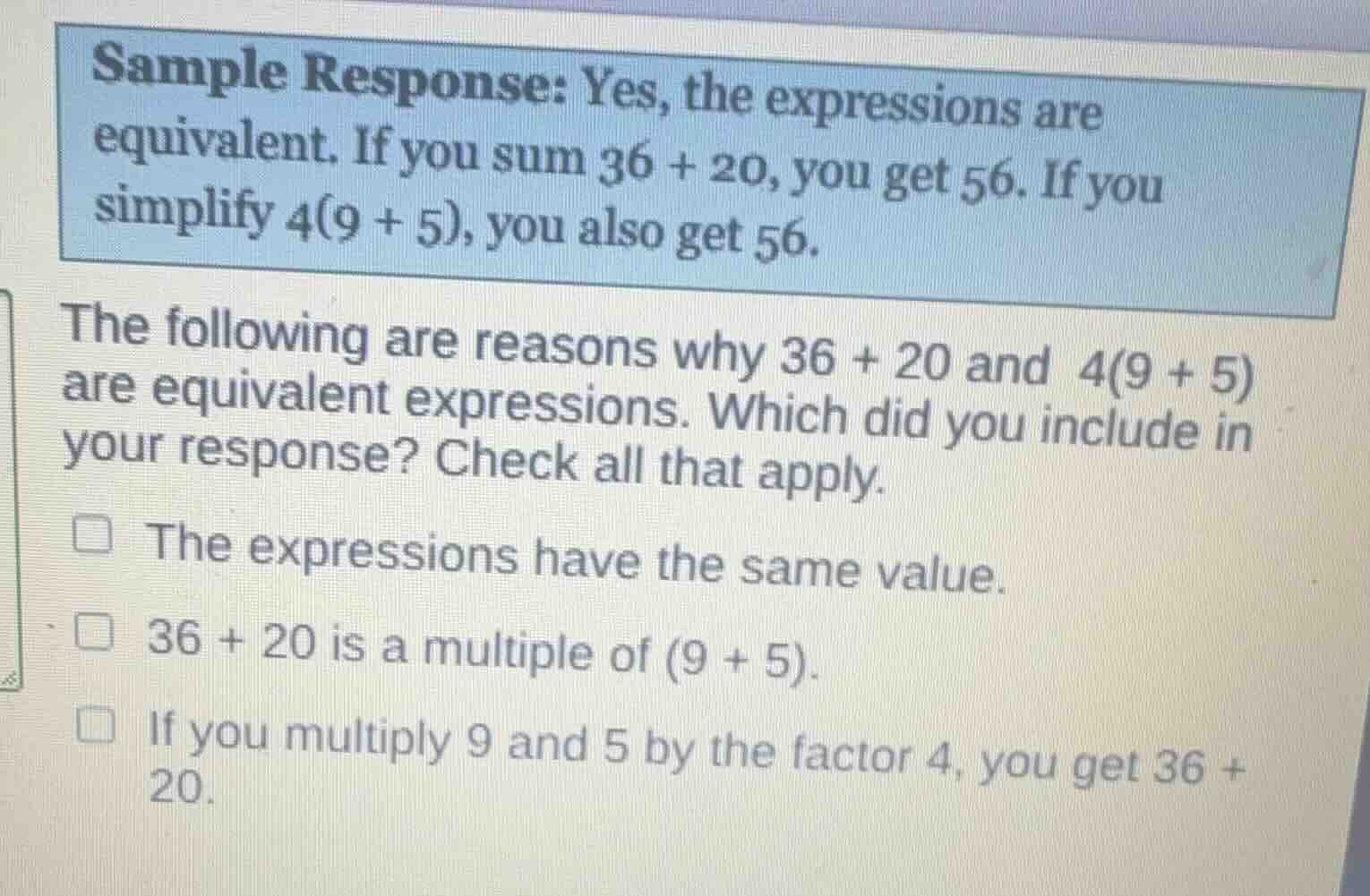
sample response: yes, the expressions are equivalent. if you sum \\(36 + 20\\), you get \\(56\\). if you simplify \\(4(9 + 5)\\), you also get \\(56\\).
the following are reasons why \\(36 + 20\\) and \\(4(9 + 5)\\) are equivalent expressions. which did you include in your response? check all that apply.
the expressions have the same value.
\\(36 + 20\\) is a multiple of \\((9 + 5)\\).
if you multiply \\(9\\) and \\(5\\) by the factor \\(4\\), you get \\(36 + 20\\).
Analyze the sample response
The sample response states: "Yes, the expressions are equivalent. If you sum \(36 + 20\), you get \(56\). If you simplify \(4(9 + 5)\), you also get \(56\)." This response directly compares the simplified numerical values of both expressions to show they are equal.
Evaluate the first option
Using the Equivalent Expressions concept, the sample response explicitly calculates the value of both expressions (\(56\)) to show they are equal. Therefore, the reason "The expressions have the same value" is included in the sample response.
Evaluate the second option
The sample response does not mention divisibility, multiples, or state that \(36 + 20\) is a multiple of \((9 + 5)\). Thus, this reason is not included.
Evaluate the third option
Using the Distributive Property concept, multiplying \(9\) and \(5\) by \(4\) yields \(36 + 20\). However, the sample response only simplifies \(4(9 + 5)\) by finding its total value (\(56\)) rather than expanding it. Thus, this algebraic explanation is not included in the sample response.

Snap & solve any problem in the app
Get step-by-step solutions on Sovi AI
Photo-based solutions with guided steps
Explore more problems and detailed explanations
- The expressions have the same value. (Correct answer)
- 36 + 20 is a multiple of (9 + 5).
- If you multiply 9 and 5 by the factor 4, you get 36 + 20.