QUESTION IMAGE
Question
rhetorical questions
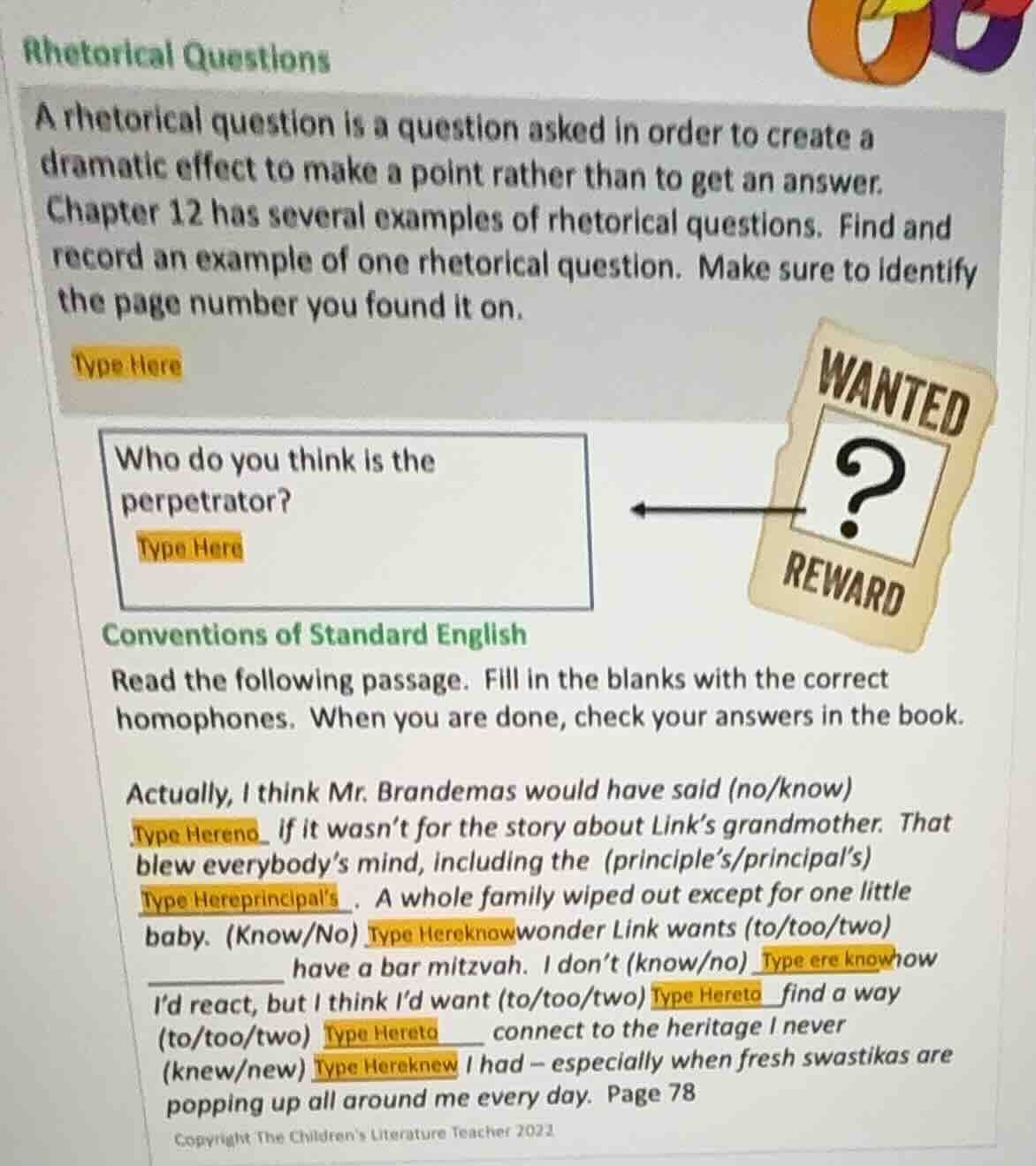
a rhetorical question is a question asked in order to create a dramatic effect to make a point rather than to get an answer. chapter 12 has several examples of rhetorical questions. find and record an example of one rhetorical question. make sure to identify the page number you found it on.
who do you think is the perpetrator?
conventions of standard english
read the following passage. fill in the blanks with the correct homophones. when you are done, check your answers in the book.
actually, i think mr. brandemas would have said (no/know) ____ if it wasnt for the story about links grandmother. that blew everybodys mind, including the (principles/principals) __ . a whole family wiped out except for one little baby. (know/no) __ wonder link wants (to/too/two) __ have a bar mitzvah. i dont (know/no) __ how id react, but i think id want (to/too/two) __ find a way (to/too/two) __ connect to the heritage i never (knew/new) ____ i had - especially when fresh swastikas are popping up all around me every day. page 78
🆕 New Concept Discovered: Homophones and Word Usage
Words that sound the same but have different meanings and spellings.
Step 1: Analyze the first blank (no/know)
- Context: "...would have said (no/know)..."
- Reasoning: The speaker is talking about saying the word "no" (expressing negation or refusal) rather than "know" (having knowledge).
- Correct Word: no
Step 2: Analyze the second blank (principle's/principal's)
- Context: "...including the (principle's/principal's)..."
- Reasoning: A "principal" is the head of a school, while a "principle" is a fundamental truth or rule. Since this refers to a person (the school principal) possessing something (their mind being blown), we use the possessive form of principal.
- Correct Word: principal's
Step 3: Analyze the third blank (Know/No)
- Context: "(Know/No) wonder Link wants..."
- Reasoning: The common idiom is "No wonder," which means "it is not surprising that."
- Correct Word: No
Step 4: Analyze the fourth blank (to/too/two)
- Context: "...wants (to/too/two) have a bar mitzvah."
- Reasoning: We need the preposition "to" to form the infinitive verb phrase "to have." "Too" means also/excessively, and "two" is the number 2.
- Correct Word: to
Step 5: Analyze the fifth blank (know/no)
- Context: "I don't (know/no) how I'd react..."
- Reasoning: The sentence refers to having knowledge or understanding, which requires the verb "know."
- Correct Word: know
Step 6: Analyze the sixth blank (to/too/two)
- Context: "...I think I'd want (to/too/two) find a way..."
- Reasoning: We need the infinitive marker "to" to go with the verb "find" ("to find").
- Correct Word: to
Step 7: Analyze the seventh blank (to/too/two)
- Context: "...(to/too/two) connect to the heritage..."
- Reasoning: We need the infinitive marker "to" to go with the verb "connect" ("to connect").
- Correct Word: to
Step 8: Analyze the eighth blank (knew/new)
- Context: "...the heritage I never (knew/new) I had..."
- Reasoning: This refers to past knowledge or awareness, which is the verb "knew." "New" means something that is fresh or recently created.
- Correct Word: knew
---

Snap & solve any problem in the app
Get step-by-step solutions on Sovi AI
Photo-based solutions with guided steps
Explore more problems and detailed explanations
Here are the correct homophones to fill in the blanks:
Actually, I think Mr. Brandemas would have said no if it wasn't for the story about Link's grandmother. That blew everybody's mind, including the principal's. A whole family wiped out except for one little baby. No wonder Link wants to have a bar mitzvah. I don't know how I'd react, but I think I'd want to find a way to connect to the heritage I never knew I had – especially when fresh swastikas are popping up all around me every day. Page 78