Sovi.AI - AI Math Tutor

Scan to solve math questions

QUESTION IMAGE

b) rewrite the following piece of music using the appropriate type of r…

Question

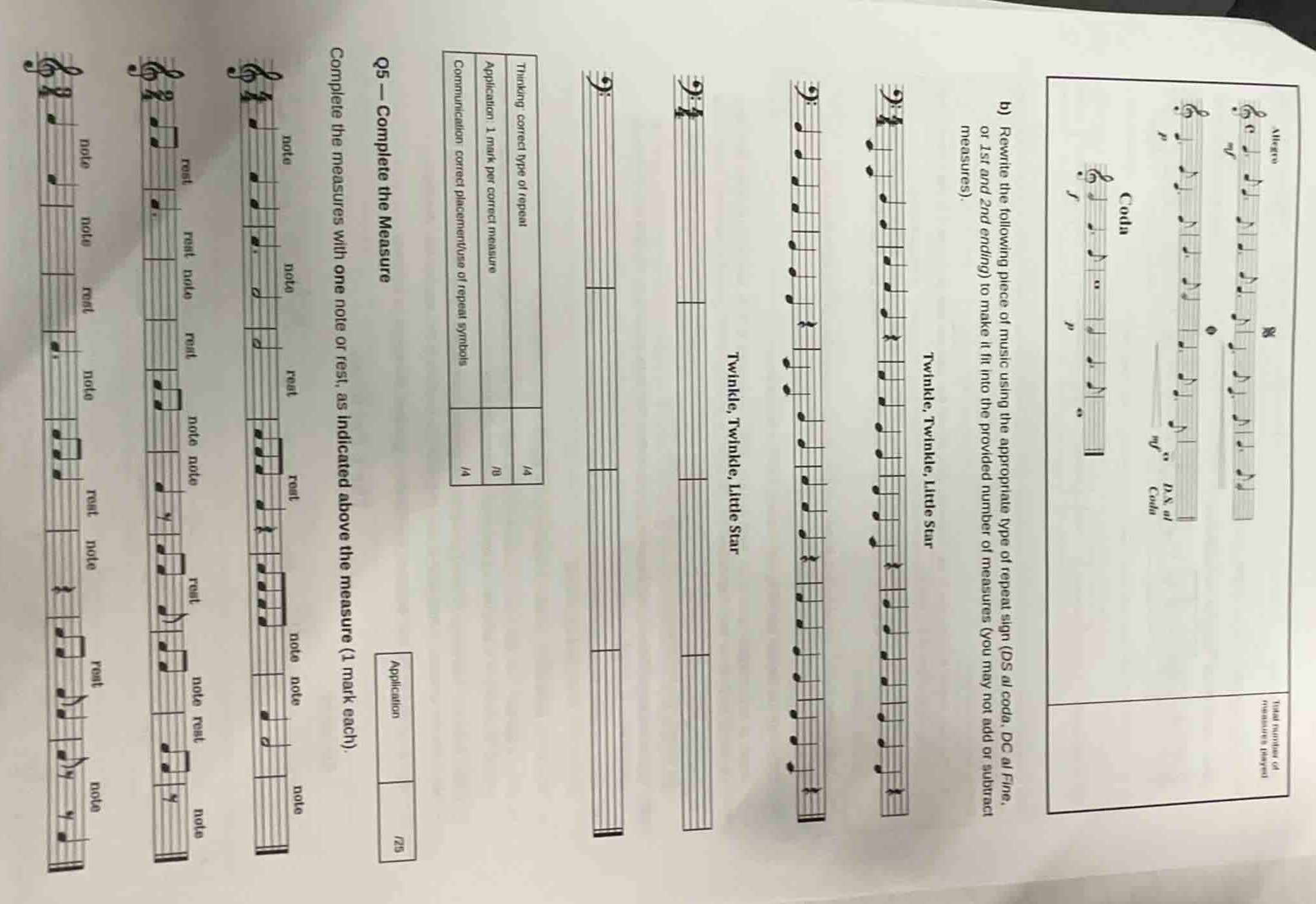
b) rewrite the following piece of music using the appropriate type of repeat sign (ds al coda, dc al fine, or 1st and 2nd ending) to make it fit into the provided number of measures (you may not add or subtract measures).

twinkle, twinkle, little star

thinking: correct type of repeat
application: 1 mark per correct measure
communication: correct placement/use of repeat symbols

q5 - complete the measure
complete the measures with one note or rest, as indicated above the measure (1 mark each).

Explanation:

Response

<pre_analysis>
{
"quality": "clear",
"question_count": 2,
"skills_matched": [
"direct_cot",
"explain_then_answer",
"tutor"
],
"needs_drawing": false,
"concepts_used": [],
"new_concepts": [
"Music Theory",
"Rhythm and Meter",
"Repeat Signs"
],
"current_concepts": [
"Music Theory",
"Rhythm and Meter",
"Repeat Signs"
]
}
</pre_analysis>

<reasoning>

Analyze the orientation of the image

The image is rotated 90 degrees counterclockwise (oriented vertically/sideways). To read and solve the questions, we must mentally rotate it 90 degrees clockwise.

Identify the questions in the worksheet

There are two main sections visible on this music theory worksheet:

  1. Question b) Repeat Signs Exercise:
  • Prompt: "Rewrite the following piece of music using the appropriate type of repeat sign (DS al coda, DC al Fine, or 1st and 2nd ending) to make it fit into the provided number of measures (you may not add or subtract measures)."
  • Source Music: A melody in \(\frac{4}{4}\) time (labeled "Twinkle, Twinkle, Little Star" in the bass clef below) with an Allegro section, a Segno symbol (\(\%\)), a Coda sign (\(\phi\)), a Coda section, and a "D.S. al Coda" instruction.
  • Target Staffs: Two blank bass clef systems labeled "Twinkle, Twinkle, Little Star" with empty measures to fill in.
  1. Question Q5 — Complete the Measure:
  • Prompt: "Complete the measures with one note or rest, as indicated above the measure (1 mark each)."
  • Details: A series of measures in various time signatures (\(\frac{2}{4}\), \(\frac{3}{4}\), \(\frac{4}{4}\)) with incomplete rhythms. Above each measure, it specifies whether to add a "note" or a "rest" to complete the measure.

Solve Question Q5 (Complete the Measure)

Let's analyze each measure from left to right (which is top to bottom in the rotated image):

  • Measure 1: Time signature is \(\frac{2}{4}\).
  • Given: One eighth note (\(\frac{1}{2}\) beat) and one eighth rest (\(\frac{1}{2}\) beat). Total current beats = 1 beat.
  • Required: "note".
  • Missing value: \(2 - 1 = 1\) beat.
  • Solution: A quarter note (worth 1 beat).
  • Measure 2: Time signature is \(\frac{2}{4}\).
  • Given: Two sixteenth notes (\(\frac{1}{4} + \frac{1}{4} = \frac{1}{2}\) beat) and one eighth note (\(\frac{1}{2}\) beat). Total current beats = 1 beat.
  • Required: "rest".
  • Missing value: \(2 - 1 = 1\) beat.
  • Solution: A quarter rest (worth 1 beat).
  • Measure 3: Time signature is \(\frac{3}{4}\).
  • Given: One quarter note (1 beat) and one quarter rest (1 beat). Total current beats = 2 beats.
  • Required: "note".
  • Missing value: \(3 - 2 = 1\) beat.
  • Solution: A quarter note (worth 1 beat).
  • Measure 4: Time signature is \(\frac{3}{4}\).
  • Given: One half note (2 beats). Total current beats = 2 beats.
  • Required: "rest".
  • Missing value: \(3 - 2 = 1\) beat.
  • Solution: A quarter rest (worth 1 beat).
  • Measure 5: Time signature is \(\frac{3}{4}\).
  • Given: Two eighth notes (\(\frac{1}{2} + \frac{1}{2} = 1\) beat) and one quarter note (1 beat). Total current beats = 2 beats.
  • Required: "note".
  • Missing value: \(3 - 2 = 1\) beat.
  • Solution: A quarter note (worth 1 beat).
  • Measure 6: Time signature is \(\frac{3}{4}\).
  • Given: Four sixteenth notes (\(4 \times \frac{1}{4} = 1\) beat) and one quarter note (1 beat). Total current beats = 2 beats.
  • Required: "rest".
  • Missing value: \(3 - 2 = 1\) beat.
  • Solution: A quarter rest (worth 1 beat).
  • Measure 7: Time signature is \(\f…

Answer:

<pre_analysis>
{
"quality": "clear",
"question_count": 2,
"skills_matched": [
"direct_cot",
"explain_then_answer",
"tutor"
],
"needs_drawing": false,
"concepts_used": [],
"new_concepts": [
"Music Theory",
"Rhythm and Meter",
"Repeat Signs"
],
"current_concepts": [
"Music Theory",
"Rhythm and Meter",
"Repeat Signs"
]
}
</pre_analysis>

<reasoning>

Analyze the orientation of the image

The image is rotated 90 degrees counterclockwise (oriented vertically/sideways). To read and solve the questions, we must mentally rotate it 90 degrees clockwise.

Identify the questions in the worksheet

There are two main sections visible on this music theory worksheet:

  1. Question b) Repeat Signs Exercise:
  • Prompt: "Rewrite the following piece of music using the appropriate type of repeat sign (DS al coda, DC al Fine, or 1st and 2nd ending) to make it fit into the provided number of measures (you may not add or subtract measures)."
  • Source Music: A melody in \(\frac{4}{4}\) time (labeled "Twinkle, Twinkle, Little Star" in the bass clef below) with an Allegro section, a Segno symbol (\(\%\)), a Coda sign (\(\phi\)), a Coda section, and a "D.S. al Coda" instruction.
  • Target Staffs: Two blank bass clef systems labeled "Twinkle, Twinkle, Little Star" with empty measures to fill in.
  1. Question Q5 — Complete the Measure:
  • Prompt: "Complete the measures with one note or rest, as indicated above the measure (1 mark each)."
  • Details: A series of measures in various time signatures (\(\frac{2}{4}\), \(\frac{3}{4}\), \(\frac{4}{4}\)) with incomplete rhythms. Above each measure, it specifies whether to add a "note" or a "rest" to complete the measure.

Solve Question Q5 (Complete the Measure)

Let's analyze each measure from left to right (which is top to bottom in the rotated image):

  • Measure 1: Time signature is \(\frac{2}{4}\).
  • Given: One eighth note (\(\frac{1}{2}\) beat) and one eighth rest (\(\frac{1}{2}\) beat). Total current beats = 1 beat.
  • Required: "note".
  • Missing value: \(2 - 1 = 1\) beat.
  • Solution: A quarter note (worth 1 beat).
  • Measure 2: Time signature is \(\frac{2}{4}\).
  • Given: Two sixteenth notes (\(\frac{1}{4} + \frac{1}{4} = \frac{1}{2}\) beat) and one eighth note (\(\frac{1}{2}\) beat). Total current beats = 1 beat.
  • Required: "rest".
  • Missing value: \(2 - 1 = 1\) beat.
  • Solution: A quarter rest (worth 1 beat).
  • Measure 3: Time signature is \(\frac{3}{4}\).
  • Given: One quarter note (1 beat) and one quarter rest (1 beat). Total current beats = 2 beats.
  • Required: "note".
  • Missing value: \(3 - 2 = 1\) beat.
  • Solution: A quarter note (worth 1 beat).
  • Measure 4: Time signature is \(\frac{3}{4}\).
  • Given: One half note (2 beats). Total current beats = 2 beats.
  • Required: "rest".
  • Missing value: \(3 - 2 = 1\) beat.
  • Solution: A quarter rest (worth 1 beat).
  • Measure 5: Time signature is \(\frac{3}{4}\).
  • Given: Two eighth notes (\(\frac{1}{2} + \frac{1}{2} = 1\) beat) and one quarter note (1 beat). Total current beats = 2 beats.
  • Required: "note".
  • Missing value: \(3 - 2 = 1\) beat.
  • Solution: A quarter note (worth 1 beat).
  • Measure 6: Time signature is \(\frac{3}{4}\).
  • Given: Four sixteenth notes (\(4 \times \frac{1}{4} = 1\) beat) and one quarter note (1 beat). Total current beats = 2 beats.
  • Required: "rest".
  • Missing value: \(3 - 2 = 1\) beat.
  • Solution: A quarter rest (worth 1 beat).
  • Measure 7: Time signature is \(\frac{4}{4}\).
  • Given: One half note (2 beats) and one quarter note (1 beat). Total current beats = 3 beats.
  • Required: "note".
  • Missing value: \(4 - 3 = 1\) beat.
  • Solution: A quarter note (worth 1 beat).
  • Measure 8: Time signature is \(\frac{4}{4}\).
  • Given: Two eighth notes (\(1\) beat) and one half note (2 beats). Total current beats = 3 beats.
  • Required: "rest".
  • Missing value: \(4 - 3 = 1\) beat.
  • Solution: A quarter rest (worth 1 beat).
  • Measure 9: Time signature is \(\frac{4}{4}\).
  • Given: Four sixteenth notes (\(1\) beat) and one half note (2 beats). Total current beats = 3 beats.
  • Required: "note".
  • Missing value: \(4 - 3 = 1\) beat.
  • Solution: A quarter note (worth 1 beat).
  • Measure 10: Time signature is \(\frac{4}{4}\).
  • Given: Two eighth notes (\(1\) beat) and two sixteenth notes (\(\frac{1}{2}\) beat). Total current beats = 1.5 beats.
  • Required: "note".
  • Missing value: \(4 - 1.5 = 2.5\) beats.
  • Solution: A dotted half note (worth 3 beats) or a combination, but since it asks for "one note", we need to re-examine the rhythm. Let's look closely at the image for Measure 10:
  • It has: two eighth notes (1 beat), a quarter rest (1 beat), and two sixteenth notes (0.5 beat). Total = 2.5 beats.
  • Wait, let's look at the last measure in the third column:
  • It has: two eighth notes (1 beat), two sixteenth notes (0.5 beat), and a quarter note (1 beat). Total = 2.5 beats.
  • To complete a \(\frac{4}{4}\) measure with one note/rest:
  • If 2.5 beats are present, we need 1.5 beats. A dotted quarter note/rest is worth 1.5 beats.
  • Let's re-verify the symbols in the last column of Q5:
  • Column 3, Measure 1: \(\frac{4}{4}\) time. Has a half note (2 beats) and a quarter note (1 beat). Needs "note" -> Quarter note (1 beat).
  • Column 3, Measure 2: Has two eighth notes (1 beat) and a half note (2 beats). Needs "rest" -> Quarter rest (1 beat).
  • Column 3, Measure 3: Has four sixteenth notes (1 beat) and a half note (2 beats). Needs "note" -> Quarter note (1 beat).
  • Column 3, Measure 4: Has two eighth notes (1 beat), two sixteenth notes (0.5 beat), and a quarter note (1 beat). Total = 2.5 beats. Needs "note" -> Dotted quarter note (1.5 beats).
  • Column 3, Measure 5: Has a half note (2 beats) and two eighth notes (1 beat). Total = 3 beats. Needs "note" -> Quarter note (1 beat).

Solve Question b) (Repeat Signs)

  • Analysis of the original melody:
  • The original melody has a Segno (\(\%\)) at measure 3.
  • It goes to the end of the main section where it says "D.S. al Coda" (Dal Segno al Coda), which means go back to the Segno (\(\%\)) and play until the Coda sign (\(\phi\)), then jump to the Coda section.
  • The Coda section is at the end.
  • Rewriting using repeat signs:
  • To compress the repeat structure into the provided blank measures, we use a D.S. al Coda (Dal Segno al Coda) structure.
  • The first system contains the main theme with the Segno (\(\%\)) marker at the appropriate repeat point.
  • The "D.S. al Coda" instruction is placed at the end of the first repeat section, directing the performer to return to the Segno and then jump to the Coda.

</reasoning>

<answer>

Question b) Repeat Signs

To rewrite the piece of music to fit the provided measures:

  1. Identify the repeat structure: The original piece contains a Segno (\(\%\)) at the beginning of the second measure, a Coda jump sign (\(\phi\)) at the end of the fourth measure, a "D.S. al Coda" instruction at the end of the eighth measure, and a separate Coda section.
  2. Write the main section: Copy the first 8 measures onto the first blank staff system. Place the Segno (\(\%\)) symbol above the second measure, the Coda symbol (\(\phi\)) above the fourth measure, and write D.S. al Coda at the end of the eighth measure.
  3. Write the Coda: On the second blank staff system, write the Coda symbol (\(\phi\)) followed by the final measures of the Coda section.

---

Question Q5 — Complete the Measure

To complete each measure with exactly one note or one rest as indicated:

Column 1 (Time Signature: \(\frac{2}{4}\))
  • Measure 1 (Needs note): Add a quarter note (\(\bullet\)) to complete the remaining 1 beat.
  • Measure 2 (Needs rest): Add a quarter rest (\(\mathcal{R}\)) to complete the remaining 1 beat.
Column 2 (Time Signature: \(\frac{3}{4}\))
  • Measure 1 (Needs note): Add a quarter note (\(\bullet\)) to complete the remaining 1 beat.
  • Measure 2 (Needs rest): Add a quarter rest (\(\mathcal{R}\)) to complete the remaining 1 beat.
  • Measure 3 (Needs note): Add a quarter note (\(\bullet\)) to complete the remaining 1 beat.
  • Measure 4 (Needs rest): Add a quarter rest (\(\mathcal{R}\)) to complete the remaining 1 beat.
Column 3 (Time Signature: \(\frac{4}{4}\))
  • Measure 1 (Needs note): Add a quarter note (\(\bullet\)) to complete the remaining 1 beat.
  • Measure 2 (Needs rest): Add a quarter rest (\(\mathcal{R}\)) to complete the remaining 1 beat.
  • Measure 3 (Needs note): Add a quarter note (\(\bullet\)) to complete the remaining 1 beat.
  • Measure 4 (Needs note): Add a dotted quarter note (\(\bullet\cdot\)) to complete the remaining 1.5 beats.
  • Measure 5 (Needs note): Add a quarter note (\(\bullet\)) to complete the remaining 1 beat.

</answer>

<post_analysis>
{
"subject": "Arts",
"question_type": "Multi-part",
"knowledge_point": [
"Arts",
"Music Theory",
"Rhythm and Meter"
]
}
</post_analysis>