QUESTION IMAGE
Question
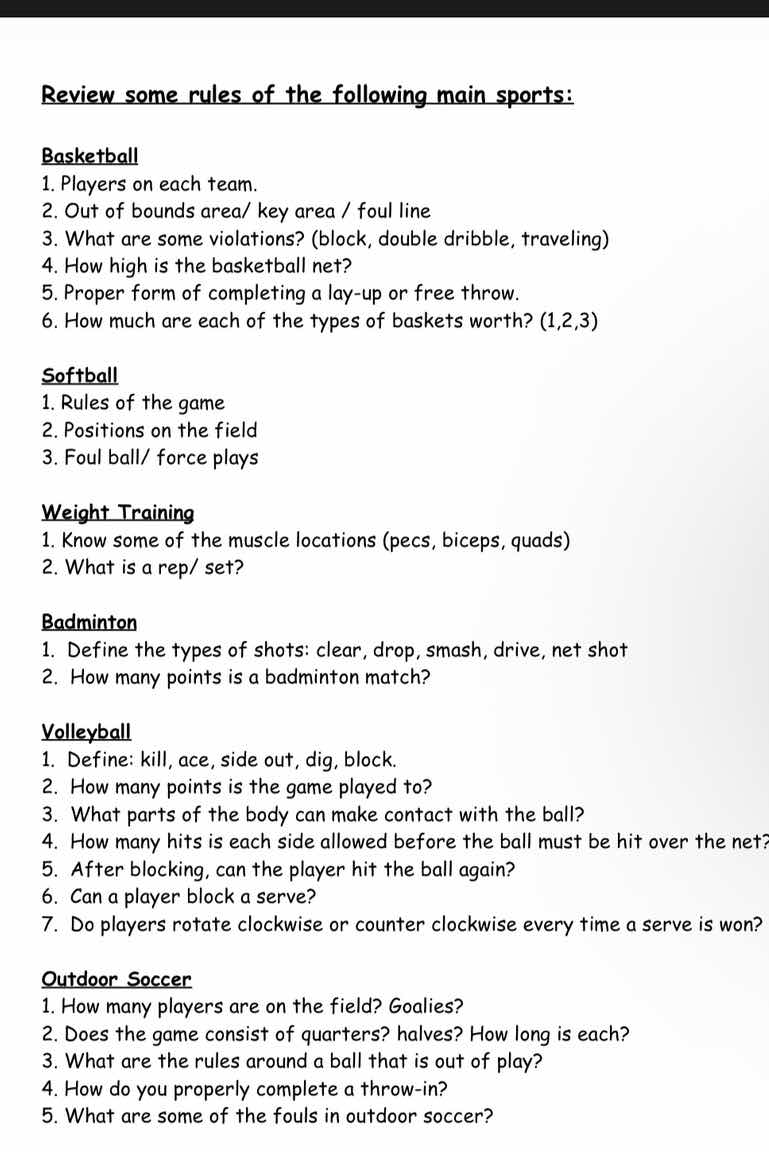
review some rules of the following main sports:
basketball
- players on each team.
- out of bounds area/ key area / foul line
- what are some violations? (block, double dribble, traveling)
- how high is the basketball net?
- proper form of completing a lay-up or free throw.
- how much are each of the types of baskets worth? (1,2,3)
softball
- rules of the game
- positions on the field
- foul ball/ force plays
weight training
- know some of the muscle locations (pecs, biceps, quads)
- what is a rep/ set?
badminton
- define the types of shots: clear, drop, smash, drive, net shot
- how many points is a badminton match?
volleyball
- define: kill, ace, side out, dig, block.
- how many points is the game played to?
- what parts of the body can make contact with the ball?
- how many hits is each side allowed before the ball must be hit over the net?
- after blocking, can the player hit the ball again?
- can a player block a serve?
- do players rotate clockwise or counter clockwise every time a serve is won?
outdoor soccer
- how many players are on the field? goalies?
- does the game consist of quarters? halves? how long is each?
- what are the rules around a ball that is out of play?
- how do you properly complete a throw-in?
- what are some of the fouls in outdoor soccer?
Basketball Rules
We will review the fundamental rules of basketball as outlined in the study guide.
- Players on each team: There are 5 active players on the court for each team.
- Key areas: The "key" is the restricted area under the basket. The "foul line" is where free throws are taken. "Out of bounds" is any area outside the boundary lines.
- Violations: A "block" is a defensive foul if contact is made without establishing position. "Double dribble" occurs when a player dribbles, stops, and dribbles again, or dribbles with both hands. "Traveling" is taking too many steps without dribbling.
- Net height: The standard basketball rim is 10 feet (3.05 meters) high.
- Lay-up and free throw form: A lay-up involves driving to the basket, jumping off the inside foot, and releasing the ball off the backboard. A free throw requires a balanced stance behind the line, bending the knees, and a smooth follow-through.
- Baskets worth: Free throws are worth 1 point, standard field goals are worth 2 points, and shots from behind the arc are worth 3 points.
Softball Rules
We will review the core concepts of softball.
- Rules of the game: Played on a diamond with 4 bases. The objective is to score more runs than the opponent over 7 innings.
- Positions on the field: There are 9 defensive positions: pitcher, catcher, first baseman, second baseman, third baseman, shortstop, left fielder, center fielder, and right fielder.
- Foul ball and force plays: A "foul ball" is a batted ball that lands outside the first or third base lines. A "force play" occurs when a runner is legally forced to advance to the next base because the batter became a runner.
Weight Training
We will review basic weight training terminology and anatomy.
- Muscle locations: "Pecs" (pectoralis major) are in the chest. "Biceps" are on the front of the upper arm. "Quads" (quadriceps) are on the front of the thigh.
- Rep vs. Set: A "rep" (repetition) is a single complete execution of an exercise. A "set" is a group of consecutive repetitions performed without resting.
Badminton Rules
We will review the scoring and shot types in badminton.
- Types of shots: A "clear" is a high, deep shot to the back of the opponent's court. A "drop" is a soft shot landing just over the net. A "smash" is a powerful downward hit. A "drive" is a fast, flat shot. A "net shot" is played close to the net.
- Match points: A standard badminton game is played to 21 points, and a match is typically the best of 3 games.
Volleyball Rules
We will review the rules and terminology of volleyball.
- Definitions: A "kill" is a successful attack that results in an immediate point. An "ace" is a serve that lands untouched or cannot be returned. A "side out" is when the receiving team wins the rally and the right to serve. A "dig" is preventing a successful attack from hitting the floor. A "block" is deflecting the ball near the net.
- Game points: Indoor volleyball games are played to 25 points (must win by 2), with a deciding fifth game played to 15…

Snap & solve any problem in the app
Get step-by-step solutions on Sovi AI
Photo-based solutions with guided steps
Explore more problems and detailed explanations
Basketball
- Players on each team: 5 players on the court per team.
- Key areas:
- Out of bounds: Outside the boundary lines.
- Key area: The restricted lane under the basket.
- Foul line: The line 15 feet from the backboard where free throws are taken.
- Violations:
- Block: Illegal personal contact resulting from a defender not establishing position.
- Double dribble: Dribbling, stopping, and starting again, or dribbling with both hands.
- Traveling: Walking or running with the ball without dribbling.
- Net height: 10 feet (3.05 meters).
- Proper form:
- Lay-up: Drive toward the hoop, jump off the inside foot, and softly release the ball off the backboard.
- Free throw: Balanced stance, knees bent, consistent release, and follow-through.
- Baskets worth: Free throws are worth 1 point; field goals inside the arc are worth 2 points; shots behind the arc are worth 3 points.
Softball
- Rules of the game: Played on a diamond with 4 bases; teams take turns batting and fielding over 7 innings to score the most runs.
- Positions on the field: Pitcher, catcher, first baseman, second baseman, third baseman, shortstop, left fielder, center fielder, right fielder (9 positions).
- Foul ball & force plays:
- Foul ball: A batted ball that lands outside the lines connecting home plate to first and third base.
- Force play: A play where a runner is forced to advance to the next base because the batter became a runner.
Weight Training
- Muscle locations:
- Pecs (Pectorals): Chest muscles.
- Biceps: Front of the upper arm.
- Quads (Quadriceps): Front of the thigh.
- Rep vs. Set:
- Rep (Repetition): One single complete movement of an exercise.
- Set: A group of consecutive repetitions performed without resting.
Badminton
- Types of shots:
- Clear: A high, deep shot to the back of the opponent's court.
- Drop: A soft shot that falls close to the net on the opponent's side.
- Smash: A powerful, downward overhead hit.
- Drive: A fast, flat shot sent horizontally over the net.
- Net shot: A delicate shot played close to the net that falls just over.
- Match points: Played to 21 points; a match is typically the best of 3 games.
Volleyball
- Definitions:
- Kill: An attack that results in an immediate point.
- Ace: A serve that lands directly in bounds or is not returned.
- Side out: When the receiving team wins the rally, earning the right to serve.
- Dig: Passing a spiked or rapidly hit ball close to the ground.
- Block: Deflecting an opponent's attack at the net.
- Game points: Played to 25 points (must win by 2).
- Body contact: Any part of the body can make contact with the ball, including feet.
- Hits allowed: A maximum of 3 hits per side before sending the ball over.
- Hits after blocking: Yes, a block does not count as one of the 3 hits, so the blocker can hit it again.
- Block a serve: No, blocking or spiking a serve is illegal.
- Rotation: Players rotate clockwise when they win the serve.
Outdoor Soccer
- Players & goalies: 11 players on the field per team, including 1 goalie.
- Game duration: Consists of two halves, each lasting 45 minutes.
- Out of play: The ball is out of play when it completely crosses the boundary lines (touchline or goal line), either on the ground or in the air.
- Throw-in form: Both feet must remain on or behind the touchline, and the ball must be thrown with both hands from directly behind and over the head.
- Fouls: Tripping, kicking, pushing, holding, or handling the ball with hands/arms (except the goalie).