QUESTION IMAGE
Question
related questions: lesson 5: inequalities
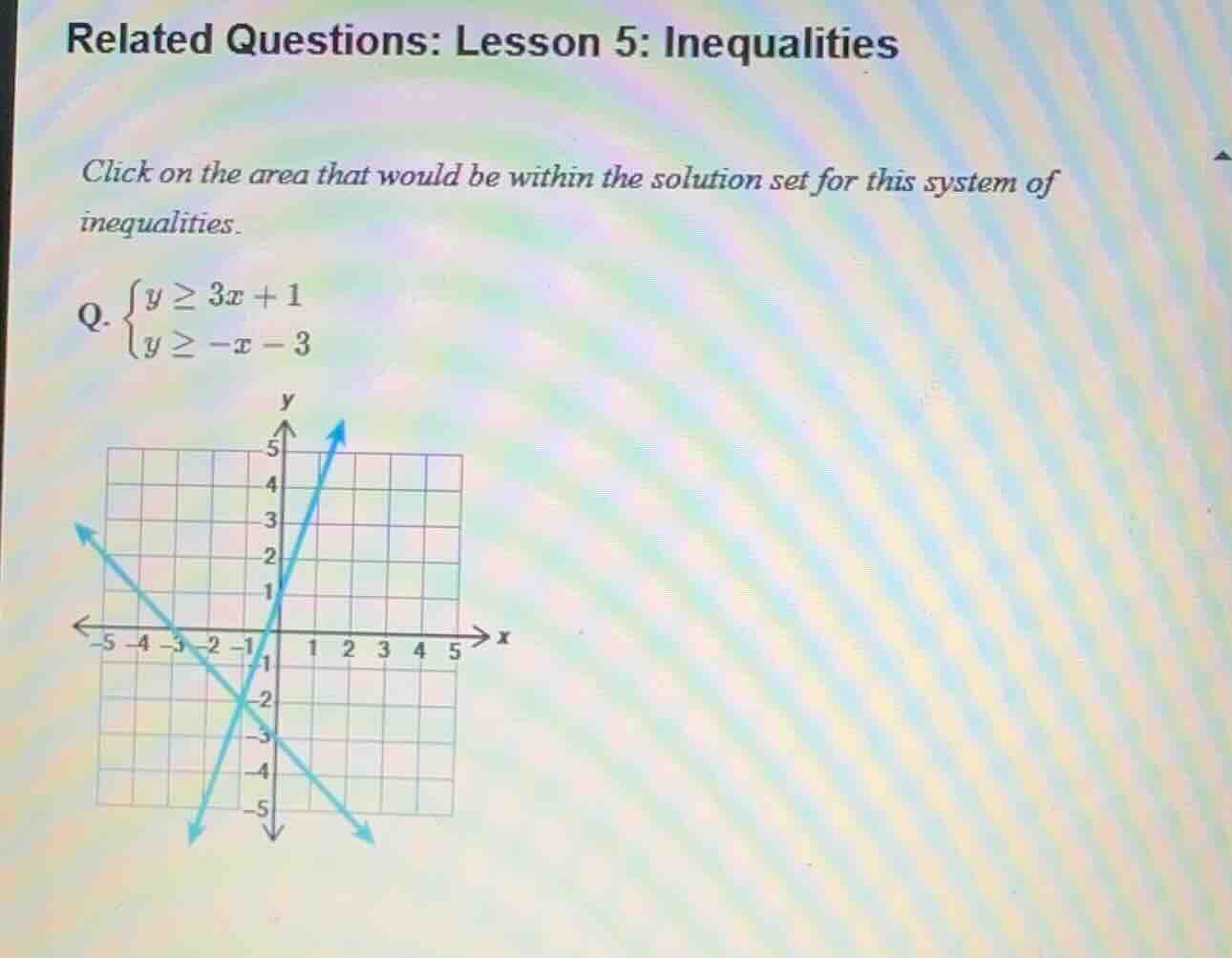
click on the area that would be within the solution set for this system of inequalities.
q. \\(\
\\)
Identify the boundary lines
Using the Boundary Line Analysis knowledge point
Determine the shaded region for each inequality
Using the Graphing Linear Inequalities knowledge point
Find the intersection of the shaded regions
To find the common solution set, we look for the region that is simultaneously above both boundary lines.
- The line \(y = 3x + 1\) goes upward steeply from left to right. The region "above" this line is to its left/upper-left.
- The line \(y = -x - 3\) goes downward from left to right. The region "above" this line is to its right/upper-right.
- The intersection of these two half-planes is the upper V-shaped region bounded by the two lines. This region contains the positive y-axis (for example, the point \((0, 2)\) satisfies both: \(2 \ge 1\) and \(2 \ge -3\)).
Identify a representative point in the solution set
Let's test a point in the upper region, such as \((0, 0)\):
- For \(y \ge 3x + 1\): \(0 \ge 3(0) + 1 \implies 0 \ge 1\) (False). Thus, \((0,0)\) is not in the solution set.
Let's test \((-1, 2)\):
- For \(y \ge 3x + 1\): \(2 \ge 3(-1) + 1 \implies 2 \ge -2\) (True).
- For \(y \ge -x - 3\): \(2 \ge -(-1) - 3 \implies 2 \ge -2\) (True).
The region containing \((-1, 2)\) (the top region between the two intersecting lines) is the solution set.

Snap & solve any problem in the app
Get step-by-step solutions on Sovi AI
Photo-based solutions with guided steps
Explore more problems and detailed explanations
The solution set for this system of inequalities is the upper region bounded by both lines (the region containing the upper y-axis, above both boundary lines).
To select the correct area on the screen, click anywhere in the region above both intersecting lines (for example, near the point \((-1, 2)\) or \((0, 3)\)).