QUESTION IMAGE
Question
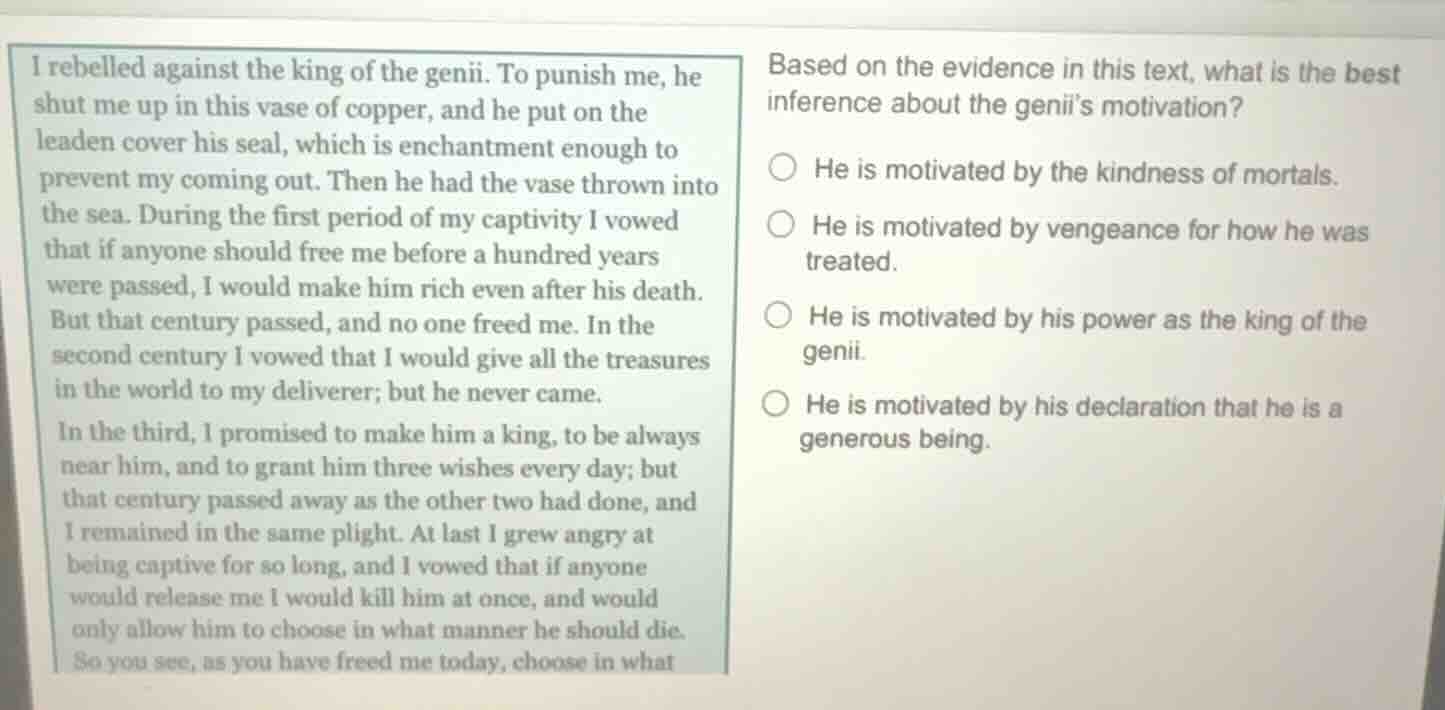
i rebelled against the king of the genii. to punish me, he shut me up in this vase of copper, and he put on the leaden cover his seal, which is enchantment enough to prevent my coming out. then he had the vase thrown into the sea. during the first period of my captivity i vowed that if anyone should free me before a hundred years were passed, i would make him rich even after his death. but that century passed, and no one freed me. in the second century i vowed that i would give all the treasures in the world to my deliverer; but he never came.
in the third, i promised to make him a king, to be always near him, and to grant him three wishes every day; but that century passed away as the other two had done, and i remained in the same plight. at last i grew angry at being captive for so long, and i vowed that if anyone would release me i would kill him at once, and would only allow him to choose in what manner he should die. so you see, as you have freed me today, choose in what
based on the evidence in this text, what is the best inference about the geniis motivation?
he is motivated by the kindness of mortals.
he is motivated by vengeance for how he was treated.
he is motivated by his power as the king of the genii.
he is motivated by his declaration that he is a generous being.
Analyze the character's actions and statements
The speaker in the text explains that they rebelled against the king of the genii. In response, the king punished them by sealing them in a copper vase and throwing it into the sea. This establishes the initial conflict and the king's action as a direct consequence of rebellion.
Evaluate the speaker's changing vows
During their long captivity, the speaker's internal state and vows changed over the centuries:
- First century: Vowed to make their rescuer rich.
- Second century: Vowed to give all the treasures in the world to their deliverer.
- Third century: Vowed to make their rescuer a king and grant three wishes daily.
- After the third century: Grew angry at being captive so long and vowed to kill whoever released them, only allowing them to choose how they die.
Identify the genii's motivation
The question asks for the best inference about the genii's (the speaker's) motivation based on the text evidence.
- The speaker states: "At last I grew angry at being captive for so long, and I vowed that if anyone would release me I would kill him at once..."
- This shows that the speaker's current motivation to kill their rescuer is driven by anger and resentment over their prolonged imprisonment.
- Therefore, the genii is motivated by vengeance for how he was treated (being left imprisoned for centuries).
Match with the options
- Option 1: "He is motivated by the kindness of mortals." (Incorrect; he wants to kill his rescuer).
- Option 2: "He is motivated by vengeance for how he was treated." (Correct; his anger at being captive for so long drives his desire to kill).
- Option 3: "He is motivated by his power as the king of the genii." (Incorrect; the speaker rebelled against the king of the genii, and is not the king himself).
- Option 4: "He is motivated by his declaration that he is a generous being." (Incorrect; his final vow is murderous, not generous).
We apply the concepts of Textual Evidence and Literary Plot Motivation to confirm that his vengeful vow is a direct reaction to his long, neglected captivity.

Snap & solve any problem in the app
Get step-by-step solutions on Sovi AI
Photo-based solutions with guided steps
Explore more problems and detailed explanations
- He is motivated by the kindness of mortals.
- He is motivated by vengeance for how he was treated. (Correct answer)
- He is motivated by his power as the king of the genii.
- He is motivated by his declaration that he is a generous being.