QUESTION IMAGE
Question
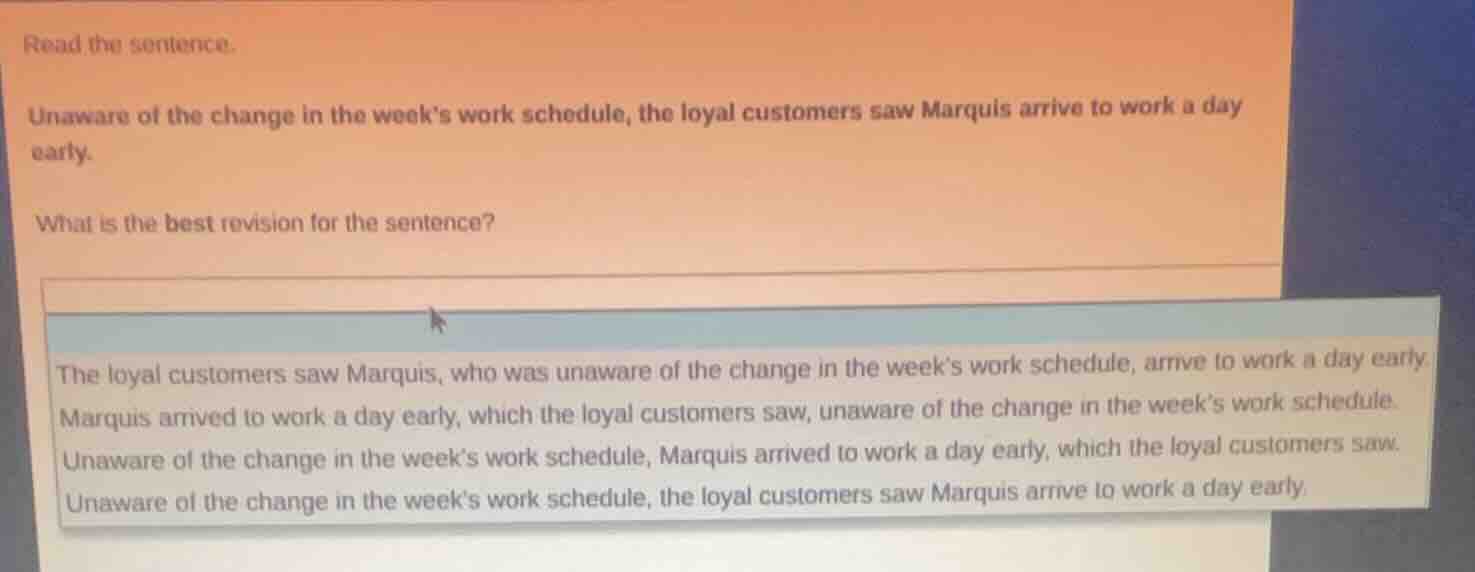
read the sentence.
unaware of the change in the weeks work schedule, the loyal customers saw marquis arrive to work a day early.
what is the best revision for the sentence?
the loyal customers saw marquis, who was unaware of the change in the weeks work schedule, arrive to work a day early.
marquis arrived to work a day early, which the loyal customers saw, unaware of the change in the weeks work schedule.
unaware of the change in the weeks work schedule, marquis arrived to work a day early, which the loyal customers saw.
unaware of the change in the weeks work schedule, the loyal customers saw marquis arrive to work a day early.
Analyze the modifier error in the original sentence
Using the Sentence Revision and Word Choice knowledge points
The original sentence contains a misplaced modifier: "Unaware of the change in the week's work schedule, the loyal customers saw Marquis arrive to work a day early." The introductory participial phrase "Unaware of the change..." is positioned next to "the loyal customers," which illogically suggests that the customers were the ones unaware of the schedule. However, contextually, it is Marquis who is unaware of the schedule, causing him to arrive early.
Evaluate the options for logical clarity and correct modifier placement
- Option 1: "The loyal customers saw Marquis, who was unaware of the change in the week's work schedule, arrive to work a day early."
This correctly places the modifying clause "who was unaware of the change..." directly after "Marquis," making it clear that Marquis was the one unaware of the schedule. This resolves the modifier error.
- Option 2: "Marquis arrived to work a day early, which the loyal customers saw, unaware of the change in the week's work schedule."
This is awkward and leaves "unaware of the change..." dangling at the end, still creating ambiguity about who was unaware.
- Option 3: "Unaware of the change in the week's work schedule, Marquis arrived to work a day early, which the loyal customers saw."
This correctly associates the introductory modifier with "Marquis," but the relative clause ", which the loyal customers saw" is slightly informal/awkward compared to Option 1. Let's re-evaluate Option 3 vs Option 1.
Actually, let's look closely at Option 3: "Unaware of the change in the week's work schedule, Marquis arrived to work a day early, which the loyal customers saw." This is grammatically correct and places the modifier "Unaware of..." directly before "Marquis," whom it modifies.
Let's compare Option 1 and Option 3. Option 1: "The loyal customers saw Marquis, who was unaware of the change in the week's work schedule, arrive to work a day early." This is highly fluent, uses a nonrestrictive relative clause correctly, and maintains the active perception of the customers seeing the event smoothly.
Let's look at Option 3 again: "Unaware of the change in the week's work schedule, Marquis arrived to work a day early, which the loyal customers saw." The pronoun "which" refers vaguely to the entire preceding clause, which is generally discouraged in formal writing. Therefore, Option 1 is the most precise and grammatically superior revision.

Snap & solve any problem in the app
Get step-by-step solutions on Sovi AI
Photo-based solutions with guided steps
Explore more problems and detailed explanations
- (A) The loyal customers saw Marquis, who was unaware of the change in the week's work schedule, arrive to work a day early. (Correct answer)
- (B) Marquis arrived to work a day early, which the loyal customers saw, unaware of the change in the week's work schedule.
- (C) Unaware of the change in the week's work schedule, Marquis arrived to work a day early, which the loyal customers saw.
- (D) Unaware of the change in the week's work schedule, the loyal customers saw Marquis arrive to work a day early.