Sovi.AI - AI Math Tutor

Scan to solve math questions

QUESTION IMAGE

read the scenario below and answer the question that follows. julie usu…

Question

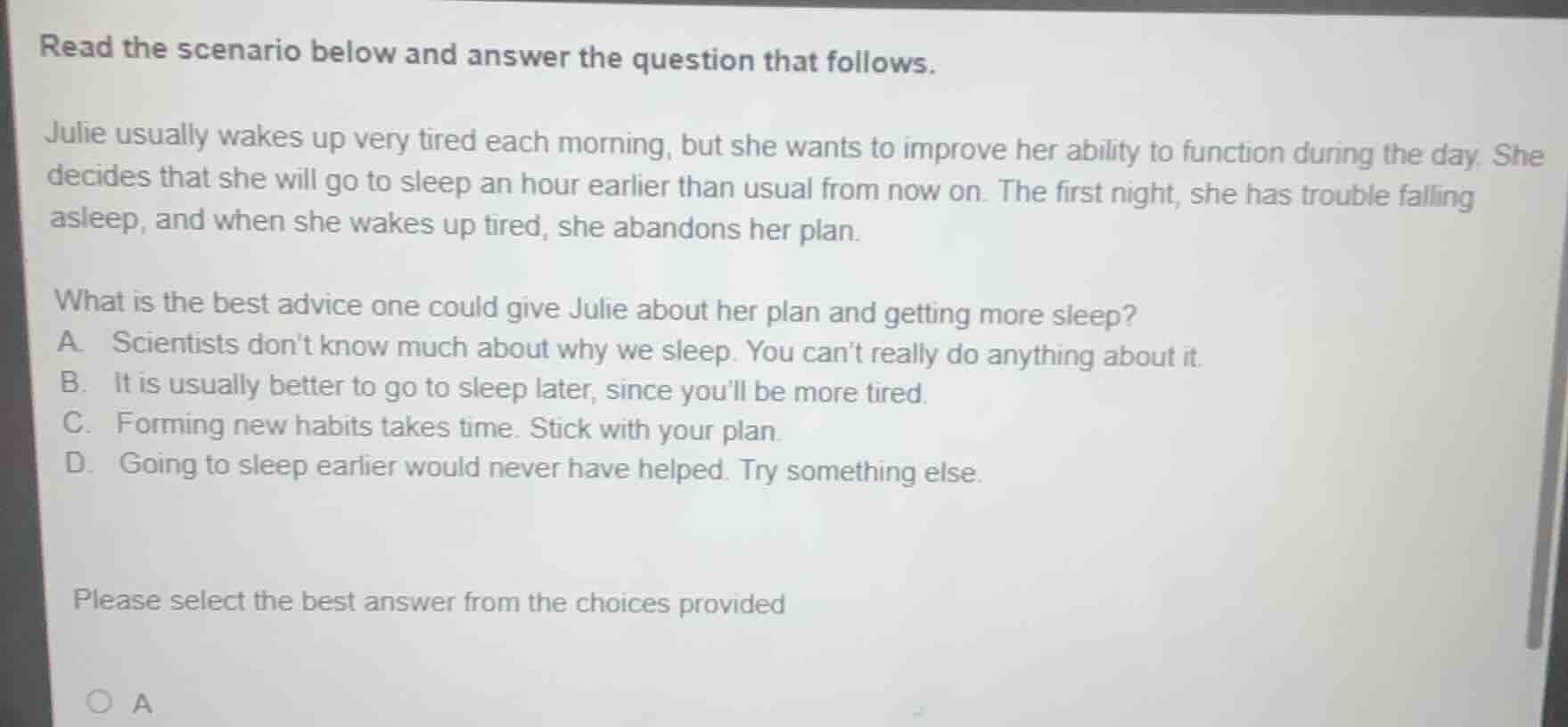
read the scenario below and answer the question that follows.

julie usually wakes up very tired each morning, but she wants to improve her ability to function during the day. she decides that she will go to sleep an hour earlier than usual from now on. the first night, she has trouble falling asleep, and when she wakes up tired, she abandons her plan.

what is the best advice one could give julie about her plan and getting more sleep?
a. scientists dont know much about why we sleep. you cant really do anything about it.
b. it is usually better to go to sleep later, since youll be more tired.
c. forming new habits takes time. stick with your plan.
d. going to sleep earlier would never have helped. try something else.

please select the best answer from the choices provided

Explanation:

Response

<pre_analysis>
{
"quality": "clear",
"question_count": 1,
"skills_matched": [
"direct_cot",
"multiple_choice_formatter",
"explain_then_answer",
"quick"
],
"needs_drawing": false,
"concepts_used": [
"Sleep Hygiene"
],
"new_concepts": [],
"current_concepts": [
"Sleep Hygiene",
"Sleep Needs"
]
}
</pre_analysis>

<reasoning>

Analyze Julie's scenario and behavior

Julie wants to improve her daytime functioning by sleeping an hour earlier. She abandons her plan after only one night of difficulty falling asleep.

Evaluate the advice options

  • A is incorrect because scientists have extensive knowledge about sleep, and sleep habits can be modified.
  • B is incorrect because going to sleep later would reduce her total sleep time, worsening her morning tiredness.
  • C is correct because adjusting circadian rhythms and establishing new sleep hygiene habits require consistent effort over time.
  • D is incorrect because sleeping earlier to increase total sleep duration is a valid strategy if given time to work.

Select the best option

Option C is the most constructive and scientifically sound advice.
</reasoning>

<answer>
<mcq-option>(A) Scientists don't know much about why we sleep. You can't really do anything about it.</mcq-option>
<mcq-option>(B) It is usually better to go to sleep later, since you'll be more tired.</mcq-option>
<mcq-correct>(C) Forming new habits takes time. Stick with your plan.</mcq-correct>
<mcq-option>(D) Going to sleep earlier would never have helped. Try something else.</mcq-option>
</answer>

<post_analysis>
{
"subject": "Natural Science",
"question_type": "Multiple Choice",
"knowledge_point": [
"Natural Science",
"Psychology",
"Sleep Hygiene"
]
}
</post_analysis>

Answer:

<pre_analysis>
{
"quality": "clear",
"question_count": 1,
"skills_matched": [
"direct_cot",
"multiple_choice_formatter",
"explain_then_answer",
"quick"
],
"needs_drawing": false,
"concepts_used": [
"Sleep Hygiene"
],
"new_concepts": [],
"current_concepts": [
"Sleep Hygiene",
"Sleep Needs"
]
}
</pre_analysis>

<reasoning>

Analyze Julie's scenario and behavior

Julie wants to improve her daytime functioning by sleeping an hour earlier. She abandons her plan after only one night of difficulty falling asleep.

Evaluate the advice options

  • A is incorrect because scientists have extensive knowledge about sleep, and sleep habits can be modified.
  • B is incorrect because going to sleep later would reduce her total sleep time, worsening her morning tiredness.
  • C is correct because adjusting circadian rhythms and establishing new sleep hygiene habits require consistent effort over time.
  • D is incorrect because sleeping earlier to increase total sleep duration is a valid strategy if given time to work.

Select the best option

Option C is the most constructive and scientifically sound advice.
</reasoning>

<answer>
<mcq-option>(A) Scientists don't know much about why we sleep. You can't really do anything about it.</mcq-option>
<mcq-option>(B) It is usually better to go to sleep later, since you'll be more tired.</mcq-option>
<mcq-correct>(C) Forming new habits takes time. Stick with your plan.</mcq-correct>
<mcq-option>(D) Going to sleep earlier would never have helped. Try something else.</mcq-option>
</answer>

<post_analysis>
{
"subject": "Natural Science",
"question_type": "Multiple Choice",
"knowledge_point": [
"Natural Science",
"Psychology",
"Sleep Hygiene"
]
}
</post_analysis>