QUESTION IMAGE
Question
read the passage, then answer the question that follows.
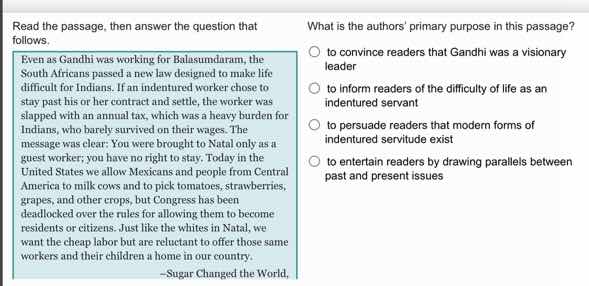
even as gandhi was working for balsasundaram, the south africans passed a new law designed to make life difficult for indians. if an indentured worker chose to stay past his or her contract and settle, the worker was slapped with an annual tax, which was a heavy burden for indians, who barely survived on their wages. the message was clear: you were brought to natal only as a guest worker; you have no right to stay. today in the united states we allow mexicans and people from central america to milk cows and pick tomatoes, strawberries, grapes, and other crops, but congress has been reluctant to offer them citizenship. like the indians, these new residents or citizens, just like the whites in natal, we want the cheap labor but are reluctant to offer those same workers and their children a home in our country.
—sugar changed the world,
what is the authors primary purpose in this passage?
to convince readers that gandhi was a visionary leader
to inform readers of the difficulty of life as an indentured servant
to persuade readers that modern forms of indentured servitude exist
to entertain readers by drawing parallels between past and present issues
The passage compares the situation of indentured workers in South Africa during Gandhi's time to modern situations where people from other countries (like Mexico, Central America) are used for cheap labor but not given a home. The authors are trying to show that modern forms of indentured servitude (exploitative labor with lack of rights) still exist by drawing this parallel. The other options: convincing Gandhi was a visionary isn't the focus; informing about difficulty of indentured servant life is part of the example, not the main purpose; entertaining by parallels is not the goal as it's a persuasive/argumentative point about modern servitude.

Snap & solve any problem in the app
Get step-by-step solutions on Sovi AI
Photo-based solutions with guided steps
Explore more problems and detailed explanations
to persuade readers that modern forms of indentured servitude exist