QUESTION IMAGE
Question
read the following passage.
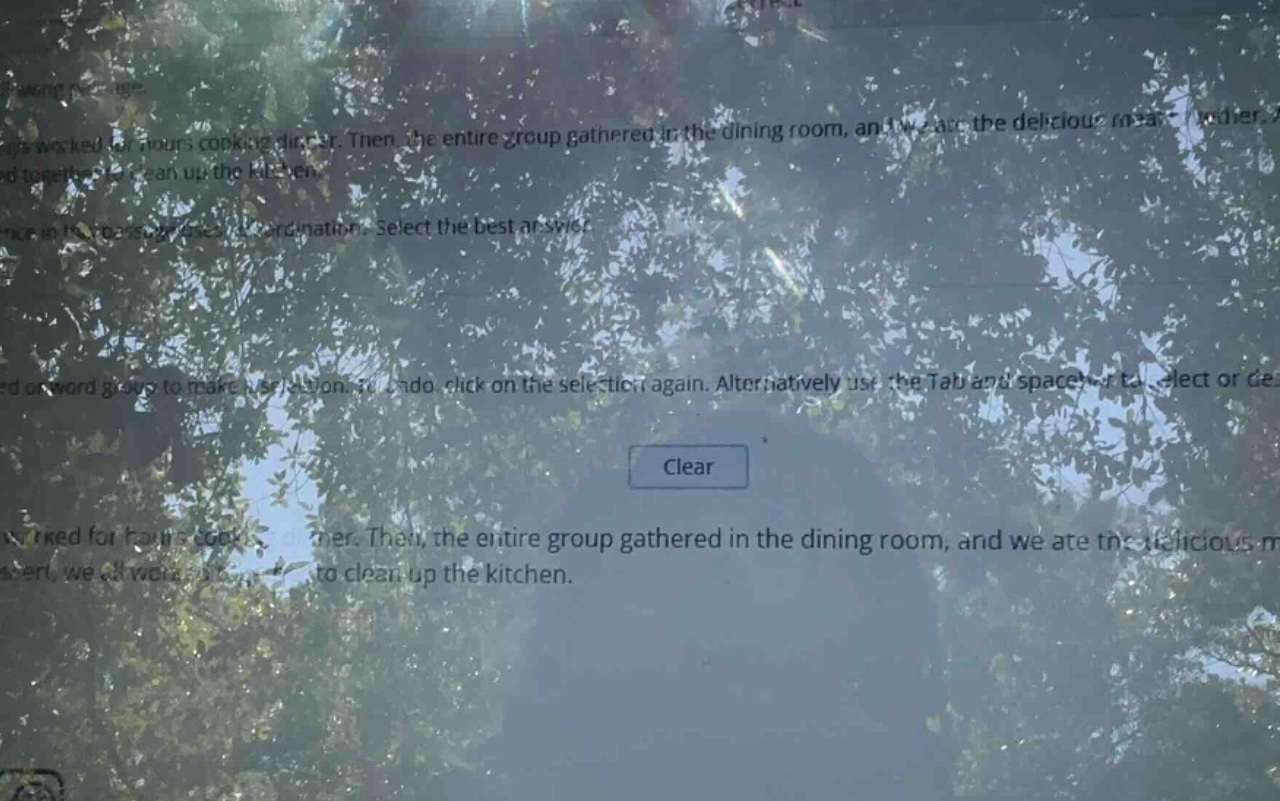
they worked for hours cooking dinner. then, the entire group gathered in the dining room, and we ate the delicious meal together. after dessert, we all worked together to clean up the kitchen.
one sentence in the passage uses coordination. select the best answer.
click on a word or word group to make a selection. to undo, click on the selection again. alternatively use the tab and spacebar to select or deselect.
they worked for hours cooking dinner. then, the entire group gathered in the dining room, and we ate the delicious meal together. after dessert, we all worked together to clean up the kitchen.
🆕 New Concept Discovered: Coordination in Sentence Structure
Connecting equal grammatical elements using coordinating conjunctions.
Step 1: Analyze the Request
The question asks to identify which sentence in the passage uses coordination.
Coordination is a grammatical structure that connects two or more independent clauses (complete thoughts) of equal importance, typically using a coordinating conjunction (such as and, but, or, nor, for, so, yet) preceded by a comma.
Step 2: Examine the Sentences in the Passage
Let's look at each sentence in the provided text:
- Sentence 1:
"We worked for hours cooking dinner."
- This is a single independent clause with no coordinating conjunctions connecting multiple clauses.
- Sentence 2:
"Then, the entire group gathered in the dining room, and we ate the delicious meal together."
- This sentence contains two independent clauses:
- Clause 1: "the entire group gathered in the dining room"
- Clause 2: "we ate the delicious meal together"
- These two complete thoughts are joined by the coordinating conjunction ", and". This is a classic example of coordination.
- Sentence 3:
"After dessert, we all worked together to clean up the kitchen."
- This sentence begins with a prepositional phrase ("After dessert") followed by a single independent clause. It does not use coordination to join clauses.

Snap & solve any problem in the app
Get step-by-step solutions on Sovi AI
Photo-based solutions with guided steps
Explore more problems and detailed explanations
"Then, the entire group gathered in the dining room, and we ate the delicious meal together."