QUESTION IMAGE
Question
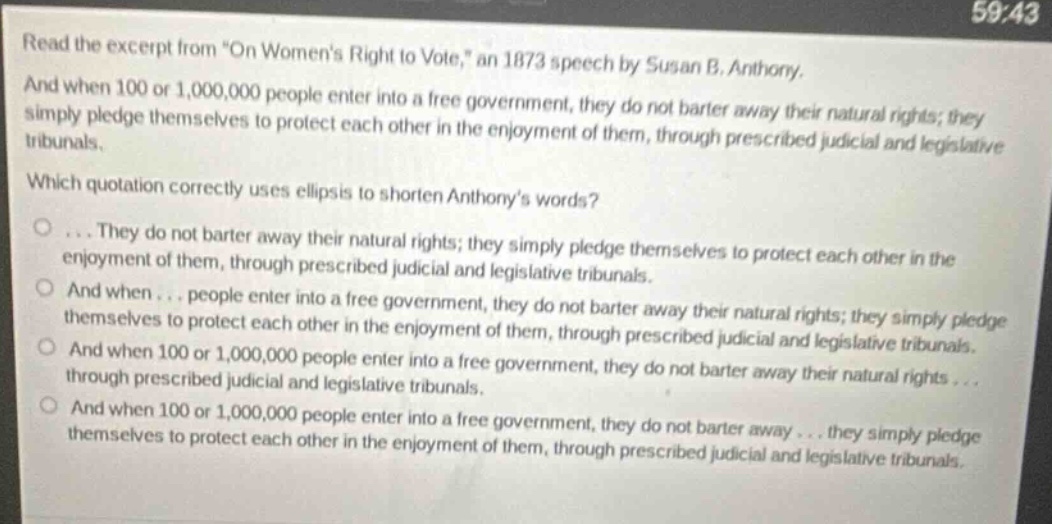
read the excerpt from \on womens right to vote,\ an 1873 speech by susan b. anthony.
and when 100 or 1,000,000 people enter into a free government, they do not barter away their natural rights; they simply pledge themselves to protect each other in the enjoyment of them, through prescribed judicial and legislative tribunals.
which quotation correctly uses ellipsis to shorten anthonys words?
- ... they do not barter away their natural rights; they simply pledge themselves to protect each other in the enjoyment of them, through prescribed judicial and legislative tribunals.
- and when ... people enter into a free government, they do not barter away their natural rights; they simply pledge themselves to protect each other in the enjoyment of them, through prescribed judicial and legislative tribunals.
- and when 100 or 1,000,000 people enter into a free government, they do not barter away their natural rights ... through prescribed judicial and legislative tribunals.
- and when 100 or 1,000,000 people enter into a free government, they do not barter away ... they simply pledge themselves to protect each other in the enjoyment of them, through prescribed judicial and legislative tribunals.
🆕 New Concept Discovered: Proper Use of Ellipses in Quotations
Using three dots to omit words without changing the meaning
Step 1: Understand the purpose of an ellipsis
An ellipsis ... is used in writing to show that words have been omitted from a direct quotation. When shortening a quote, the omission must meet two main rules:
- It must not change the original meaning of the text.
- The remaining sentence must still be grammatically correct.
Step 2: Analyze the original text
The original excerpt is:
"And when 100 or 1,000,000 people enter into a free government, they do not barter away their natural rights; they simply pledge themselves to protect each other in the enjoyment of them, through prescribed judicial and legislative tribunals."
Step 3: Evaluate each option
- Option 1:
... They do not barter away their natural rights; they simply pledge themselves to protect each other in the enjoyment of them, through prescribed judicial and legislative tribunals. - Analysis: This removes the introductory clause "And when 100 or 1,000,000 people enter into a free government,". Without this clause, the pronoun "They" has no clear antecedent (we don't know who "they" refers to), which alters the clarity and grammatical flow of the sentence.
- Option 2:
And when ... people enter into a free government, they do not barter away their natural rights; they simply pledge themselves to protect each other in the enjoyment of them, through prescribed judicial and legislative tribunals. - Analysis: This replaces "100 or 1,000,000" with an ellipsis. The remaining phrase "And when people enter into a free government..." is grammatically correct and perfectly preserves the original meaning (that citizens entering a free government retain their natural rights).
- Option 3:
And when 100 or 1,000,000 people enter into a free government, they do not barter away their natural rights ... through prescribed judicial and legislative tribunals. - Analysis: This cuts out "they simply pledge themselves to protect each other in the enjoyment of them,". By connecting "barter away their natural rights" directly to "through prescribed... tribunals," it completely changes the meaning of the sentence.
- Option 4:
And when 100 or 1,000,000 people enter into a free government, they do not barter away ... they simply pledge themselves to protect each other in the enjoyment of them, through prescribed judicial and legislative tribunals. - Analysis: This removes "their natural rights;". Without these words, the sentence is grammatically incomplete because "barter away" is missing its direct object.

Snap & solve any problem in the app
Get step-by-step solutions on Sovi AI
Photo-based solutions with guided steps
Explore more problems and detailed explanations
Second Option:
And when . . . people enter into a free government, they do not barter away their natural rights; they simply pledge themselves to protect each other in the enjoyment of them, through prescribed judicial and legislative tribunals.