QUESTION IMAGE
Question
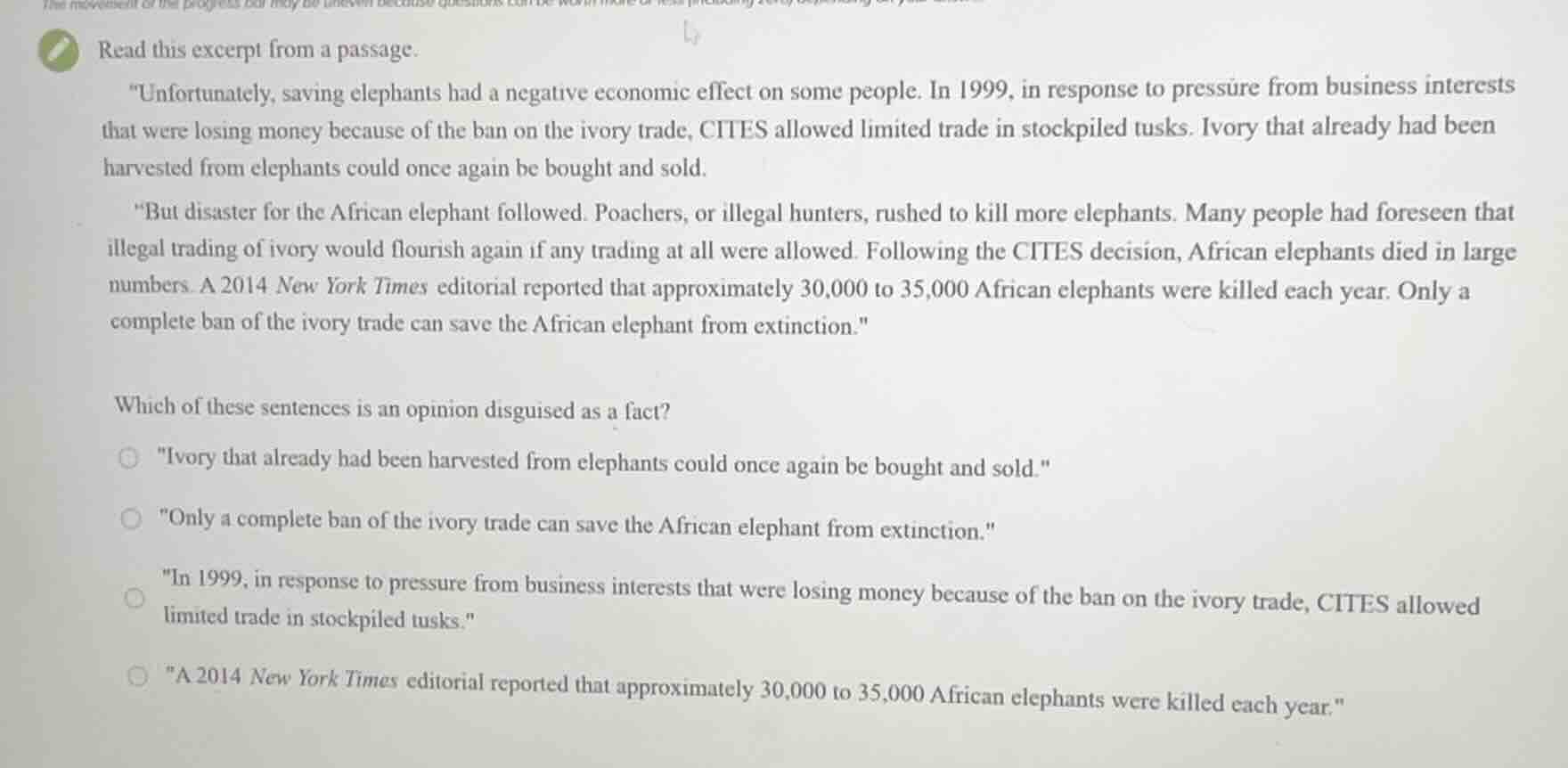
read this excerpt from a passage.
\unfortunately, saving elephants had a negative economic effect on some people. in 1999, in response to pressure from business interests that were losing money because of the ban on the ivory trade, cites allowed limited trade in stockpiled tusks. ivory that already had been harvested from elephants could once again be bought and sold.
\but disaster for the african elephant followed. poachers, or illegal hunters, rushed to kill more elephants. many people had foreseen that illegal trading of ivory would flourish again if any trading at all were allowed. following the cites decision, african elephants died in large numbers. a 2014 new york times editorial reported that approximately 30,000 to 35,000 african elephants were killed each year. only a complete ban of the ivory trade can save the african elephant from extinction.\
which of these sentences is an opinion disguised as a fact?
\ivory that already had been harvested from elephants could once again be bought and sold.\
\only a complete ban of the ivory trade can save the african elephant from extinction.\
\in 1999, in response to pressure from business interests that were losing money because of the ban on the ivory trade, cites allowed limited trade in stockpiled tusks.\
\a 2014 new york times editorial reported that approximately 30,000 to 35,000 african elephants were killed each year.\
Analyze the question and definitions
Using the Reading Comprehension knowledge point, we must identify which sentence is an opinion disguised as a fact. A fact is a statement that can be objectively proven true or false with evidence. An opinion is a personal belief, judgment, or prediction that cannot be objectively proven, even if it is presented as an absolute truth.
Evaluate the first option
The sentence is: "Ivory that already had been harvested from elephants could once again be bought and sold."
This statement describes a historical, legal change in trade regulations that occurred in 1999. Because this change can be verified through official records, it is a verifiable fact, not an opinion.
Evaluate the second option
Using the Identifying Author Bias knowledge point, we analyze: "Only a complete ban of the ivory trade can save the African elephant from extinction."
This statement makes an absolute prediction about the future ("can save") and asserts a singular, necessary solution ("Only a complete ban"). While it is a strong argument, it is a subjective policy recommendation and prediction that cannot be objectively proven as a historical or scientific certainty. Presenting this subjective claim as an absolute truth makes it an opinion disguised as a fact.
Evaluate the third option
The sentence is: "In 1999, in response to pressure from business interests that were losing money because of the ban on the ivory trade, CITES allowed limited trade in stockpiled tusks."
This sentence describes documented historical events: the pressure from business interests, their financial losses, and the decision made by CITES in 1999. These details are verifiable through historical records, making this statement a fact.
Evaluate the fourth option
The sentence is: "A 2014 New York Times editorial reported that approximately 30,000 to 35,000 African elephants were killed each year."
This sentence states a verifiable fact about what a specific publication reported in a specific year. Whether the report's estimate is accurate or not, the statement that the New York Times reported these numbers is an objective, verifiable fact.

Snap & solve any problem in the app
Get step-by-step solutions on Sovi AI
Photo-based solutions with guided steps
Explore more problems and detailed explanations
- "Ivory that already had been harvested from elephants could once again be bought and sold."
- "Only a complete ban of the ivory trade can save the African elephant from extinction." (Correct answer)
- "In 1999, in response to pressure from business interests that were losing money because of the ban on the ivory trade, CITES allowed limited trade in stockpiled tusks."
- "A 2014 New York Times editorial reported that approximately 30,000 to 35,000 African elephants were killed each year."