Sovi.AI - AI Math Tutor

Scan to solve math questions

QUESTION IMAGE

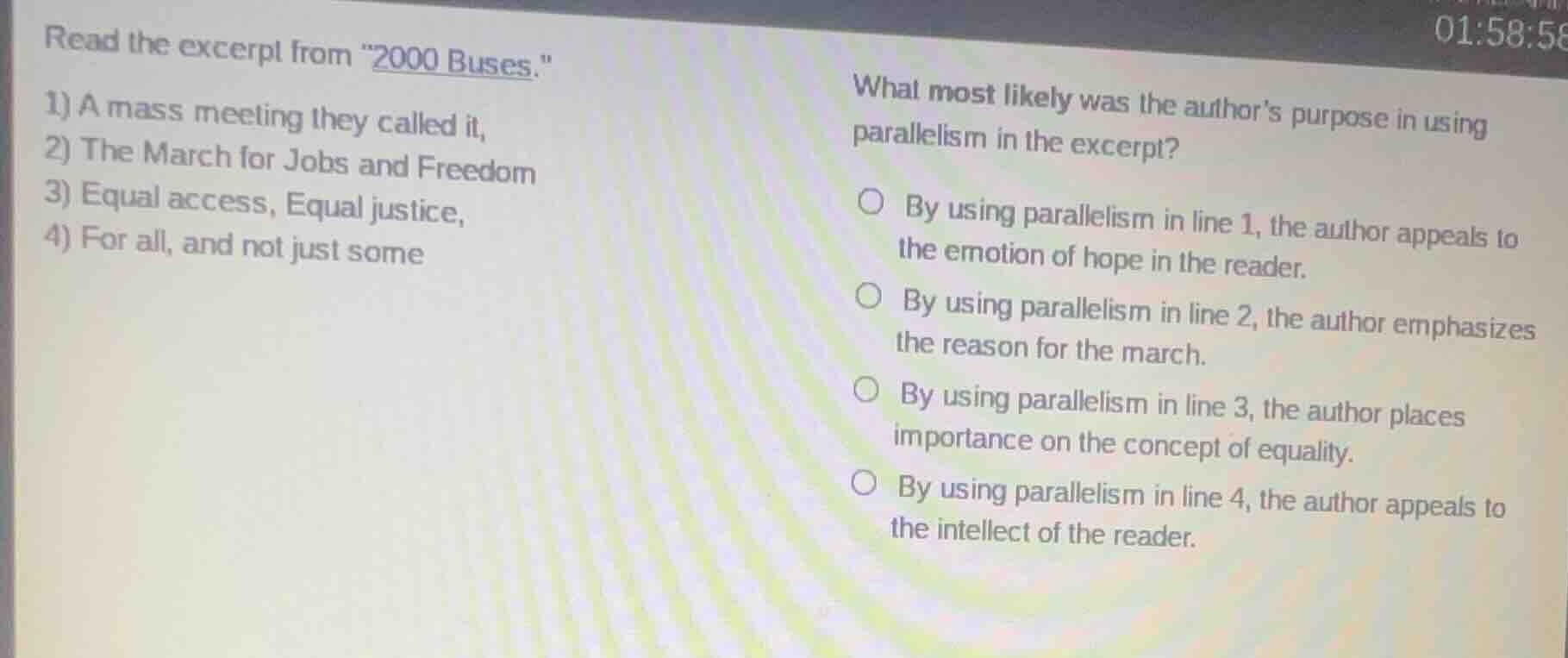
read the excerpt from \2000 buses.\ 1) a mass meeting they called it, 2…

Question

read the excerpt from \2000 buses.\

  1. a mass meeting they called it,
  2. the march for jobs and freedom
  3. equal access, equal justice,
  4. for all, and not just some

what most likely was the authors purpose in using parallelism in the excerpt?

by using parallelism in line 1, the author appeals to the emotion of hope in the reader.
by using parallelism in line 2, the author emphasizes the reason for the march.
by using parallelism in line 3, the author places importance on the concept of equality.
by using parallelism in line 4, the author appeals to the intellect of the reader.

Explanation:

Response

<pre_analysis>
{
"quality": "clear",
"question_count": 1,
"skills_matched": [
"direct_cot",
"multiple_choice_formatter",
"explain_then_answer",
"quick"
],
"needs_drawing": false,
"concepts_used": [
"Author's Purpose"
],
"new_concepts": [
"Parallelism Analysis"
],
"current_concepts": [
"Author's Purpose",
"Parallelism Analysis"
]
}
</pre_analysis>

<reasoning>

Identify the line containing parallelism

Line 3 ("Equal access, Equal justice") uses grammatical parallelism by repeating the word "Equal" followed by a noun ("access" and "justice").

Analyze the author's purpose

The repetition of "Equal" in line 3 emphasizes the core concept of equality, highlighting the fundamental demands of the march.

Evaluate the options

  • Option 1: Line 1 does not contain parallelism.
  • Option 2: Line 2 does not contain parallelism.
  • Option 3: Line 3 contains parallelism ("Equal access, Equal justice") to emphasize equality. This is correct.
  • Option 4: Line 4 does not contain parallelism.

</reasoning>

<answer>
<mcq-option>By using parallelism in line 1, the author appeals to the emotion of hope in the reader.</mcq-option>
<mcq-option>By using parallelism in line 2, the author emphasizes the reason for the march.</mcq-option>
<mcq-correct>By using parallelism in line 3, the author places importance on the concept of equality.</mcq-correct>
<mcq-option>By using parallelism in line 4, the author appeals to the intellect of the reader.</mcq-option>
</answer>

<post_analysis>
{
"subject": "Others",
"question_type": "Multiple Choice",
"knowledge_point": [
"Others",
"English Language Arts",
"Rhetorical Devices"
]
}
</post_analysis>

Answer:

<pre_analysis>
{
"quality": "clear",
"question_count": 1,
"skills_matched": [
"direct_cot",
"multiple_choice_formatter",
"explain_then_answer",
"quick"
],
"needs_drawing": false,
"concepts_used": [
"Author's Purpose"
],
"new_concepts": [
"Parallelism Analysis"
],
"current_concepts": [
"Author's Purpose",
"Parallelism Analysis"
]
}
</pre_analysis>

<reasoning>

Identify the line containing parallelism

Line 3 ("Equal access, Equal justice") uses grammatical parallelism by repeating the word "Equal" followed by a noun ("access" and "justice").

Analyze the author's purpose

The repetition of "Equal" in line 3 emphasizes the core concept of equality, highlighting the fundamental demands of the march.

Evaluate the options

  • Option 1: Line 1 does not contain parallelism.
  • Option 2: Line 2 does not contain parallelism.
  • Option 3: Line 3 contains parallelism ("Equal access, Equal justice") to emphasize equality. This is correct.
  • Option 4: Line 4 does not contain parallelism.

</reasoning>

<answer>
<mcq-option>By using parallelism in line 1, the author appeals to the emotion of hope in the reader.</mcq-option>
<mcq-option>By using parallelism in line 2, the author emphasizes the reason for the march.</mcq-option>
<mcq-correct>By using parallelism in line 3, the author places importance on the concept of equality.</mcq-correct>
<mcq-option>By using parallelism in line 4, the author appeals to the intellect of the reader.</mcq-option>
</answer>

<post_analysis>
{
"subject": "Others",
"question_type": "Multiple Choice",
"knowledge_point": [
"Others",
"English Language Arts",
"Rhetorical Devices"
]
}
</post_analysis>