QUESTION IMAGE
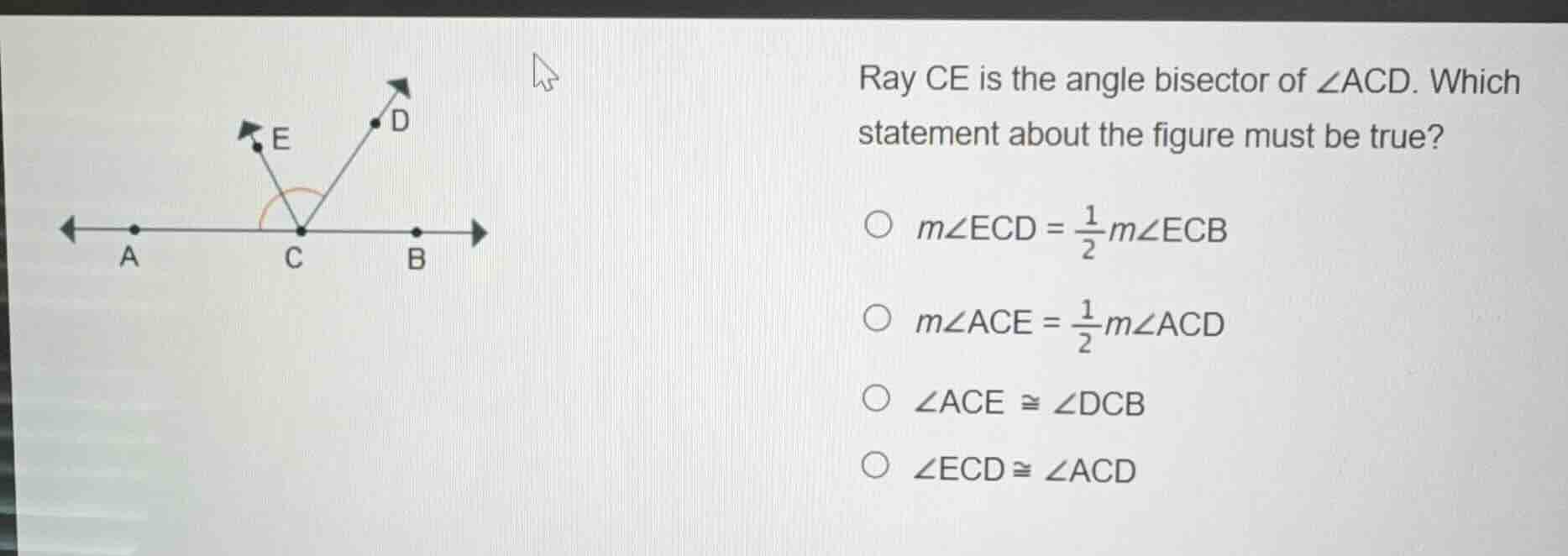
Question
ray ce is the angle bisector of $angle acd$. which statement about the figure must be true?
$\bigcirc$ $mangle ecd = \frac{1}{2}m\angle ecb$
$\bigcirc$ $m\angle ace = \frac{1}{2}m\angle acd$
$\bigcirc$ $\angle ace \cong \angle dcb$
$\bigcirc$ $\angle ecd \cong \angle acd$
Step1: Recall angle bisector definition
An angle bisector splits an angle into two congruent angles, each equal to half the original angle. For $\angle ACD$, ray $CE$ divides it into $\angle ACE$ and $\angle ECD$, so $m\angle ACE = m\angle ECD = \frac{1}{2}m\angle ACD$.
Step2: Evaluate each option
- Option1: $m\angle ECD = \frac{1}{2}m\angle ECB$: No basis, $\angle ECB$ is not related to the bisected angle.
- Option2: $m\angle ACE = \frac{1}{2}m\angle ACD$: Matches the angle bisector property.
- Option3: $\angle ACE \cong \angle DCB$: No given relation between these angles.
- Option4: $\angle ECD \cong \angle ACD$: $\angle ECD$ is half of $\angle ACD$, not congruent.

Snap & solve any problem in the app
Get step-by-step solutions on Sovi AI
Photo-based solutions with guided steps
Explore more problems and detailed explanations
B. $m\angle ACE = \frac{1}{2}m\angle ACD$