QUESTION IMAGE
Question
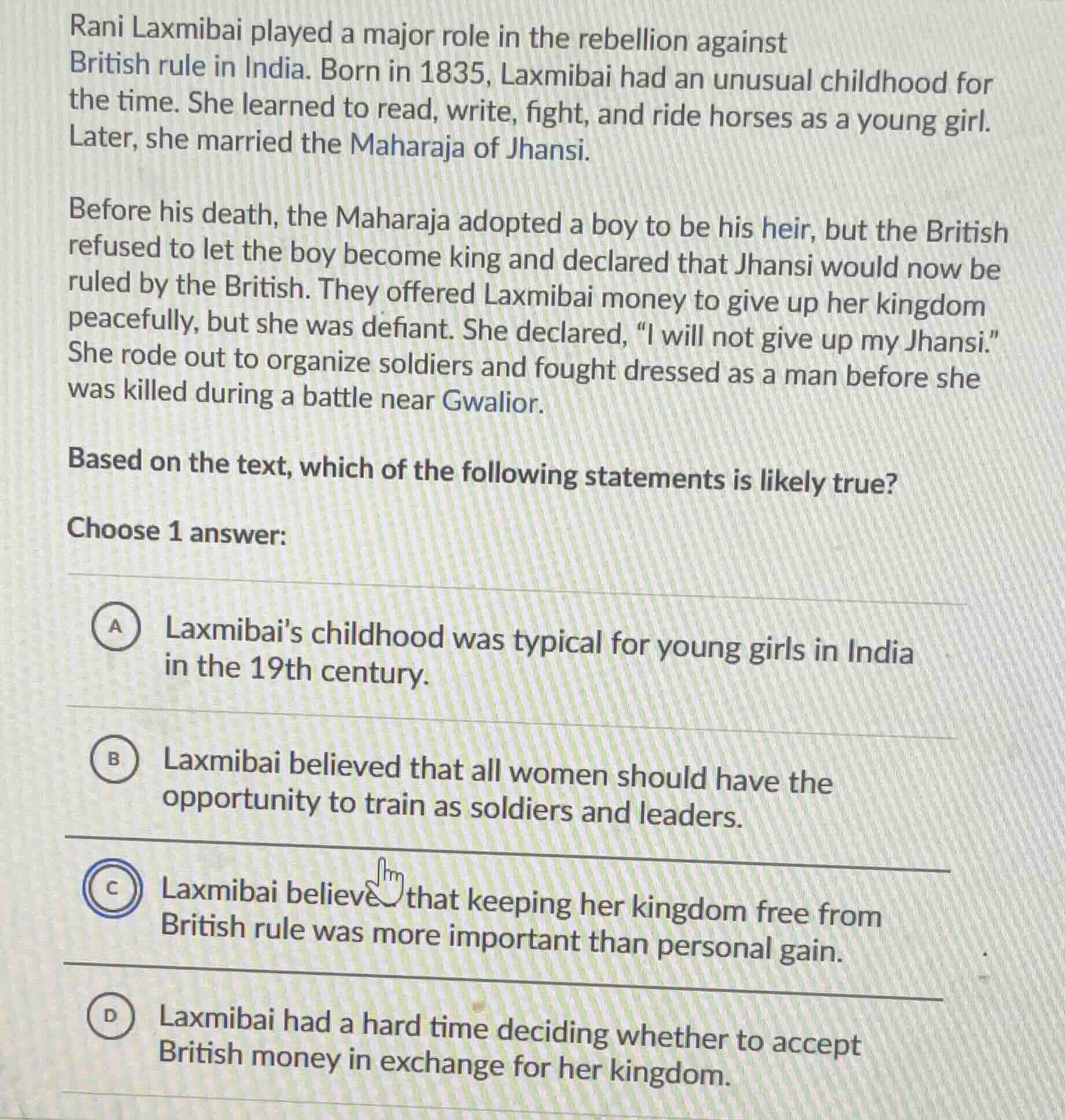
rani laxmibai played a major role in the rebellion against british rule in india. born in 1835, laxmibai had an unusual childhood for the time. she learned to read, write, fight, and ride horses as a young girl. later, she married the maharaja of jhansi.
before his death, the maharaja adopted a boy to be his heir, but the british refused to let the boy become king and declared that jhansi would now be ruled by the british. they offered laxmibai money to give up her kingdom peacefully, but she was defiant. she declared, \i will not give up my jhansi.\ she rode out to organize soldiers and fought dressed as a man before she was killed during a battle near gwalior.
based on the text, which of the following statements is likely true?
choose 1 answer:
a laxmibais childhood was typical for young girls in india in the 19th century.
b laxmibai believed that all women should have the opportunity to train as soldiers and leaders.
c laxmibai believed that keeping her kingdom free from british rule was more important than personal gain.
d laxmibai had a hard time deciding whether to accept british money in exchange for her kingdom.
Analyze the passage details
Using Reading Comprehension, we examine the text's key facts:
- Rani Laxmibai had an "unusual childhood" learning to read, write, fight, and ride.
- The British refused her adopted son's heirship and claimed Jhansi.
- They offered her money to surrender peacefully, but she was "defiant."
- She declared, "I will not give up my Jhansi," organized soldiers, and fought.
Evaluate the answer choices
Using Evidence Evaluation, we test each option against the text:
- Option A contradicts the text, which states she had an "unusual childhood for the time."
- Option B is unsupported; the text does not mention her views on all women.
- Option C is supported because she rejected British money ("personal gain") to fight for her kingdom's freedom.
- Option D is contradicted by her immediate defiance and declaration: "I will not give up my Jhansi."
Formulate the final inference
Using Textual Inference, we conclude that Option C is the most logical deduction. Her refusal of money in favor of leading a rebellion demonstrates that preserving her kingdom's independence was more important to her than personal wealth.

Snap & solve any problem in the app
Get step-by-step solutions on Sovi AI
Photo-based solutions with guided steps
Explore more problems and detailed explanations
- (A) Laxmibai's childhood was typical for young girls in India in the 19th century.
- (B) Laxmibai believed that all women should have the opportunity to train as soldiers and leaders.
- (C) Laxmibai believed that keeping her kingdom free from British rule was more important than personal gain. (Correct answer)
- (D) Laxmibai had a hard time deciding whether to accept British money in exchange for her kingdom.