QUESTION IMAGE
Question
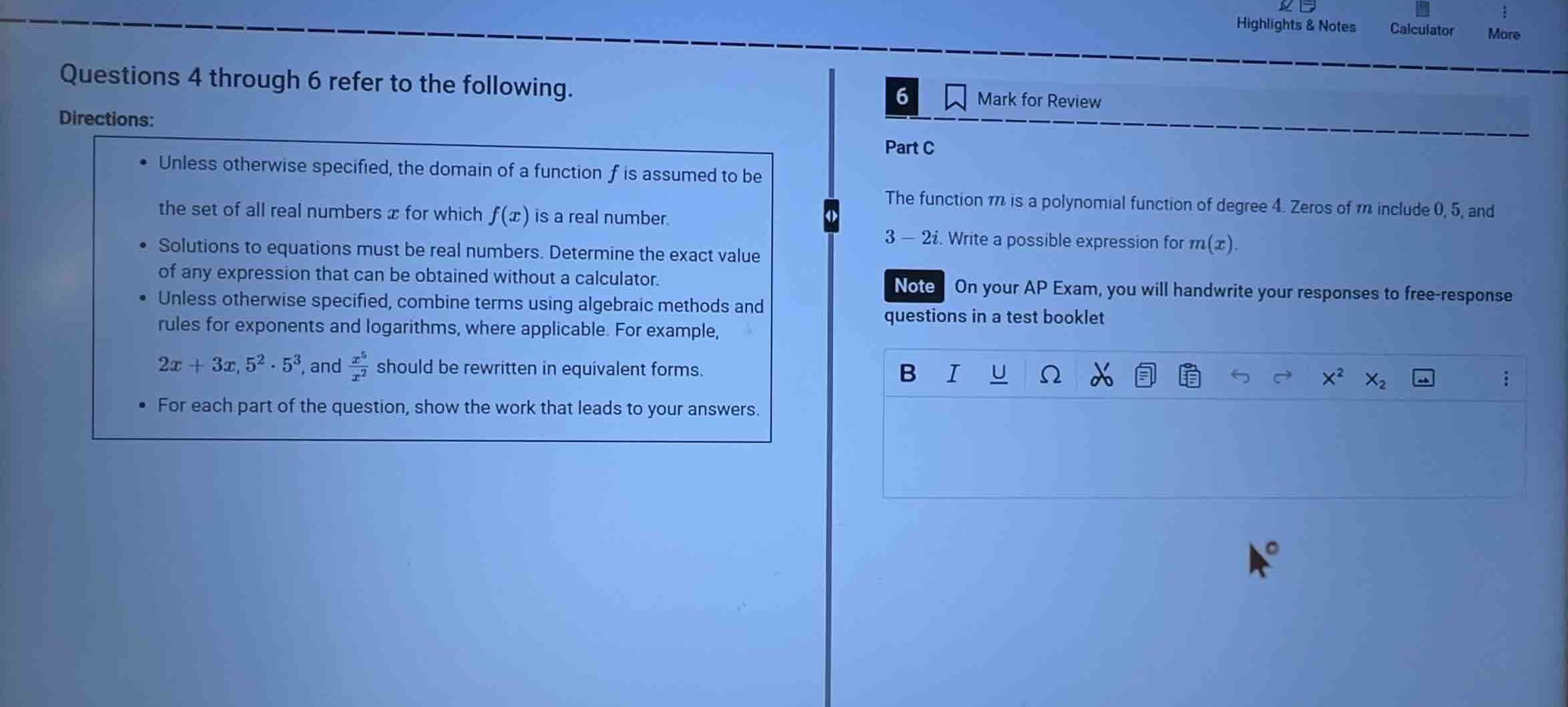
questions 4 through 6 refer to the following.
directions:
- unless otherwise specified, the domain of a function \\(f\\) is assumed to be the set of all real numbers \\(x\\) for which \\(f(x)\\) is a real number.
- solutions to equations must be real numbers. determine the exact value of any expression that can be obtained without a calculator.
- unless otherwise specified, combine terms using algebraic methods and rules for exponents and logarithms, where applicable. for example, \\(2x + 3x\\), \\(5^2 \cdot 5^3\\), and \\(\frac{x^5}{x^2}\\) should be rewritten in equivalent forms.
- for each part of the question, show the work that leads to your answers.
part c
the function \\(m\\) is a polynomial function of degree 4. zeros of \\(m\\) include 0, 5, and \\(3 - 2i\\). write a possible expression for \\(m(x)\\).
Identify the given zeros and degree
The function \(m\) is a polynomial function of degree 4.
The given zeros are \(0\), \(5\), and \(3 - 2i\).
Apply the Complex Conjugate Root Theorem
Since the polynomial has real coefficients, any non-real complex zeros must occur in conjugate pairs.
The conjugate of \(3 - 2i\) is \(3 + 2i\).
Therefore, the four zeros of the degree 4 polynomial are:
\(x_1 = 0\), \(x_2 = 5\), \(x_3 = 3 - 2i\), and \(x_4 = 3 + 2i\).
Set up the factored form of the polynomial
Using the zeros, we can write the polynomial in its factored form:
For a possible expression, we can choose the leading coefficient \(a = 1\):
Simplify the complex factors
We simplify the product of the complex conjugate factors:
Applying the difference of squares:
Write the final polynomial expression
Substitute the simplified quadratic factor back into the expression:
Expanding the first two terms:
Either the factored form or the expanded form is a valid possible expression.

Snap & solve any problem in the app
Get step-by-step solutions on Sovi AI
Photo-based solutions with guided steps
Explore more problems and detailed explanations
\(m(x) = x(x - 5)(x^2 - 6x + 13)\)