QUESTION IMAGE
Question
questions:
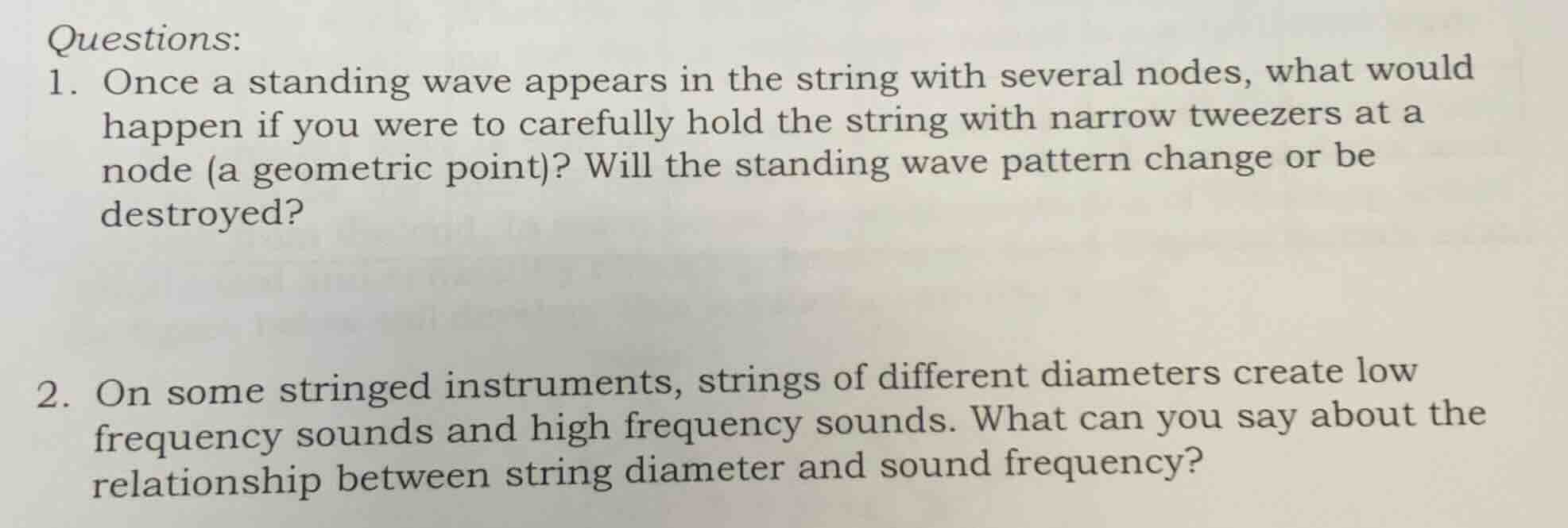
- once a standing wave appears in the string with several nodes, what would happen if you were to carefully hold the string with narrow tweezers at a node (a geometric point)? will the standing wave pattern change or be destroyed?
- on some stringed instruments, strings of different diameters create low frequency sounds and high frequency sounds. what can you say about the relationship between string diameter and sound frequency?
<pre_analysis>
{
"quality": "clear",
"question_count": 2,
"skills_matched": [
"direct_cot",
"explain_then_answer",
"tutor"
],
"needs_drawing": false,
"concepts_used": [],
"new_concepts": [
"Standing Wave Nodes",
"String Linear Density",
"Wave Speed on Strings"
],
"current_concepts": [
"Standing Wave Nodes",
"String Linear Density",
"Wave Speed on Strings"
]
}
</pre_analysis>
<reasoning>
Analyze holding a standing wave at a node
A node in a standing wave is a point along a medium where the displacement is always zero. Because the string does not move at this geometric point, holding it gently with narrow tweezers at this exact position does not restrict any natural movement of the wave. Therefore, the standing wave pattern will not change or be destroyed.
Relate string diameter to linear mass density
The frequency of a vibrating string depends on the wave speed and the wavelength. The wave speed \(v\) on a string under tension \(T\) with linear mass density \(\mu\) is given by:
\[v = \sqrt{\frac{T}{\mu}}\]
The linear mass density \(\mu\) is mass per unit length. For a cylindrical string of diameter \(d\) and density \(
ho\):
\[\mu =
ho \cdot A =
ho \cdot \frac{\pi d^2}{4}\]
This shows that a larger diameter increases the linear mass density \(\mu\).
Relate linear mass density to wave speed
As the string diameter \(d\) increases, the linear mass density \(\mu\) increases. Since \(\mu\) is in the denominator of the wave speed formula:
\[v = \sqrt{\frac{T}{\mu}}\]
An increase in \(\mu\) results in a lower wave speed \(v\) along the string, assuming the tension \(T\) remains constant.
Relate wave speed to sound frequency
The fundamental frequency \(f\) of a string of length \(L\) is:
\[f = \frac{v}{2L}\]
Substituting the wave speed expression gives:
\[f = \frac{1}{2L}\sqrt{\frac{T}{\mu}} = \frac{1}{L \cdot d}\sqrt{\frac{T}{\pi
ho}}\]
This demonstrates that frequency \(f\) is inversely proportional to the diameter \(d\). Therefore, thicker strings (larger diameter) produce lower frequency sounds, while thinner strings (smaller diameter) produce higher frequency sounds.
</reasoning>
<answer>
Question 1
The standing wave pattern will not change or be destroyed. Because a node is a point of zero displacement, holding the string at this exact geometric point does not interfere with the wave's motion.
Question 2
There is an inverse relationship between string diameter and sound frequency. Thicker strings (larger diameter) have a greater linear mass density, which decreases the wave propagation speed and results in lower frequency sounds. Thinner strings (smaller diameter) have less mass per unit length, allowing waves to travel faster and produce higher frequency sounds.
</answer>
<post_analysis>
{
"subject": "Natural Science",
"question_type": "Multi-part",
"knowledge_point": [
"Natural Science",
"Physics",
"Waves and Acoustics"
]
}
</post_analysis>
Snap & solve any problem in the app
Get step-by-step solutions on Sovi AI
Photo-based solutions with guided steps
Explore more problems and detailed explanations
<pre_analysis>
{
"quality": "clear",
"question_count": 2,
"skills_matched": [
"direct_cot",
"explain_then_answer",
"tutor"
],
"needs_drawing": false,
"concepts_used": [],
"new_concepts": [
"Standing Wave Nodes",
"String Linear Density",
"Wave Speed on Strings"
],
"current_concepts": [
"Standing Wave Nodes",
"String Linear Density",
"Wave Speed on Strings"
]
}
</pre_analysis>
<reasoning>
Analyze holding a standing wave at a node
A node in a standing wave is a point along a medium where the displacement is always zero. Because the string does not move at this geometric point, holding it gently with narrow tweezers at this exact position does not restrict any natural movement of the wave. Therefore, the standing wave pattern will not change or be destroyed.
Relate string diameter to linear mass density
The frequency of a vibrating string depends on the wave speed and the wavelength. The wave speed \(v\) on a string under tension \(T\) with linear mass density \(\mu\) is given by:
\[v = \sqrt{\frac{T}{\mu}}\]
The linear mass density \(\mu\) is mass per unit length. For a cylindrical string of diameter \(d\) and density \(
ho\):
\[\mu =
ho \cdot A =
ho \cdot \frac{\pi d^2}{4}\]
This shows that a larger diameter increases the linear mass density \(\mu\).
Relate linear mass density to wave speed
As the string diameter \(d\) increases, the linear mass density \(\mu\) increases. Since \(\mu\) is in the denominator of the wave speed formula:
\[v = \sqrt{\frac{T}{\mu}}\]
An increase in \(\mu\) results in a lower wave speed \(v\) along the string, assuming the tension \(T\) remains constant.
Relate wave speed to sound frequency
The fundamental frequency \(f\) of a string of length \(L\) is:
\[f = \frac{v}{2L}\]
Substituting the wave speed expression gives:
\[f = \frac{1}{2L}\sqrt{\frac{T}{\mu}} = \frac{1}{L \cdot d}\sqrt{\frac{T}{\pi
ho}}\]
This demonstrates that frequency \(f\) is inversely proportional to the diameter \(d\). Therefore, thicker strings (larger diameter) produce lower frequency sounds, while thinner strings (smaller diameter) produce higher frequency sounds.
</reasoning>
<answer>
Question 1
The standing wave pattern will not change or be destroyed. Because a node is a point of zero displacement, holding the string at this exact geometric point does not interfere with the wave's motion.
Question 2
There is an inverse relationship between string diameter and sound frequency. Thicker strings (larger diameter) have a greater linear mass density, which decreases the wave propagation speed and results in lower frequency sounds. Thinner strings (smaller diameter) have less mass per unit length, allowing waves to travel faster and produce higher frequency sounds.
</answer>
<post_analysis>
{
"subject": "Natural Science",
"question_type": "Multi-part",
"knowledge_point": [
"Natural Science",
"Physics",
"Waves and Acoustics"
]
}
</post_analysis>