QUESTION IMAGE
Question
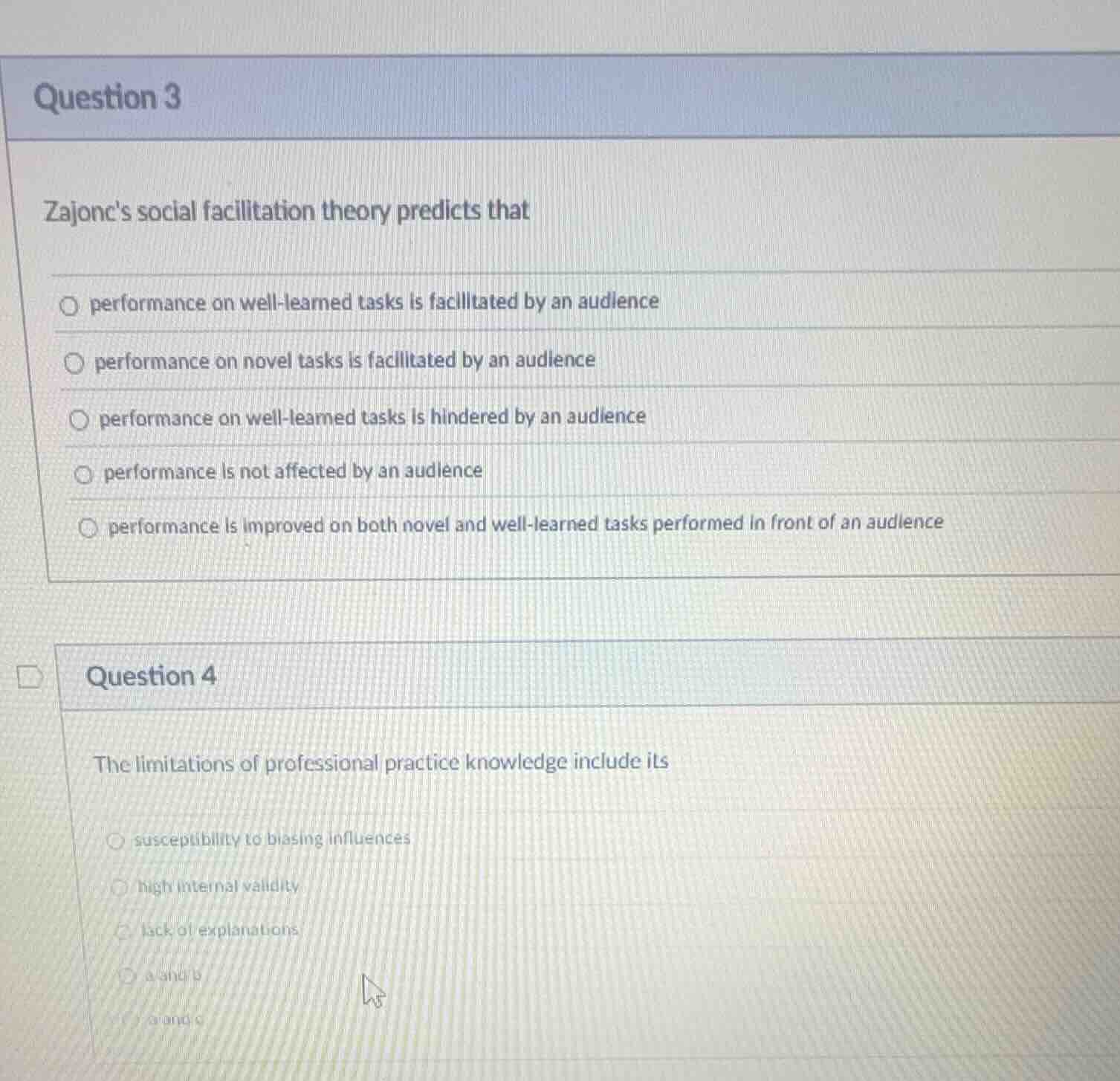
question 3
zajoncs social facilitation theory predicts that
performance on well-learned tasks is facilitated by an audience
performance on novel tasks is facilitated by an audience
performance on well-learned tasks is hindered by an audience
performance is not affected by an audience
performance is improved on both novel and well-learned tasks performed in front of an audience
question 4
the limitations of professional practice knowledge include its
susceptibility to biasing influences
high internal validity
lack of explanations
a and b
a and c
Analyze Zajonc's social facilitation theory
Zajonc's social facilitation theory (drive theory) posits that the presence of others increases physiological arousal. This arousal strengthens the emission of the dominant response. For well-learned or simple tasks, the dominant response is typically correct, meaning performance is facilitated (improved) by an audience. For novel, complex, or unlearned tasks, the dominant response is often incorrect, meaning performance is impaired (hindered) by an audience. Therefore, the theory predicts that performance on well-learned tasks is facilitated by an audience.
Analyze limitations of professional practice knowledge
Professional practice knowledge is gained through practical experience rather than systematic scientific research. In sport psychology and kinesiology, its limitations include being highly susceptible to subjective bias (biasing influences) and lacking systematic explanations for why certain interventions work (lack of explanations). High internal validity is a characteristic of tightly controlled scientific experiments, not professional practice knowledge. Therefore, the limitations include both susceptibility to biasing influences and lack of explanations, which corresponds to options "a and c".

Snap & solve any problem in the app
Get step-by-step solutions on Sovi AI
Photo-based solutions with guided steps
Explore more problems and detailed explanations
Question 3
- performance on well-learned tasks is facilitated by an audience (Correct answer)
- performance on novel tasks is facilitated by an audience
- performance on well-learned tasks is hindered by an audience
- performance is not affected by an audience
- performance is improved on both novel and well-learned tasks performed in front of an audience
Question 4
- susceptibility to biasing influences
- high internal validity
- lack of explanations
- a and b
- a and c (Correct answer)