QUESTION IMAGE
Question
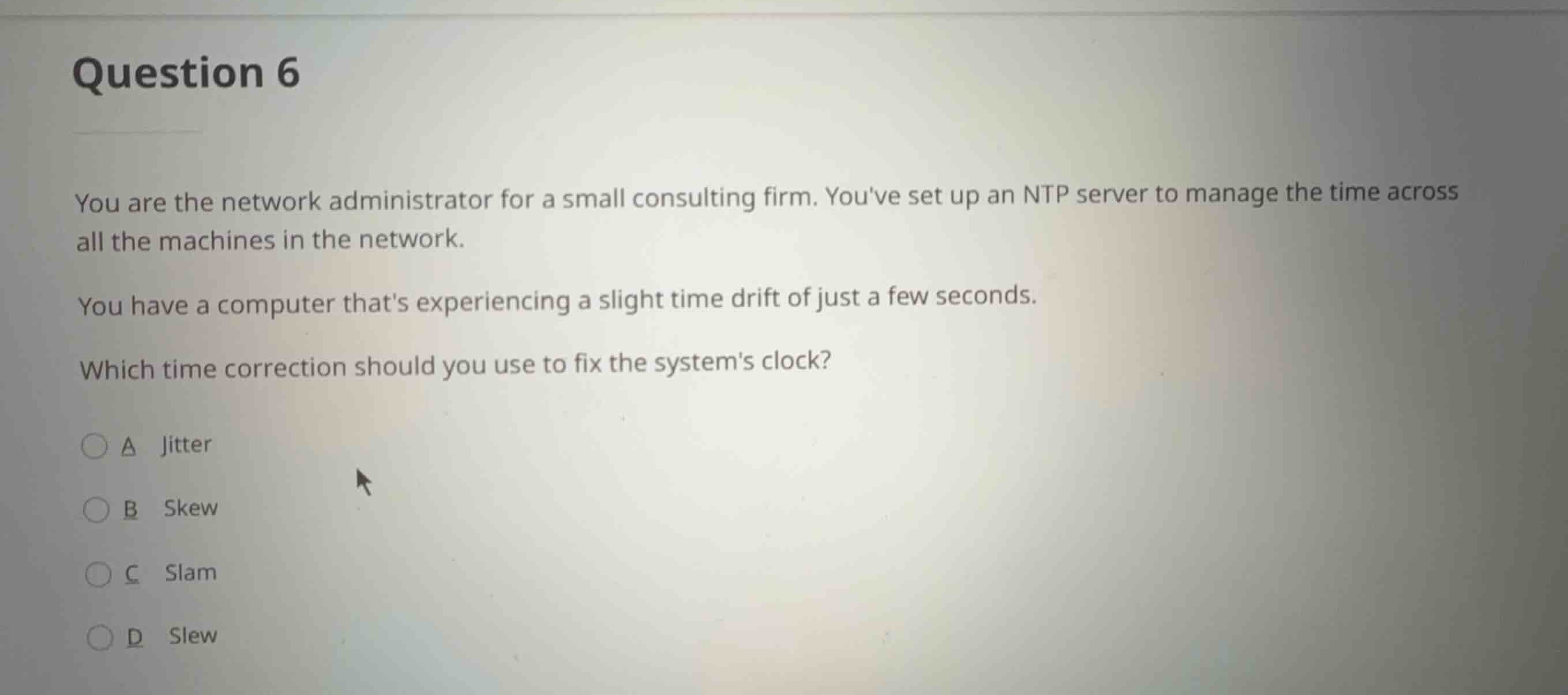
question 6
you are the network administrator for a small consulting firm. youve set up an ntp server to manage the time across all the machines in the network.
you have a computer thats experiencing a slight time drift of just a few seconds.
which time correction should you use to fix the systems clock?
a jitter
b skew
c slam
d slew
Analyze the scenario and time drift
The scenario describes a computer experiencing a slight time drift of just a few seconds. We need to determine the most appropriate Network Time Protocol (NTP) time correction method to fix this system's clock.
Compare NTP correction methods
NTP typically uses two primary methods to adjust a system clock:
- Slamming (Step): The system clock is immediately set to the correct time. This is used for large time differences but can cause issues with applications that rely on monotonically increasing timestamps.
- Slewing (Slew): The system clock speed is slightly adjusted (sped up or slowed down) over a period of time until it gradually aligns with the correct time. This is ideal for small time drifts (like a few seconds) because it prevents backward time jumps and maintains system stability.
Evaluate the given options
- A Jitter: This refers to the variation in latency of received packets, not a clock correction method.
- B Skew: This is the rate of change of clock drift, not a correction mechanism.
- C Slam: This is used for large offsets, not a slight drift of a few seconds.
- D Slew: This is the correct method for gradually correcting small time drifts.

Snap & solve any problem in the app
Get step-by-step solutions on Sovi AI
Photo-based solutions with guided steps
Explore more problems and detailed explanations
- (A) Jitter
- (B) Skew
- (C) Slam
- (D) Slew (Correct answer)