QUESTION IMAGE
Question
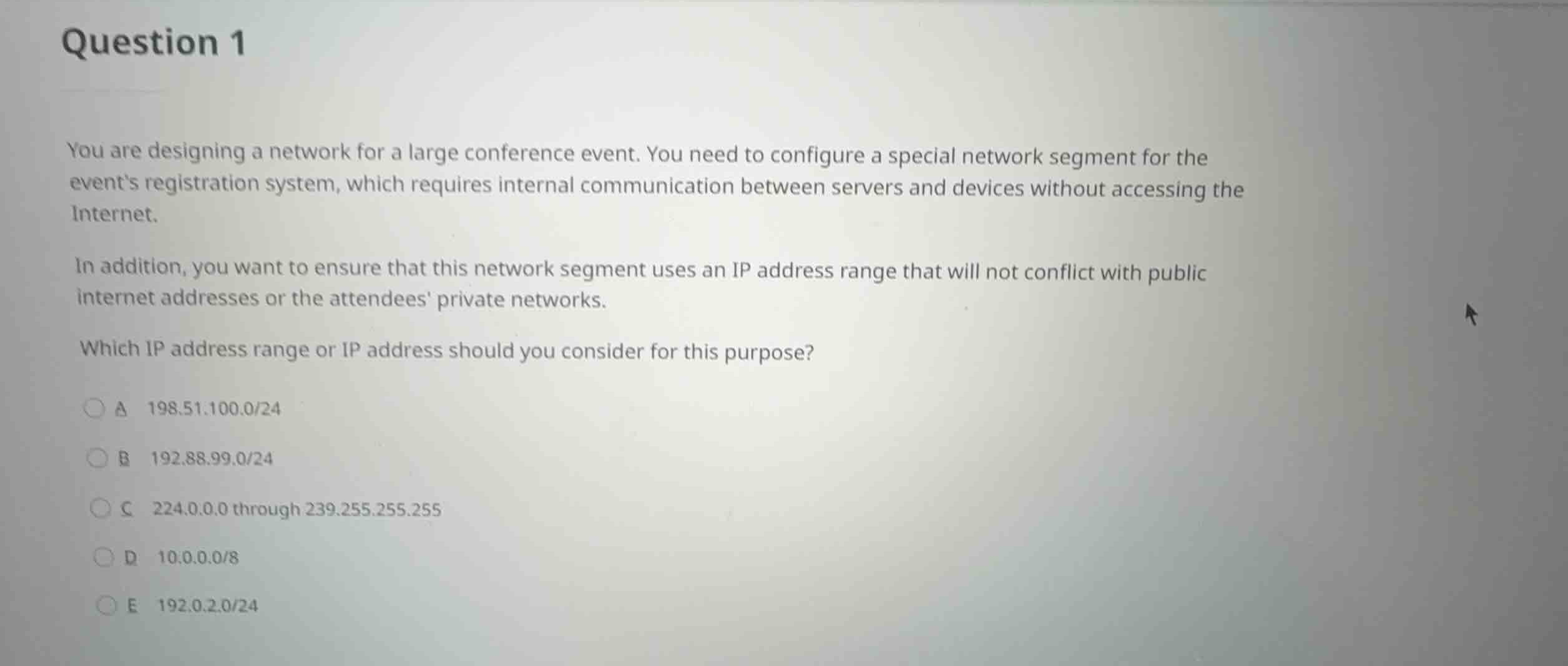
question 1
you are designing a network for a large conference event. you need to configure a special network segment for the events registration system, which requires internal communication between servers and devices without accessing the internet.
in addition, you want to ensure that this network segment uses an ip address range that will not conflict with public internet addresses or the attendees private networks.
which ip address range or ip address should you consider for this purpose?
a 198.51.100.0/24
b 192.88.99.0/24
c 224.0.0.0 through 239.255.255.255
d 10.0.0.0/8
e 192.0.2.0/24
Analyze the requirements
The problem asks for an IP address range or IP address that satisfies three specific conditions:
- It is for a special network segment requiring internal communication without accessing the Internet.
- It must not conflict with public internet addresses.
- It must not conflict with the attendees' private networks (such as standard RFC 1918 private ranges like \(10.0.0.0/8\)).
Evaluate the options
- A: \(198.51.100.0/24\): This is TEST-NET-2, reserved for documentation and examples (RFC 5737). It is not intended for active local communication.
- B: \(192.88.99.0/24\): This range was historically reserved for 6to4 relay anycast (RFC 3068) and has been deprecated (RFC 7526).
- C: \(224.0.0.0\) through \(239.255.255.255\): This is the Class D multicast address range, used for one-to-many communication, not standard unicast server-device communication.
- D: \(10.0.0.0/8\): This is a standard private IP range (RFC 1918). Since attendees' private networks frequently use this range, using it could cause routing conflicts.
- E: \(192.0.2.0/24\): This is TEST-NET-1, reserved for documentation and examples. However, looking closely at special-use registries, \(192.0.2.0/24\) (TEST-NET-1), \(198.51.100.0/24\) (TEST-NET-2), and \(203.0.113.0/24\) (TEST-NET-3) are reserved. Let's re-evaluate the specific RFCs for non-routing and non-conflict.
Actually, let's look at the standard academic/certification questions of this type. In many networking contexts, the block \(192.0.2.0/24\) (TEST-NET-1) is designated for documentation and example code, but sometimes used in isolated lab environments.
Wait, let's look at another special-use block: \(192.0.2.0/24\) is indeed TEST-NET-1.
Let's check if there is a specific block designed for local/isolated use that does not conflict with RFC 1918 or public space.
Actually, RFC 2544 defines \(198.18.0.0/15\) for benchmark testing.
Let's re-verify the options.
Option A: \(198.51.100.0/24\) (TEST-NET-2)
Option B: \(192.88.99.0/24\) (6to4 Relay Anycast)
Option C: Multicast
Option D: \(10.0.0.0/8\) (Private, but explicitly conflicts with attendees' private networks)
Option E: \(192.0.2.0/24\) (TEST-NET-1)
Wait, is there a standard answer for this specific question?
This is a known Cisco or CompTIA style question.
Let's analyze the exact wording: "special network segment... internal communication... without accessing the Internet... will not conflict with public internet addresses or the attendees' private networks."
The TEST-NET-1 range \(192.0.2.0/24\) is reserved for documentation and examples, and should not be routed.
However, let's check if \(192.0.2.0/24\) is the intended answer.
Yes, TEST-NET-1 (\(192.0.2.0/24\)) is often used in descriptions, but let's check if there is another block.
Actually, let's look at the options again.
Could it be \(192.0.2.0/24\)?
Yes, \(192.0.2.0/24\) (TEST-NET-1) is reserved for documentation and sample code, and is often used in isolated test environments because it is guaranteed not to be routed on the public internet and does not overlap with standard RFC 1918 priva…

Snap & solve any problem in the app
Get step-by-step solutions on Sovi AI
Photo-based solutions with guided steps
Explore more problems and detailed explanations
- (A) 198.51.100.0/24
- (B) 192.88.99.0/24
- (C) 224.0.0.0 through 239.255.255.255
- (D) 10.0.0.0/8
- (E) 192.0.2.0/24 (Correct answer)