QUESTION IMAGE
Question
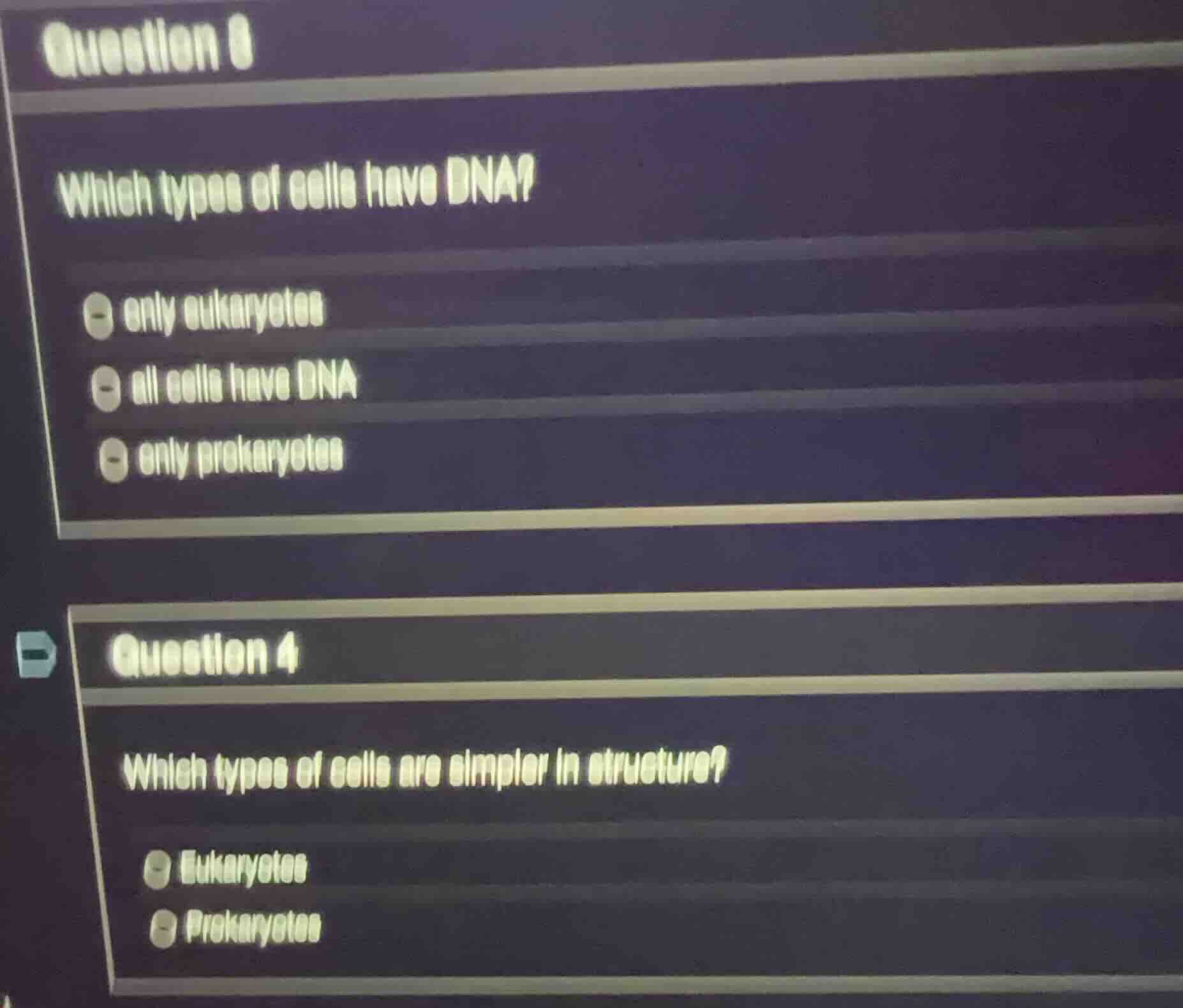
question 3
which types of cells have dna?
- only eukaryotes
- all cells have dna
- only prokaryotes
question 4
which types of cells are simpler in structure?
- eukaryotes
- prokaryotes
Analyze DNA presence in cells
Using the Universal Cell Features knowledge point
All living cells share certain fundamental components, regardless of whether they are prokaryotic or eukaryotic. These universal features include a plasma membrane, cytoplasm, ribosomes, and genetic material in the form of DNA. Therefore, DNA is not restricted to one group; all cells have DNA.
Compare structural complexity of cell types
Using the Prokaryotic Cells and Eukaryotic Cells knowledge points
Prokaryotes (bacteria and archaea) lack a membrane-bound nucleus and other membrane-bound organelles, making their internal organization highly streamlined. Eukaryotes (animals, plants, fungi, and protists) contain a distinct nucleus and numerous specialized organelles, making them structurally much more complex. Thus, prokaryotes are simpler in structure.

Snap & solve any problem in the app
Get step-by-step solutions on Sovi AI
Photo-based solutions with guided steps
Explore more problems and detailed explanations
Question 3
- only eukaryotes
- all cells have DNA (Correct answer)
- only prokaryotes
Question 4
- Eukaryotes
- Prokaryotes (Correct answer)