QUESTION IMAGE
Question
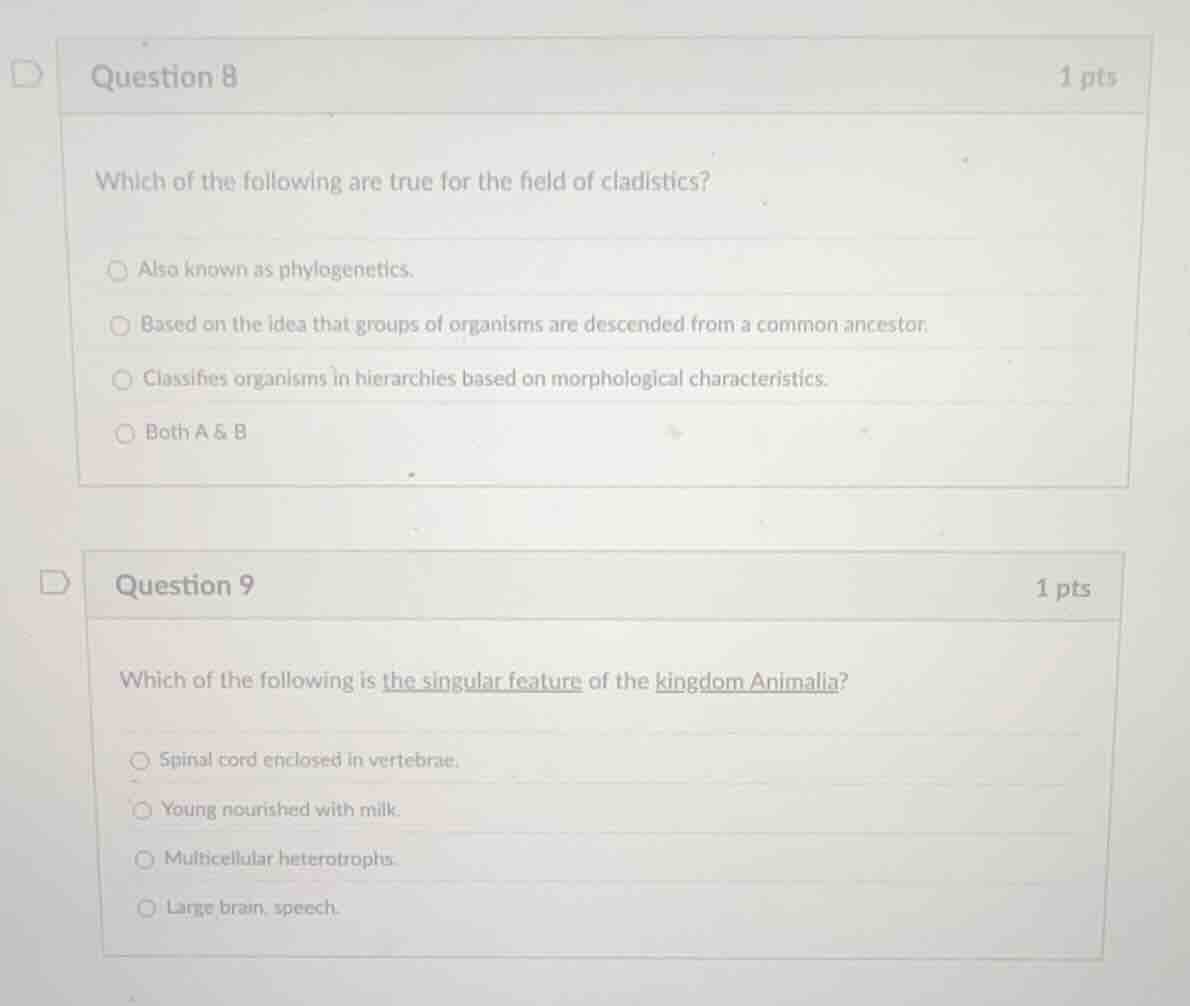
question 8
which of the following are true for the field of cladistics?
also known as phylogenetics.
based on the idea that groups of organisms are descended from a common ancestor.
classifies organisms in hierarchies based on morphological characteristics.
both a & b
question 9
which of the following is the singular feature of the kingdom animalia?
spinal cord enclosed in vertebrae.
young nourished with milk.
multicellular heterotrophs.
large brain, speech.
Analyze Question 8
Using the Cladistics vs Taxonomy knowledge point, we evaluate the statements regarding cladistics:
- Statement A: "Also known as phylogenetics." Cladistics is a biological classification system based on evolutionary relationships (phylogeny), and is often used synonymously with phylogenetic systematics.
- Statement B: "Based on the idea that groups of organisms are descended from a common ancestor." This is the core principle of cladistics, which groups organisms into clades based on shared derived characteristics (synapomorphies) inherited from a common ancestor.
- Statement C: "Classifies organisms in hierarchies based on morphological characteristics." Traditional Linnaean taxonomy relies heavily on overall morphological similarity, whereas cladistics focuses strictly on evolutionary lineages.
- Therefore, both A and B are true, making "Both A & B" the correct choice.
Analyze Question 9
We evaluate the options to find the singular defining feature of the kingdom Animalia:
- "Spinal cord enclosed in vertebrae" is a characteristic of subphylum Vertebrata, not all animals (many animals are invertebrates).
- "Young nourished with milk" is unique to class Mammalia, not all animals.
- "Multicellular heterotrophs" describes the fundamental, defining combination of traits shared by all members of the kingdom Animalia (ingestive heterotrophy in multicellular organisms lacking cell walls).
- "Large brain, speech" is specific to humans (Homo sapiens).
- Therefore, "Multicellular heterotrophs" is the correct choice.

Snap & solve any problem in the app
Get step-by-step solutions on Sovi AI
Photo-based solutions with guided steps
Explore more problems and detailed explanations
Question 8
- Also known as phylogenetics.
- Based on the idea that groups of organisms are descended from a common ancestor.
- Classifies organisms in hierarchies based on morphological characteristics.
- Both A & B (Correct answer)
Question 9
- Spinal cord enclosed in vertebrae.
- Young nourished with milk.
- Multicellular heterotrophs. (Correct answer)
- Large brain, speech.