Sovi.AI - AI Math Tutor

Scan to solve math questions

QUESTION IMAGE

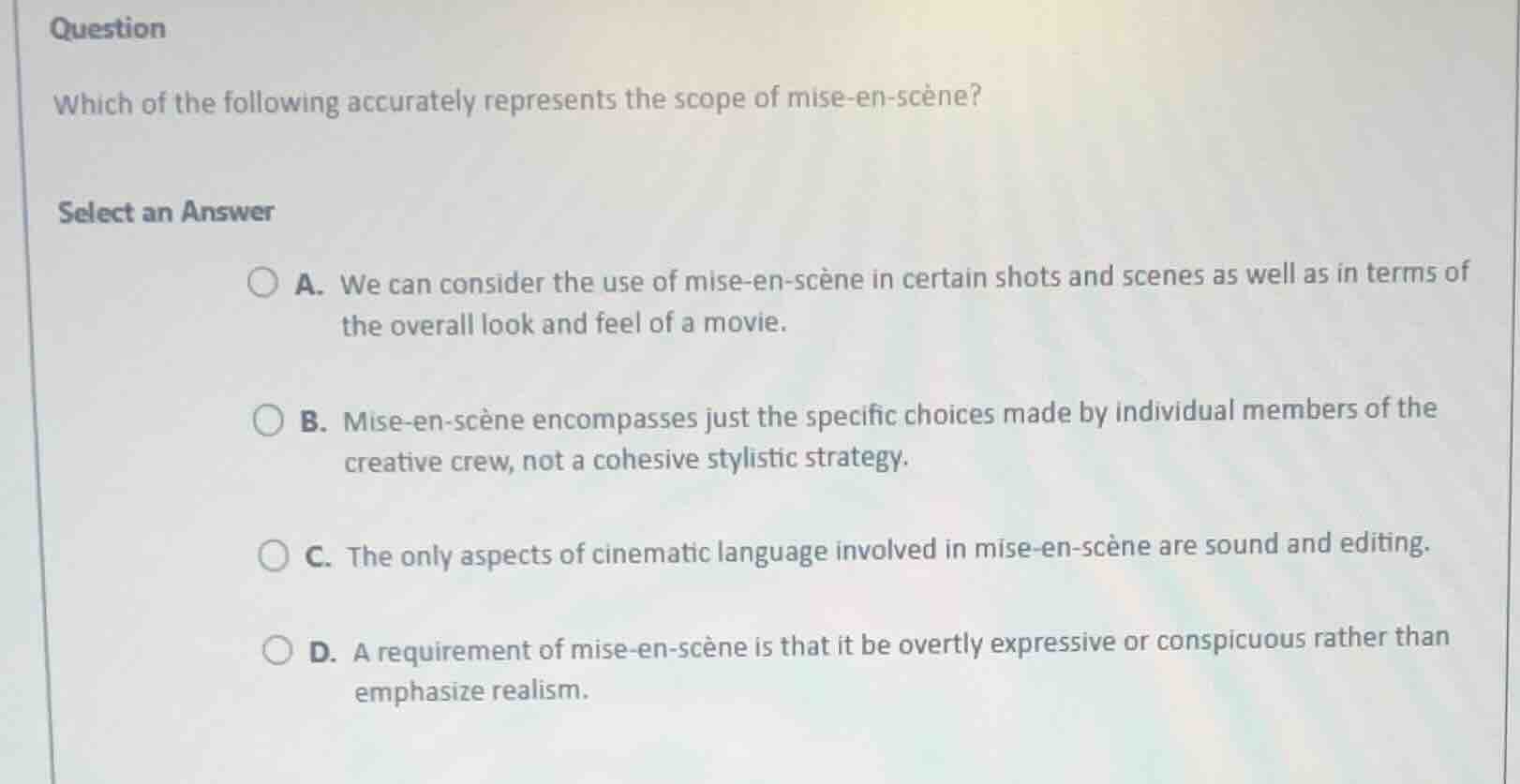
question which of the following accurately represents the scope of mise…

Question

question

which of the following accurately represents the scope of mise-en-scène?

select an answer

a. we can consider the use of mise-en-scène in certain shots and scenes as well as in terms of the overall look and feel of a movie.

b. mise-en-scène encompasses just the specific choices made by individual members of the creative crew, not a cohesive stylistic strategy.

c. the only aspects of cinematic language involved in mise-en-scène are sound and editing.

d. a requirement of mise-en-scène is that it be overtly expressive or conspicuous rather than emphasize realism.

Explanation:

Response

<pre_analysis>
{
"quality": "clear",
"question_count": 1,
"skills_matched": [
"direct_cot",
"multiple_choice_formatter",
"explain_then_answer",
"tutor"
],
"needs_drawing": false,
"concepts_used": [],
"new_concepts": [
"Mise-en-scène",
"Cinematic Language",
"Film Analysis"
],
"current_concepts": [
"Mise-en-scène",
"Cinematic Language",
"Film Analysis"
]
}
</pre_analysis>

<reasoning>

Define mise-en-scène

Mise-en-scène refers to everything that appears before the camera. This includes composition, sets, props, actors, costumes, and lighting.

Analyze the scope of the term

Mise-en-scène can be analyzed in individual shots or scenes. It also establishes the overall visual style and feel of an entire film.

Evaluate Option A

Option A states we can consider it in specific shots/scenes and overall look. This accurately reflects its micro and macro scope in film analysis.

Evaluate Option B

Option B claims it is just individual choices, not a cohesive strategy. This is incorrect because mise-en-scène is highly coordinated to create a unified style.

Evaluate Options C and D

Option C is incorrect because sound and editing are separate from mise-en-scène. Option D is incorrect because mise-en-scène can be highly realistic and subtle.
</reasoning>

<answer>
<mcq-correct>A. We can consider the use of mise-en-scène in certain shots and scenes as well as in terms of the overall look and feel of a movie.</mcq-correct>
<mcq-option>B. Mise-en-scène encompasses just the specific choices made by individual members of the creative crew, not a cohesive stylistic strategy.</mcq-option>
<mcq-option>C. The only aspects of cinematic language involved in mise-en-scène are sound and editing.</mcq-option>
<mcq-option>D. A requirement of mise-en-scène is that it be overtly expressive or conspicuous rather than emphasize realism.</mcq-option>
</answer>

<post_analysis>
{
"subject": "Arts",
"question_type": "Multiple Choice",
"knowledge_point": [
"Arts",
"Film Studies",
"Mise-en-scène"
]
}
</post_analysis>

Answer:

<pre_analysis>
{
"quality": "clear",
"question_count": 1,
"skills_matched": [
"direct_cot",
"multiple_choice_formatter",
"explain_then_answer",
"tutor"
],
"needs_drawing": false,
"concepts_used": [],
"new_concepts": [
"Mise-en-scène",
"Cinematic Language",
"Film Analysis"
],
"current_concepts": [
"Mise-en-scène",
"Cinematic Language",
"Film Analysis"
]
}
</pre_analysis>

<reasoning>

Define mise-en-scène

Mise-en-scène refers to everything that appears before the camera. This includes composition, sets, props, actors, costumes, and lighting.

Analyze the scope of the term

Mise-en-scène can be analyzed in individual shots or scenes. It also establishes the overall visual style and feel of an entire film.

Evaluate Option A

Option A states we can consider it in specific shots/scenes and overall look. This accurately reflects its micro and macro scope in film analysis.

Evaluate Option B

Option B claims it is just individual choices, not a cohesive strategy. This is incorrect because mise-en-scène is highly coordinated to create a unified style.

Evaluate Options C and D

Option C is incorrect because sound and editing are separate from mise-en-scène. Option D is incorrect because mise-en-scène can be highly realistic and subtle.
</reasoning>

<answer>
<mcq-correct>A. We can consider the use of mise-en-scène in certain shots and scenes as well as in terms of the overall look and feel of a movie.</mcq-correct>
<mcq-option>B. Mise-en-scène encompasses just the specific choices made by individual members of the creative crew, not a cohesive stylistic strategy.</mcq-option>
<mcq-option>C. The only aspects of cinematic language involved in mise-en-scène are sound and editing.</mcq-option>
<mcq-option>D. A requirement of mise-en-scène is that it be overtly expressive or conspicuous rather than emphasize realism.</mcq-option>
</answer>

<post_analysis>
{
"subject": "Arts",
"question_type": "Multiple Choice",
"knowledge_point": [
"Arts",
"Film Studies",
"Mise-en-scène"
]
}
</post_analysis>