QUESTION IMAGE
Question
question 3
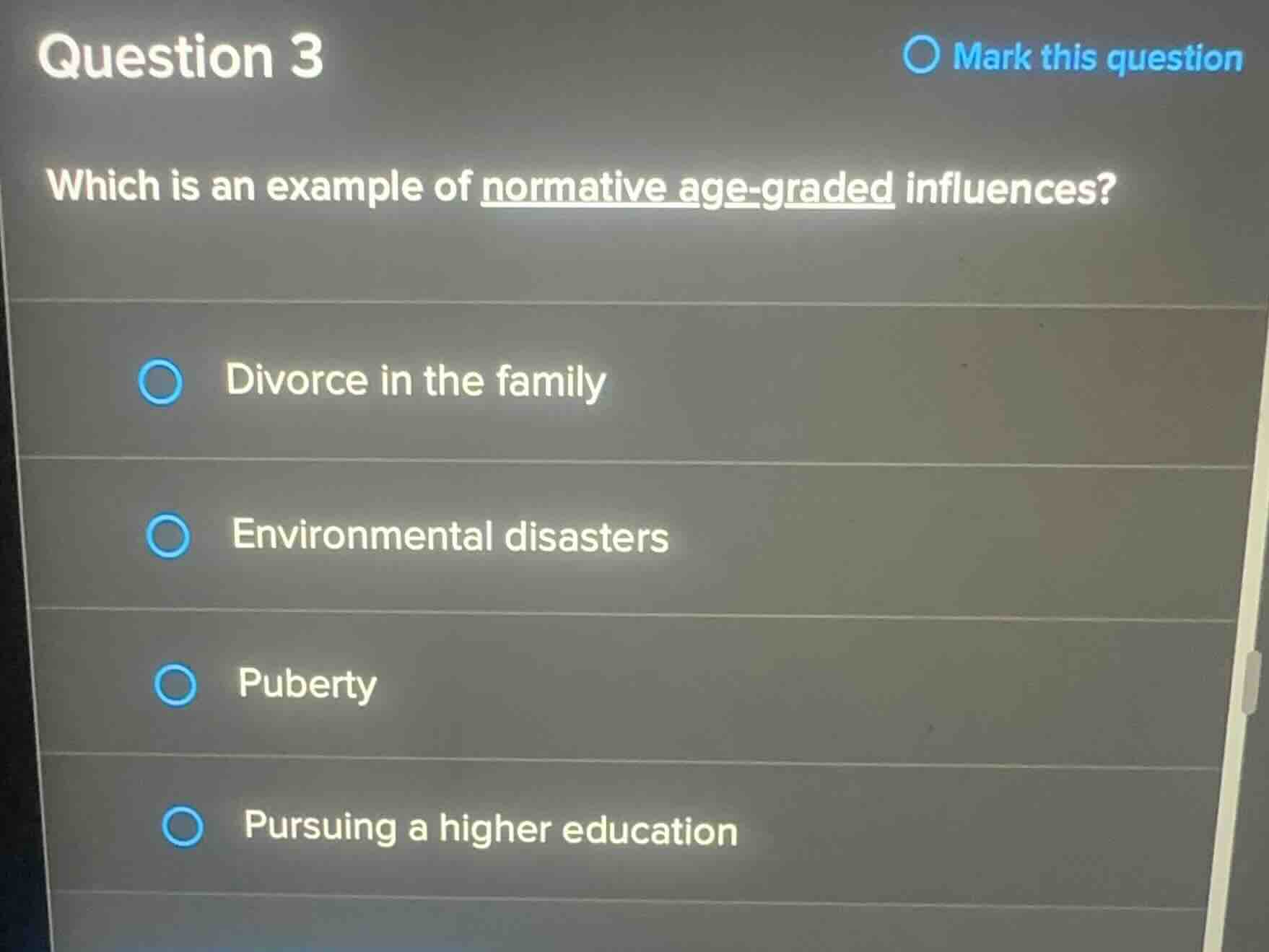
which is an example of normative age-graded influences?
divorce in the family
environmental disasters
puberty
pursuing a higher education
Define developmental influences
In Life Span Development, Paul Baltes identifies three types of influences that shape human development: normative age-graded, normative history-graded, and nonnormative life events.
Analyze age-graded influences
Normative age-graded influences are biological and environmental factors that have a strong correlation with chronological age. They are highly predictable and experienced by most individuals in a similar age group (e.g., puberty, menopause, starting formal school).
Evaluate the given options
- Divorce in the family: This is a nonnormative life event because it does not happen to everyone and has no set chronological timing.
- Environmental disasters: This is a normative history-graded influence because it affects a whole cohort/generation living through the event at a specific historical time.
- Puberty: This is a biological milestone that occurs predictably at a specific age range for almost all humans, making it a classic normative age-graded influence.
- Pursuing a higher education: While common, this is not universally experienced by everyone in an age group and is highly dependent on individual choice, making it nonnormative or socio-culturally variable rather than strictly age-graded.

Snap & solve any problem in the app
Get step-by-step solutions on Sovi AI
Photo-based solutions with guided steps
Explore more problems and detailed explanations
- (A) Divorce in the family
- (B) Environmental disasters
- (C) Puberty (Correct answer)
- (D) Pursuing a higher education