Sovi.AI - AI Math Tutor

Scan to solve math questions

QUESTION IMAGE

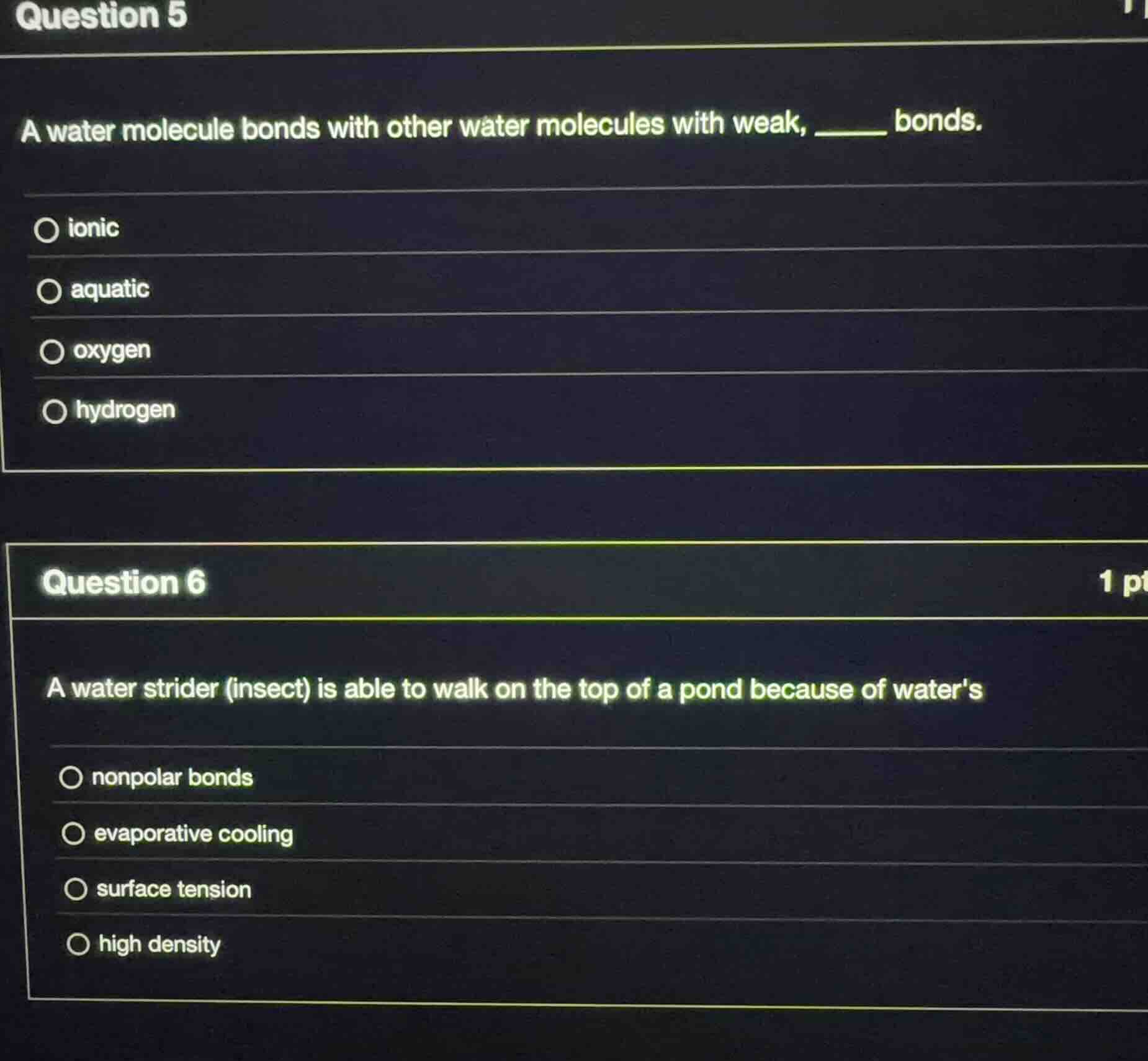
question 5 a water molecule bonds with other water molecules with weak,…

Question

question 5
a water molecule bonds with other water molecules with weak, ______ bonds.
ionic
aquatic
oxygen
hydrogen

question 6
a water strider (insect) is able to walk on the top of a pond because of waters
nonpolar bonds
evaporative cooling
surface tension
high density

Explanation:

Response

<pre_analysis>
{
"quality": "clear",
"question_count": 2,
"skills_matched": [
"direct_cot",
"multiple_choice_formatter",
"explain_then_answer",
"quick"
],
"needs_drawing": false,
"concepts_used": [
"Hydrogen Bonding",
"Properties of Water",
"Cohesion"
],
"new_concepts": [
"Surface Tension"
],
"current_concepts": [
"Hydrogen Bonding",
"Properties of Water",
"Cohesion",
"Surface Tension"
]
}
</pre_analysis>

<reasoning>

Analyze intermolecular bonding in water

The first question asks about the weak bonds that form between different water molecules. Water molecules are polar, with a partial negative charge on oxygen and a partial positive charge on hydrogen. This polarity allows the partially positive hydrogen of one water molecule to attract the partially negative oxygen of an adjacent water molecule, forming a weak intermolecular attraction known as a hydrogen bond.

Analyze surface properties of water

The second question asks why a water strider can walk on top of a pond. This phenomenon is due to the cohesive forces between water molecules at the liquid-gas interface, which create a "film" on the surface. This property is called surface tension, allowing the surface of the water to resist external forces.
</reasoning>

<answer>

Question 5

<mcq-option>ionic</mcq-option>
<mcq-option>aquatic</mcq-option>
<mcq-option>oxygen</mcq-option>
<mcq-correct>hydrogen</mcq-correct>

Question 6

<mcq-option>nonpolar bonds</mcq-option>
<mcq-option>evaporative cooling</mcq-correct>
<mcq-correct>surface tension</mcq-correct>
<mcq-option>high density</mcq-option>
</answer>

<post_analysis>
{
"subject": "Natural Science",
"question_type": "Multiple Choice",
"knowledge_point": [
"Natural Science",
"Biology",
"Properties of Water"
]
}
</post_analysis>

Answer:

<pre_analysis>
{
"quality": "clear",
"question_count": 2,
"skills_matched": [
"direct_cot",
"multiple_choice_formatter",
"explain_then_answer",
"quick"
],
"needs_drawing": false,
"concepts_used": [
"Hydrogen Bonding",
"Properties of Water",
"Cohesion"
],
"new_concepts": [
"Surface Tension"
],
"current_concepts": [
"Hydrogen Bonding",
"Properties of Water",
"Cohesion",
"Surface Tension"
]
}
</pre_analysis>

<reasoning>

Analyze intermolecular bonding in water

The first question asks about the weak bonds that form between different water molecules. Water molecules are polar, with a partial negative charge on oxygen and a partial positive charge on hydrogen. This polarity allows the partially positive hydrogen of one water molecule to attract the partially negative oxygen of an adjacent water molecule, forming a weak intermolecular attraction known as a hydrogen bond.

Analyze surface properties of water

The second question asks why a water strider can walk on top of a pond. This phenomenon is due to the cohesive forces between water molecules at the liquid-gas interface, which create a "film" on the surface. This property is called surface tension, allowing the surface of the water to resist external forces.
</reasoning>

<answer>

Question 5

<mcq-option>ionic</mcq-option>
<mcq-option>aquatic</mcq-option>
<mcq-option>oxygen</mcq-option>
<mcq-correct>hydrogen</mcq-correct>

Question 6

<mcq-option>nonpolar bonds</mcq-option>
<mcq-option>evaporative cooling</mcq-correct>
<mcq-correct>surface tension</mcq-correct>
<mcq-option>high density</mcq-option>
</answer>

<post_analysis>
{
"subject": "Natural Science",
"question_type": "Multiple Choice",
"knowledge_point": [
"Natural Science",
"Biology",
"Properties of Water"
]
}
</post_analysis>