Sovi.AI - AI Math Tutor

Scan to solve math questions

QUESTION IMAGE

question 5: there are 4 cards in a pile with 4 different suits: diamond…

Question

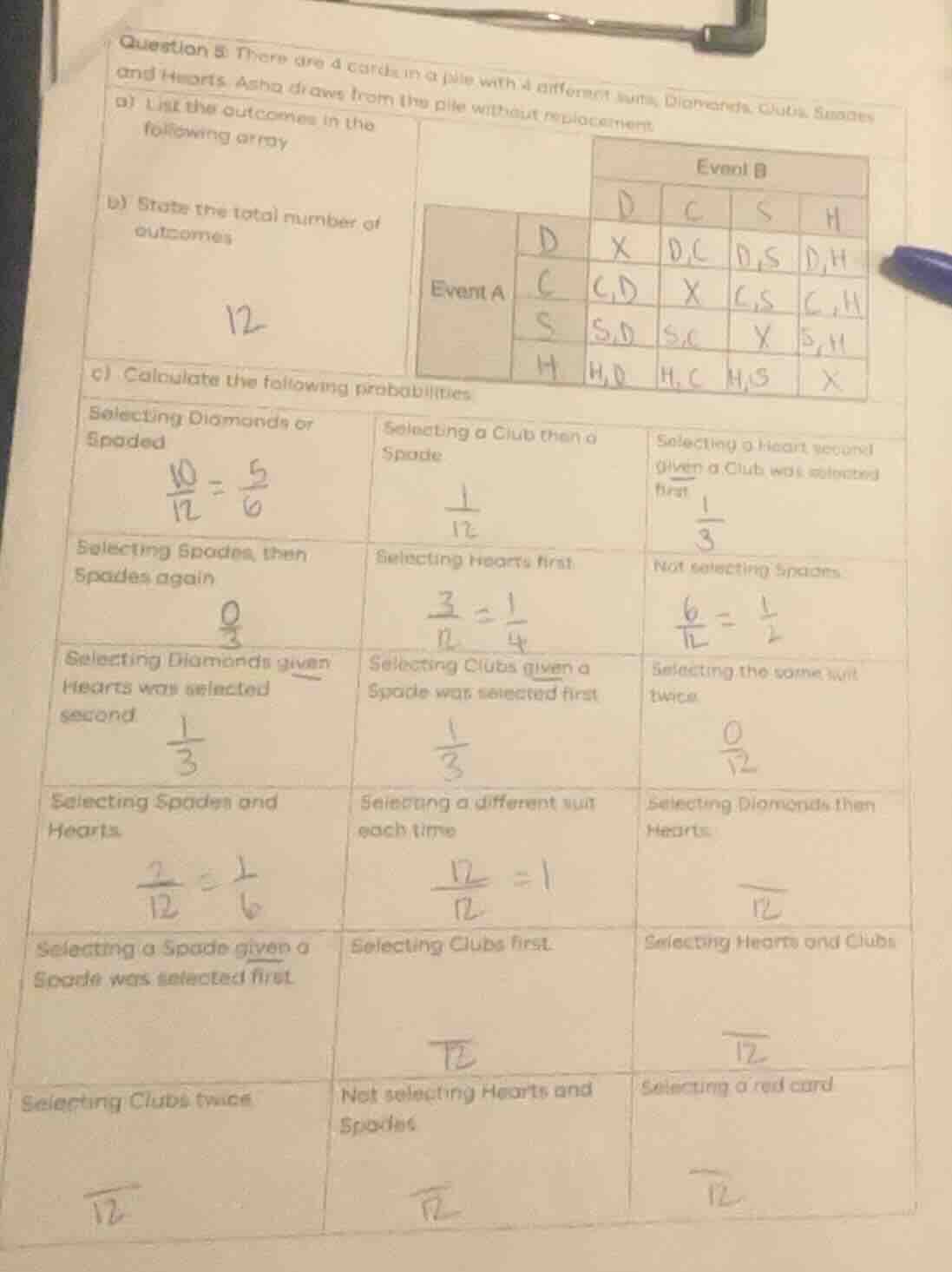
question 5: there are 4 cards in a pile with 4 different suits: diamonds, clubs, spades and hearts. asha draws from the pile without replacement.
a) list the outcomes in the following array
b) state the total number of outcomes
c) calculate the following probabilities:

  • selecting diamonds or spades
  • selecting a club then a spade
  • selecting a heart second given a club was selected first
  • selecting spades, then spades again
  • selecting hearts first
  • not selecting spades
  • selecting diamonds given hearts was selected second
  • selecting clubs given a spade was selected first
  • selecting the same suit twice
  • selecting spades and hearts
  • selecting a different suit each time
  • selecting diamonds then hearts
  • selecting a spade given a spade was selected first
  • selecting clubs first
  • selecting hearts and clubs
  • selecting clubs twice
  • not selecting hearts and spades
  • selecting a red card

Explanation:

Response

<pre_analysis>
{
"quality": "clear",
"question_count": 8,
"skills_matched": [
"step_cot",
"table_formatter",
"explain_then_answer",
"tutor"
],
"needs_drawing": false,
"concepts_used": [],
"new_concepts": [
"Probability without Replacement",
"Conditional Probability",
"Sample Space Outcomes"
],
"current_concepts": [
"Probability without Replacement",
"Conditional Probability",
"Sample Space Outcomes"
]
}
</pre_analysis>

<reasoning>

Identify sample space and outcomes

The experiment consists of drawing two cards from a pile of 4 cards (Diamonds \(D\), Clubs \(C\), Spades \(S\), Hearts \(H\)) without replacement.
The total number of outcomes in the sample space is \(4 \times 3 = 12\).
The 12 equally likely outcomes are:
\[
S = \{ (D,C), (D,S), (D,H), (C,D), (C,S), (C,H), (S,D), (S,C), (S,H), (H,D), (H,C), (H,S) \}
\]

Calculate probabilities for the first row of empty cells

  • Selecting a Spade given a Spade was selected first:

Since drawing is without replacement, if a Spade is selected first, it cannot be selected second. Thus, the probability is:
\[
P(\text{Spade second} \mid \text{Spade first}) = \frac{0}{3} = 0
\]

  • Selecting Clubs first:

The outcomes where a Club is selected first are \((C,D), (C,S), (C,H)\). There are 3 such outcomes out of 12:
\[
P(\text{Clubs first}) = \frac{3}{12} = \frac{1}{4}
\]

  • Selecting Hearts and Clubs:

This event means selecting one Heart and one Club in any order. The favorable outcomes are \((C,H)\) and \((H,C)\). There are 2 such outcomes:
\[
P(\text{Hearts and Clubs}) = \frac{2}{12} = \frac{1}{6}
\]

Calculate probabilities for the second row of empty cells

  • Selecting Clubs twice:

Since drawing is without replacement, we cannot select the same card twice:
\[
P(\text{Clubs twice}) = \frac{0}{12} = 0
\]

  • Not selecting Hearts and Spades:

This means we do not select a combination containing both a Heart and a Spade. The outcomes containing both are \((S,H)\) and \((H,S)\) (2 outcomes).
The remaining outcomes are \(12 - 2 = 10\):
\[
P(\text{Not selecting Hearts and Spades}) = \frac{10}{12} = \frac{5}{6}
\]

  • Selecting a red card:

The red suits are Diamonds (\(D\)) and Hearts (\(H\)). A "red card" here refers to the final outcome being a red card, which is typically interpreted as the card selected second or both cards being red depending on the context. However, standard convention for "selecting a red card" in a two-stage draw refers to the final card drawn, or drawing a red card on a single draw. Let's look at the probability of drawing a red card on the second draw:
Out of 12 outcomes, those ending in \(D\) or \(H\) are: \((C,D), (S,D), (H,D), (D,H), (C,H), (S,H)\). There are 6 such outcomes:
\[
P(\text{Red second}) = \frac{6}{12} = \frac{1}{2}
\]
Alternatively, if it means the first card is red: outcomes starting with \(D\) or \(H\) are 6 outcomes:
\[
P(\text{Red first}) = \frac{6}{12} = \frac{1}{2}
\]
In either case, the probability is \(\frac{1}{2}\).
</reasoning>

<answer>

No.ProblemAnswer
2Selecting Clubs first\(\frac{3}{12} = \frac{1}{4}\)
3Selecting Hearts and Clubs\(\frac{2}{12} = \frac{1}{6}\)
4Selecting Clubs twice\(\frac{0}{12} = 0\)
5Not selecting Hearts and Spades\(\frac{10}{12} = \frac{5}{6}\)
6Selecting a red card\(\frac{6}{12} = \frac{1}{2}\)

</answer>

<post_analysis>
{
"s…

Answer:

<pre_analysis>
{
"quality": "clear",
"question_count": 8,
"skills_matched": [
"step_cot",
"table_formatter",
"explain_then_answer",
"tutor"
],
"needs_drawing": false,
"concepts_used": [],
"new_concepts": [
"Probability without Replacement",
"Conditional Probability",
"Sample Space Outcomes"
],
"current_concepts": [
"Probability without Replacement",
"Conditional Probability",
"Sample Space Outcomes"
]
}
</pre_analysis>

<reasoning>

Identify sample space and outcomes

The experiment consists of drawing two cards from a pile of 4 cards (Diamonds \(D\), Clubs \(C\), Spades \(S\), Hearts \(H\)) without replacement.
The total number of outcomes in the sample space is \(4 \times 3 = 12\).
The 12 equally likely outcomes are:
\[
S = \{ (D,C), (D,S), (D,H), (C,D), (C,S), (C,H), (S,D), (S,C), (S,H), (H,D), (H,C), (H,S) \}
\]

Calculate probabilities for the first row of empty cells

  • Selecting a Spade given a Spade was selected first:

Since drawing is without replacement, if a Spade is selected first, it cannot be selected second. Thus, the probability is:
\[
P(\text{Spade second} \mid \text{Spade first}) = \frac{0}{3} = 0
\]

  • Selecting Clubs first:

The outcomes where a Club is selected first are \((C,D), (C,S), (C,H)\). There are 3 such outcomes out of 12:
\[
P(\text{Clubs first}) = \frac{3}{12} = \frac{1}{4}
\]

  • Selecting Hearts and Clubs:

This event means selecting one Heart and one Club in any order. The favorable outcomes are \((C,H)\) and \((H,C)\). There are 2 such outcomes:
\[
P(\text{Hearts and Clubs}) = \frac{2}{12} = \frac{1}{6}
\]

Calculate probabilities for the second row of empty cells

  • Selecting Clubs twice:

Since drawing is without replacement, we cannot select the same card twice:
\[
P(\text{Clubs twice}) = \frac{0}{12} = 0
\]

  • Not selecting Hearts and Spades:

This means we do not select a combination containing both a Heart and a Spade. The outcomes containing both are \((S,H)\) and \((H,S)\) (2 outcomes).
The remaining outcomes are \(12 - 2 = 10\):
\[
P(\text{Not selecting Hearts and Spades}) = \frac{10}{12} = \frac{5}{6}
\]

  • Selecting a red card:

The red suits are Diamonds (\(D\)) and Hearts (\(H\)). A "red card" here refers to the final outcome being a red card, which is typically interpreted as the card selected second or both cards being red depending on the context. However, standard convention for "selecting a red card" in a two-stage draw refers to the final card drawn, or drawing a red card on a single draw. Let's look at the probability of drawing a red card on the second draw:
Out of 12 outcomes, those ending in \(D\) or \(H\) are: \((C,D), (S,D), (H,D), (D,H), (C,H), (S,H)\). There are 6 such outcomes:
\[
P(\text{Red second}) = \frac{6}{12} = \frac{1}{2}
\]
Alternatively, if it means the first card is red: outcomes starting with \(D\) or \(H\) are 6 outcomes:
\[
P(\text{Red first}) = \frac{6}{12} = \frac{1}{2}
\]
In either case, the probability is \(\frac{1}{2}\).
</reasoning>

<answer>

No.ProblemAnswer
2Selecting Clubs first\(\frac{3}{12} = \frac{1}{4}\)
3Selecting Hearts and Clubs\(\frac{2}{12} = \frac{1}{6}\)
4Selecting Clubs twice\(\frac{0}{12} = 0\)
5Not selecting Hearts and Spades\(\frac{10}{12} = \frac{5}{6}\)
6Selecting a red card\(\frac{6}{12} = \frac{1}{2}\)

</answer>

<post_analysis>
{
"subject": "Mathematics",
"question_type": "Fill-in-the-blank",
"knowledge_point": [
"Mathematics",
"Statistics",
"Conditional Probability"
]
}
</post_analysis>