QUESTION IMAGE
Question
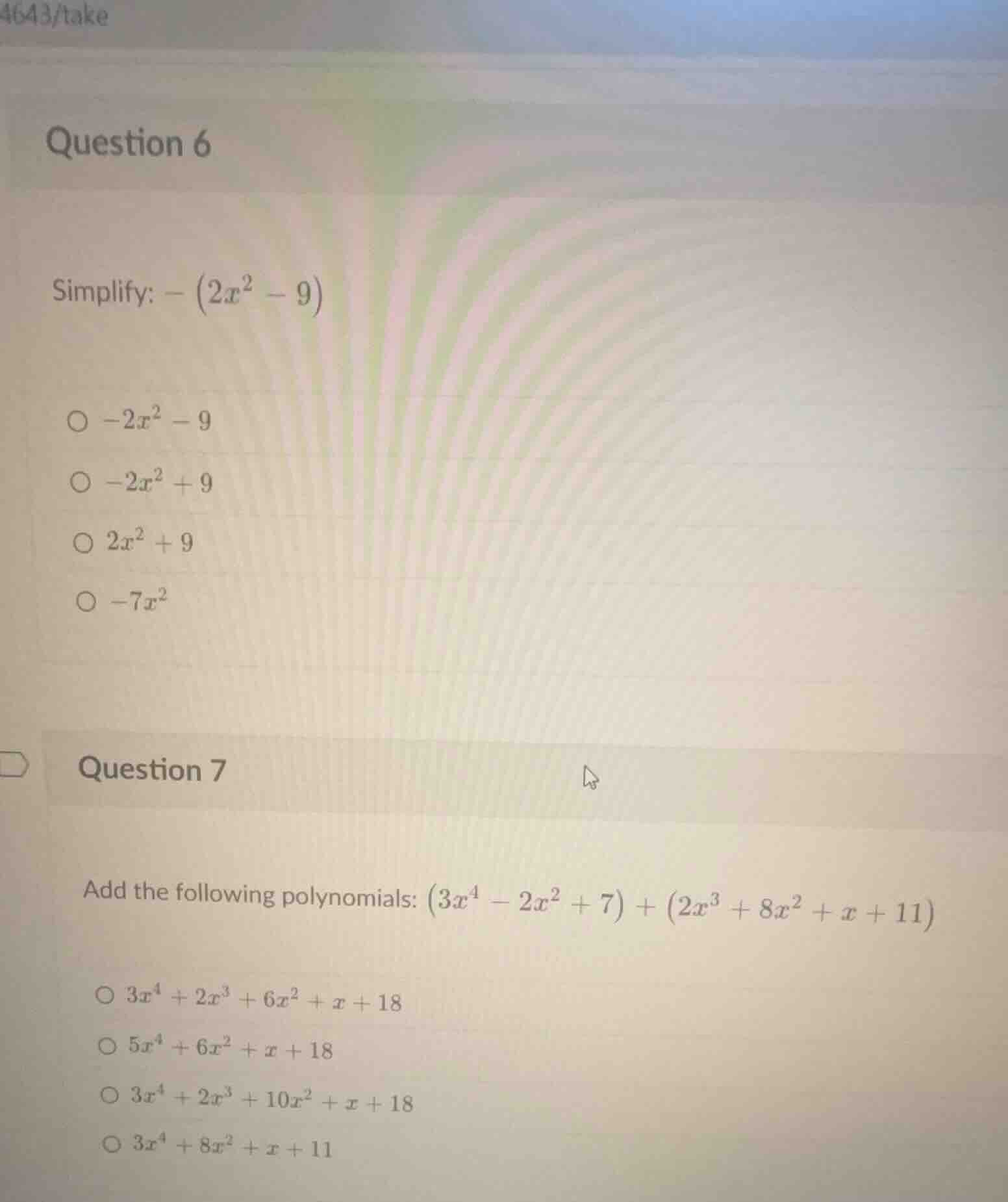
question 6
simplify: \\(-\left(2x^2 - 9\
ight)\\)
\\(\bigcirc -2x^2 - 9\\)
\\(\bigcirc -2x^2 + 9\\)
\\(\bigcirc 2x^2 + 9\\)
\\(\bigcirc -7x^2\\)
question 7
add the following polynomials: \\(\left(3x^4 - 2x^2 + 7\
ight) + \left(2x^3 + 8x^2 + x + 11\
ight)\\)
\\(\bigcirc 3x^4 + 2x^3 + 6x^2 + x + 18\\)
\\(\bigcirc 5x^4 + 6x^2 + x + 18\\)
\\(\bigcirc 3x^4 + 2x^3 + 10x^2 + x + 18\\)
\\(\bigcirc 3x^4 + 8x^2 + x + 11\\)
<pre_analysis>
{
"quality": "clear",
"question_count": 2,
"skills_matched": [
"step_cot",
"multiple_choice_formatter",
"explain_then_answer",
"tutor",
"mastery_adaptive_brevity"
],
"needs_drawing": false,
"concepts_used": [
"Combining Like Terms",
"Polynomial Addition"
],
"new_concepts": [
"Distributive Property with Negative Sign",
"Polynomial Simplification"
],
"current_concepts": [
"Combining Like Terms",
"Polynomial Addition",
"Distributive Property with Negative Sign",
"Polynomial Simplification"
]
}
</pre_analysis>
<reasoning>
Distribute the negative sign
Using the Distributive Property with Negative Sign knowledge point
\[
-(2x^2 - 9) = -1 \cdot (2x^2) - 1 \cdot (-9) = -2x^2 + 9
\]
Group like terms for addition
Using the Polynomial Addition and Combining Like Terms knowledge points
\[
\]
Combine the coefficients
Using the Combining Like Terms knowledge point
\[
\]
</reasoning>
<answer>
Question 6
<mcq-option>(A) \(-2x^2 - 9\)</mcq-option>
<mcq-correct>(B) \(-2x^2 + 9\)</mcq-correct>
<mcq-option>(C) \(2x^2 + 9\)</mcq-option>
<mcq-option>(D) \(-7x^2\)</mcq-option>
Question 7
<mcq-correct>(A) \(3x^4 + 2x^3 + 6x^2 + x + 18\)</mcq-correct>
<mcq-option>(B) \(5x^4 + 6x^2 + x + 18\)</mcq-option>
<mcq-option>(C) \(3x^4 + 2x^3 + 10x^2 + x + 18\)</mcq-option>
<mcq-option>(D) \(3x^4 + 8x^2 + x + 11\)</mcq-option>
</answer>
<post_analysis>
{
"subject": "Mathematics",
"question_type": "Multiple Choice",
"knowledge_point": [
"Mathematics",
"Algebra",
"Polynomial Addition"
]
}
</post_analysis>
Snap & solve any problem in the app
Get step-by-step solutions on Sovi AI
Photo-based solutions with guided steps
Explore more problems and detailed explanations
<pre_analysis>
{
"quality": "clear",
"question_count": 2,
"skills_matched": [
"step_cot",
"multiple_choice_formatter",
"explain_then_answer",
"tutor",
"mastery_adaptive_brevity"
],
"needs_drawing": false,
"concepts_used": [
"Combining Like Terms",
"Polynomial Addition"
],
"new_concepts": [
"Distributive Property with Negative Sign",
"Polynomial Simplification"
],
"current_concepts": [
"Combining Like Terms",
"Polynomial Addition",
"Distributive Property with Negative Sign",
"Polynomial Simplification"
]
}
</pre_analysis>
<reasoning>
Distribute the negative sign
Using the Distributive Property with Negative Sign knowledge point
\[
-(2x^2 - 9) = -1 \cdot (2x^2) - 1 \cdot (-9) = -2x^2 + 9
\]
Group like terms for addition
Using the Polynomial Addition and Combining Like Terms knowledge points
\[
\]
Combine the coefficients
Using the Combining Like Terms knowledge point
\[
\]
</reasoning>
<answer>
Question 6
<mcq-option>(A) \(-2x^2 - 9\)</mcq-option>
<mcq-correct>(B) \(-2x^2 + 9\)</mcq-correct>
<mcq-option>(C) \(2x^2 + 9\)</mcq-option>
<mcq-option>(D) \(-7x^2\)</mcq-option>
Question 7
<mcq-correct>(A) \(3x^4 + 2x^3 + 6x^2 + x + 18\)</mcq-correct>
<mcq-option>(B) \(5x^4 + 6x^2 + x + 18\)</mcq-option>
<mcq-option>(C) \(3x^4 + 2x^3 + 10x^2 + x + 18\)</mcq-option>
<mcq-option>(D) \(3x^4 + 8x^2 + x + 11\)</mcq-option>
</answer>
<post_analysis>
{
"subject": "Mathematics",
"question_type": "Multiple Choice",
"knowledge_point": [
"Mathematics",
"Algebra",
"Polynomial Addition"
]
}
</post_analysis>