QUESTION IMAGE
Question
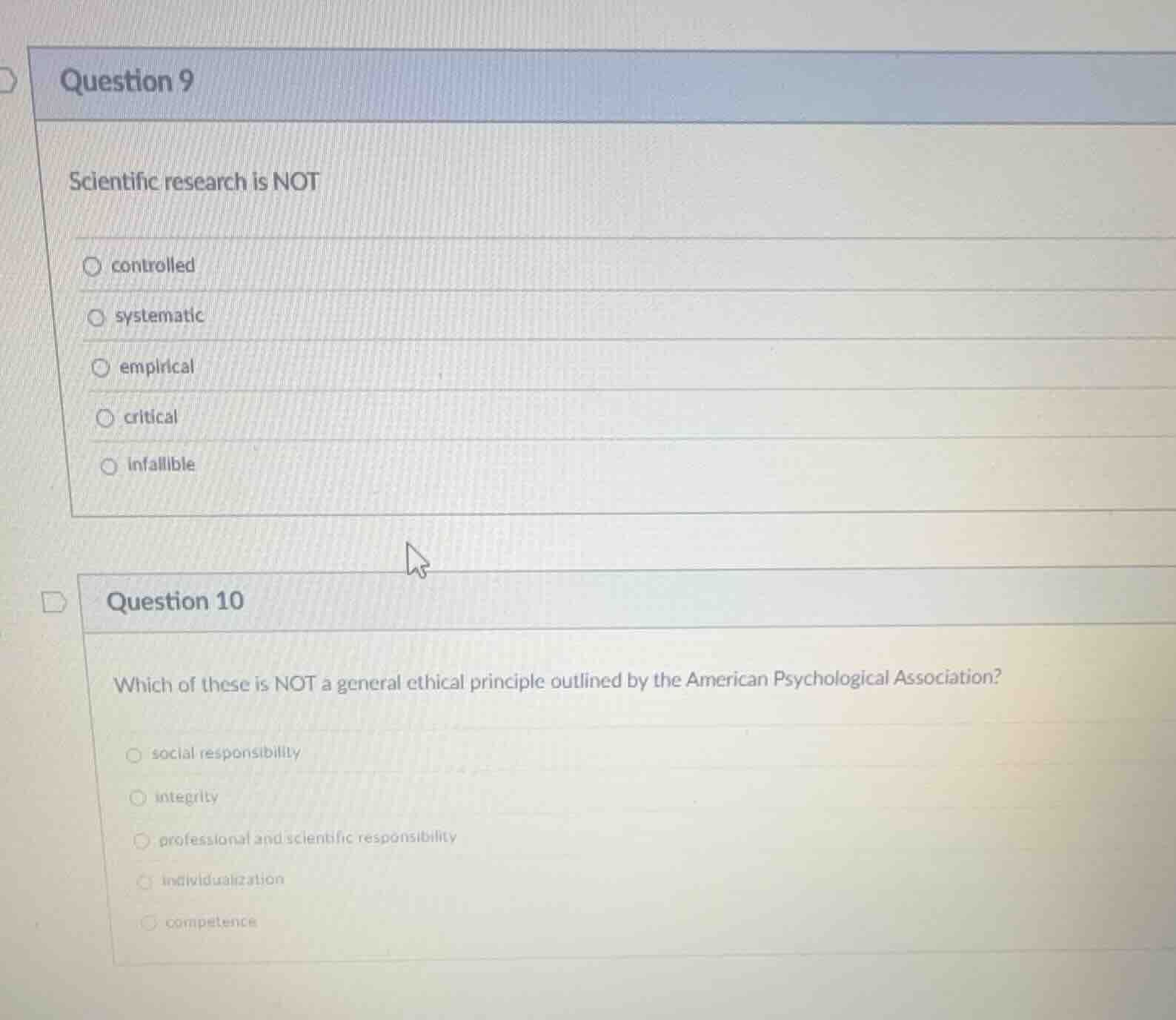
question 9
scientific research is not
controlled
systematic
empirical
critical
infallible
question 10
which of these is not a general ethical principle outlined by the american psychological association?
social responsibility
integrity
professional and scientific responsibility
individualization
competence
Analyze characteristics of scientific research
Using the Methods of Acquiring Knowledge knowledge point, scientific research is a structured process. It is defined as being controlled, systematic, empirical, and critical. However, science is never considered infallible, as all scientific knowledge is open to revision and refutation.
Identify the incorrect scientific characteristic
Since scientific research is tentative and subject to change, it is NOT infallible. Therefore, "infallible" is the correct choice for Question 9.
Analyze APA general ethical principles
The American Psychological Association (APA) outlines five core ethical principles: Beneficence and Nonmaleficence, Fidelity and Responsibility, Integrity, Justice, and Respect for People's Rights and Dignity. In some older or specific sub-field adaptations (such as sport psychology), these are summarized as competence, integrity, professional and scientific responsibility, respect for people's rights and dignity, concern for others' welfare, and social responsibility.
Identify the non-APA ethical principle
Among the options provided, "individualization" is not a recognized general ethical principle outlined by the APA. Therefore, "individualization" is the correct choice for Question 10.

Snap & solve any problem in the app
Get step-by-step solutions on Sovi AI
Photo-based solutions with guided steps
Explore more problems and detailed explanations
Question 9
- controlled
- systematic
- empirical
- critical
- infallible (Correct answer)
Question 10
- social responsibility
- integrity
- professional and scientific responsibility
- individualization (Correct answer)
- competence