Sovi.AI - AI Math Tutor

Scan to solve math questions

QUESTION IMAGE

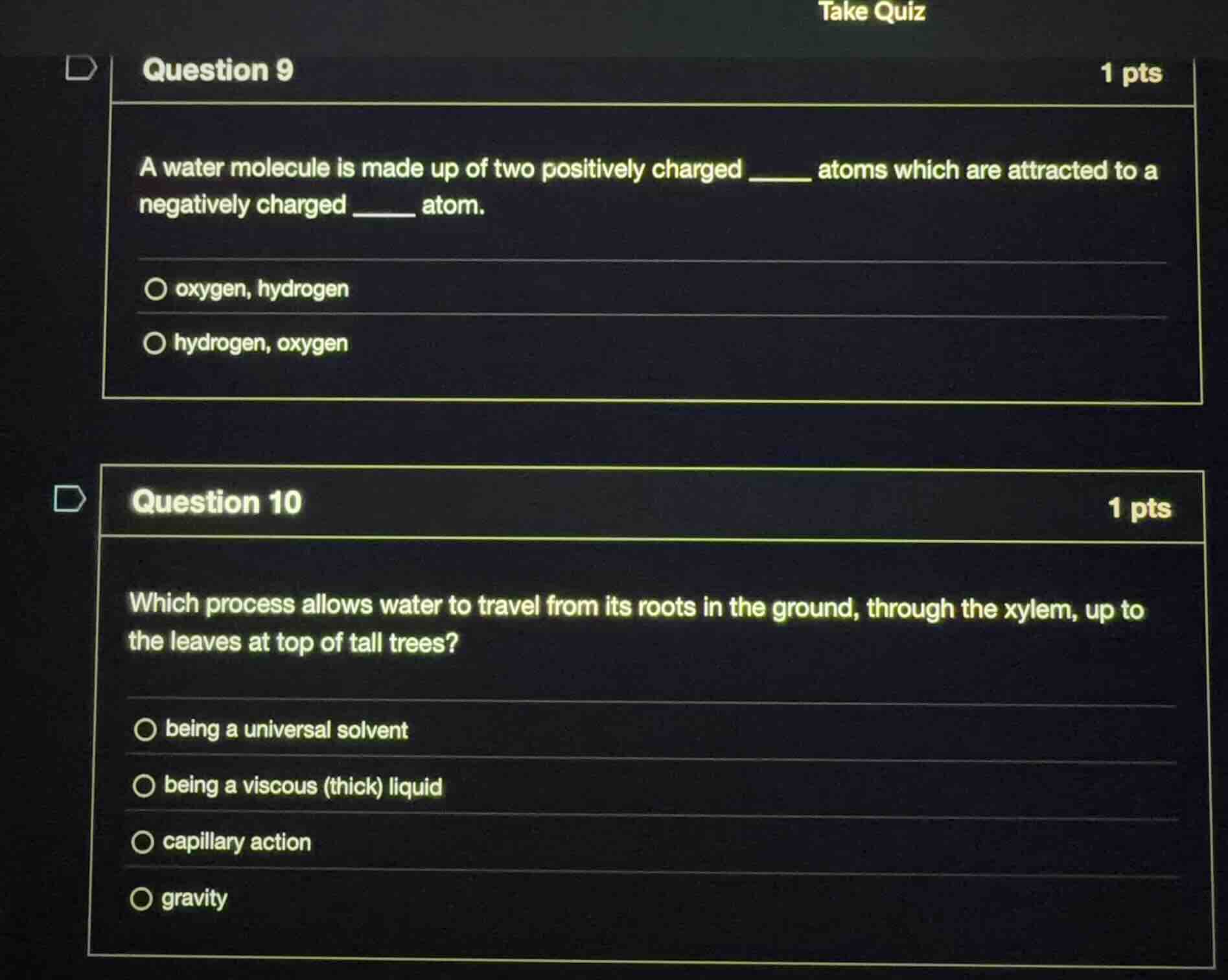
question 9 1 pts a water molecule is made up of two positively charged …

Question

question 9
1 pts
a water molecule is made up of two positively charged ___ atoms which are attracted to a negatively charged ___ atom.

oxygen, hydrogen
hydrogen, oxygen

question 10
1 pts
which process allows water to travel from its roots in the ground, through the xylem, up to the leaves at top of tall trees?

being a universal solvent
being a viscous (thick) liquid
capillary action
gravity

Explanation:

Response

<pre_analysis>
{
"quality": "clear",
"question_count": 2,
"skills_matched": [
"direct_cot",
"multiple_choice_formatter",
"explain_then_answer",
"quick"
],
"needs_drawing": false,
"concepts_used": [
"Polarity of Water",
"Adhesion and Cohesion"
],
"new_concepts": [],
"current_concepts": [
"Polarity of Water",
"Adhesion and Cohesion",
"Properties of Water"
]
}
</pre_analysis>

<reasoning>

Analyze Question 9

The chemical formula for water is \(H_2O\). It consists of two hydrogen atoms and one oxygen atom. Due to differences in electronegativity, the hydrogen atoms carry a partial positive charge, while the oxygen atom carries a partial negative charge. Therefore, the two positively charged atoms are hydrogen, and the negatively charged atom is oxygen.

Analyze Question 10

Water travels upward through the xylem of tall trees against gravity. This movement is driven by transpiration pull and facilitated by capillary action, which relies on the cohesive forces between water molecules and adhesive forces between water molecules and the xylem walls. Among the choices, capillary action is the process that directly describes this movement.
</reasoning>

<answer>

Question 9

<mcq-option>oxygen, hydrogen</mcq-option>
<mcq-correct>hydrogen, oxygen</mcq-correct>

Question 10

<mcq-option>being a universal solvent</mcq-option>
<mcq-option>being a viscous (thick) liquid</mcq-option>
<mcq-correct>capillary action</mcq-correct>
<mcq-option>gravity</mcq-option>
</answer>

<post_analysis>
{
"subject": "Natural Science",
"question_type": "Multiple Choice",
"knowledge_point": [
"Natural Science",
"Biology",
"Properties of Water"
]
}
</post_analysis>

Answer:

<pre_analysis>
{
"quality": "clear",
"question_count": 2,
"skills_matched": [
"direct_cot",
"multiple_choice_formatter",
"explain_then_answer",
"quick"
],
"needs_drawing": false,
"concepts_used": [
"Polarity of Water",
"Adhesion and Cohesion"
],
"new_concepts": [],
"current_concepts": [
"Polarity of Water",
"Adhesion and Cohesion",
"Properties of Water"
]
}
</pre_analysis>

<reasoning>

Analyze Question 9

The chemical formula for water is \(H_2O\). It consists of two hydrogen atoms and one oxygen atom. Due to differences in electronegativity, the hydrogen atoms carry a partial positive charge, while the oxygen atom carries a partial negative charge. Therefore, the two positively charged atoms are hydrogen, and the negatively charged atom is oxygen.

Analyze Question 10

Water travels upward through the xylem of tall trees against gravity. This movement is driven by transpiration pull and facilitated by capillary action, which relies on the cohesive forces between water molecules and adhesive forces between water molecules and the xylem walls. Among the choices, capillary action is the process that directly describes this movement.
</reasoning>

<answer>

Question 9

<mcq-option>oxygen, hydrogen</mcq-option>
<mcq-correct>hydrogen, oxygen</mcq-correct>

Question 10

<mcq-option>being a universal solvent</mcq-option>
<mcq-option>being a viscous (thick) liquid</mcq-option>
<mcq-correct>capillary action</mcq-correct>
<mcq-option>gravity</mcq-option>
</answer>

<post_analysis>
{
"subject": "Natural Science",
"question_type": "Multiple Choice",
"knowledge_point": [
"Natural Science",
"Biology",
"Properties of Water"
]
}
</post_analysis>