QUESTION IMAGE
Question
question 1
1 pts
(03.01 mc)
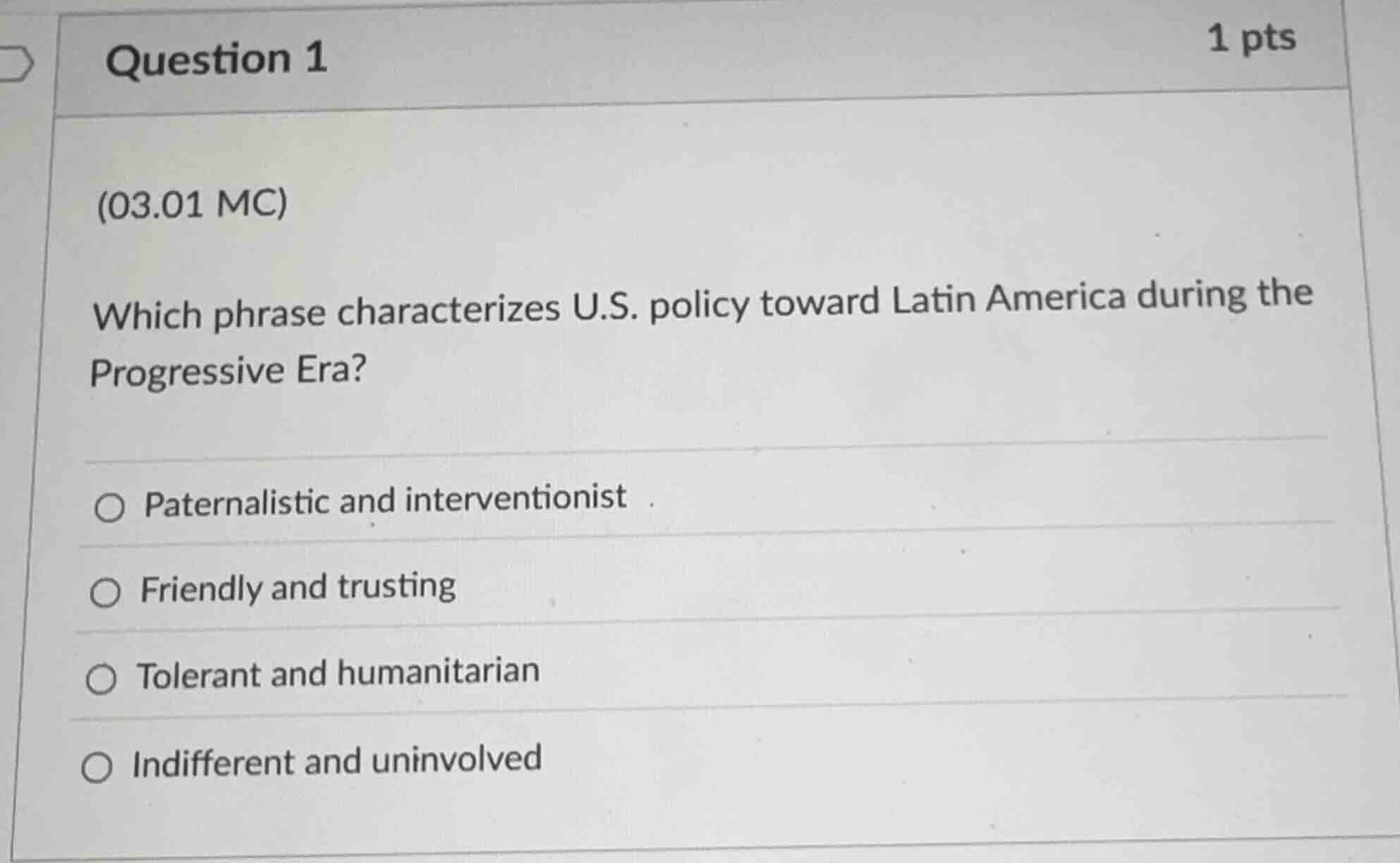
which phrase characterizes u.s. policy toward latin america during the progressive era?
paternalistic and interventionist
friendly and trusting
tolerant and humanitarian
indifferent and uninvolved
Analyze the historical context of the Progressive Era
During the Progressive Era (roughly the 1890s to the 1920s), domestic Progressive Era Reforms aimed at improving society and regulating big business were accompanied by a highly active and assertive foreign policy, particularly in Latin America and the Caribbean.
Examine key presidential foreign policies
Three successive Progressive presidents shaped U.S. policy toward Latin America:
- Theodore Roosevelt implemented "Big Stick Diplomacy" and the Roosevelt Corollary to the Monroe Doctrine, asserting the right of the U.S. to act as an "international police power" in Latin America.
- William Howard Taft pursued "Dollar Diplomacy," using American economic leverage and financial investments to influence Latin American nations.
- Woodrow Wilson championed "Moral Diplomacy," but frequently used military force to intervene in nations like Mexico, Haiti, and the Dominican Republic to promote governments aligned with U.S. interests.
Characterize the nature of these policies
These foreign policies were characterized by:
- Paternalism: The belief that Latin American nations were politically unstable or underdeveloped and required U.S. guidance, supervision, and control.
- Interventionism: Frequent military, political, and economic interventions to protect American business interests, secure debt payments, and maintain regional stability.
Evaluate the given options
- Paternalistic and interventionist: This accurately describes the combination of military interventions, financial takeovers, and the belief that the U.S. needed to guide Latin American nations.
- Friendly and trusting: Incorrect, as relations were often tense and marked by mutual suspicion due to unilateral U.S. actions.
- Tolerant and humanitarian: Incorrect, as U.S. actions primarily prioritized strategic and economic interests over local self-determination.
- Indifferent and uninvolved: Incorrect, as this was a period of intense U.S. involvement, not isolationism.

Snap & solve any problem in the app
Get step-by-step solutions on Sovi AI
Photo-based solutions with guided steps
Explore more problems and detailed explanations
- Paternalistic and interventionist (Correct answer)
- Friendly and trusting
- Tolerant and humanitarian
- Indifferent and uninvolved