QUESTION IMAGE
Question
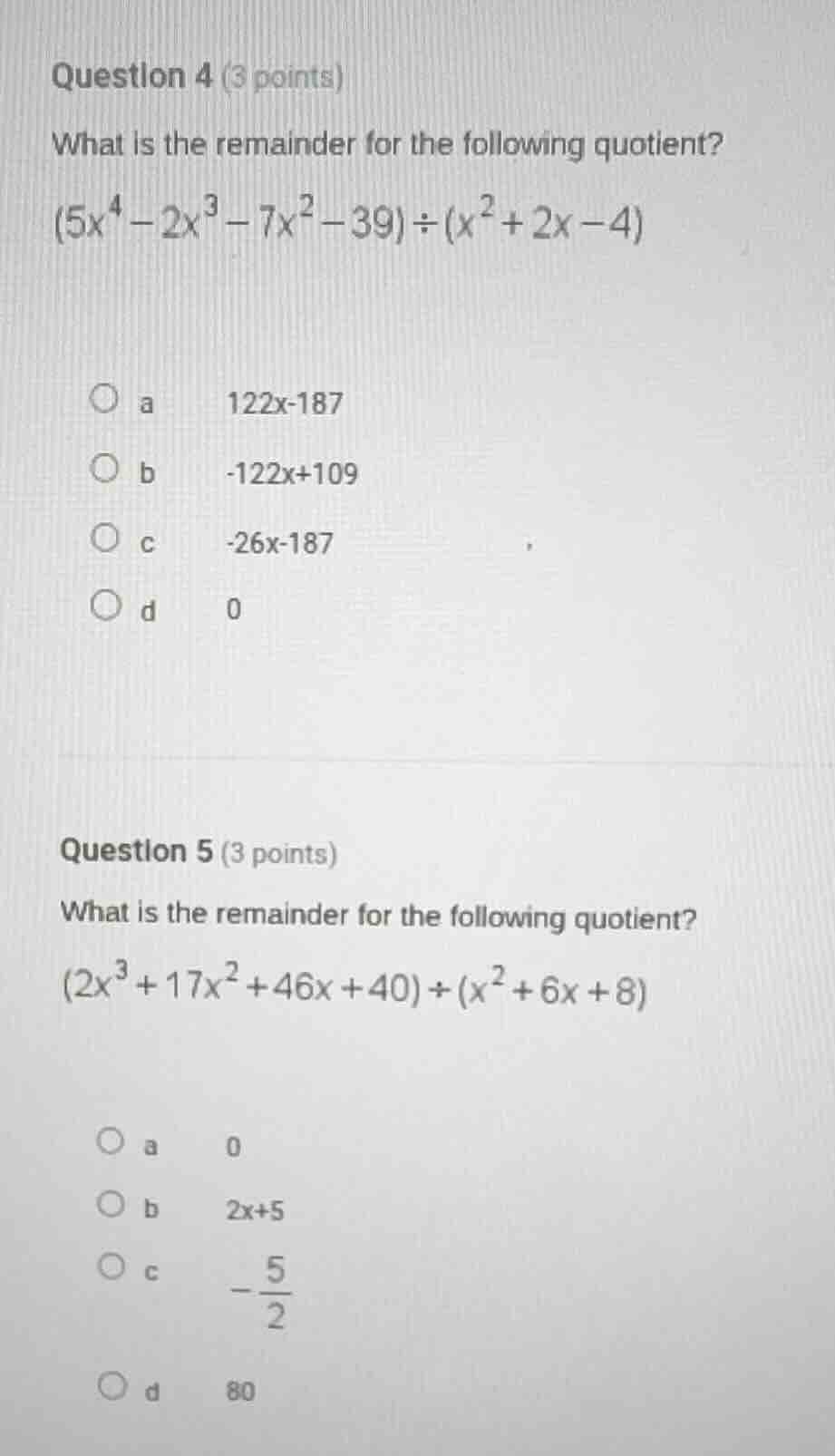
question 4 (3 points)
what is the remainder for the following quotient?
$(5x^{4}-2x^{3}-7x^{2}-39)\div(x^{2}+2x - 4)$
\\(\bigcirc\\) a \quad 122x - 187
\\(\bigcirc\\) b \quad -122x + 109
\\(\bigcirc\\) c \quad -26x - 187
\\(\bigcirc\\) d \quad 0
question 5 (3 points)
what is the remainder for the following quotient?
$(2x^{3}+17x^{2}+46x + 40)\div(x^{2}+6x + 8)$
\\(\bigcirc\\) a \quad 0
\\(\bigcirc\\) b \quad 2x + 5
\\(\bigcirc\\) c \quad $-\dfrac{5}{2}$
\\(\bigcirc\\) d \quad 80
Question 4
Step 1: Divide the leading terms
Divide the leading term of the dividend \(5x^4\) by the leading term of the divisor \(x^2\), we get \(5x^2\).
Step 2: Multiply the divisor by \(5x^2\)
Multiply \((x^2 + 2x - 4)\) by \(5x^2\), we have \(5x^4 + 10x^3 - 20x^2\).
Step 3: Subtract from the dividend
Subtract \(5x^4 + 10x^3 - 20x^2\) from \(5x^4 - 2x^3 - 7x^2 - 39\):
Step 4: Divide the new leading term
Divide the leading term of \(-12x^3 + 13x^2 - 39\) (which is \(-12x^3\)) by the leading term of the divisor \(x^2\), we get \(-12x\).
Step 5: Multiply the divisor by \(-12x\)
Multiply \((x^2 + 2x - 4)\) by \(-12x\), we have \(-12x^3 - 24x^2 + 48x\).
Step 6: Subtract from the new dividend
Subtract \(-12x^3 - 24x^2 + 48x\) from \(-12x^3 + 13x^2 - 39\):
Step 7: Divide the new leading term
Divide the leading term of \(37x^2 - 48x - 39\) (which is \(37x^2\)) by the leading term of the divisor \(x^2\), we get \(37\).
Step 8: Multiply the divisor by \(37\)
Multiply \((x^2 + 2x - 4)\) by \(37\), we have \(37x^2 + 74x - 148\).
Step 9: Subtract from the new dividend
Subtract \(37x^2 + 74x - 148\) from \(37x^2 - 48x - 39\):
Step 1: Divide the leading terms
Divide the leading term of the dividend \(2x^3\) by the leading term of the divisor \(x^2\), we get \(2x\).
Step 2: Multiply the divisor by \(2x\)
Multiply \((x^2 + 6x + 8)\) by \(2x\), we have \(2x^3 + 12x^2 + 16x\).
Step 3: Subtract from the dividend
Subtract \(2x^3 + 12x^2 + 16x\) from \(2x^3 + 17x^2 + 46x + 40\):
Step 4: Divide the new leading term
Divide the leading term of \(5x^2 + 30x + 40\) (which is \(5x^2\)) by the leading term of the divisor \(x^2\), we get \(5\).
Step 5: Multiply the divisor by \(5\)
Multiply \((x^2 + 6x + 8)\) by \(5\), we have \(5x^2 + 30x + 40\).
Step 6: Subtract from the new dividend
Subtract \(5x^2 + 30x + 40\) from \(5x^2 + 30x + 40\):

Snap & solve any problem in the app
Get step-by-step solutions on Sovi AI
Photo-based solutions with guided steps
Explore more problems and detailed explanations
b. -122x+109