QUESTION IMAGE
Question
question 7 (1 point)
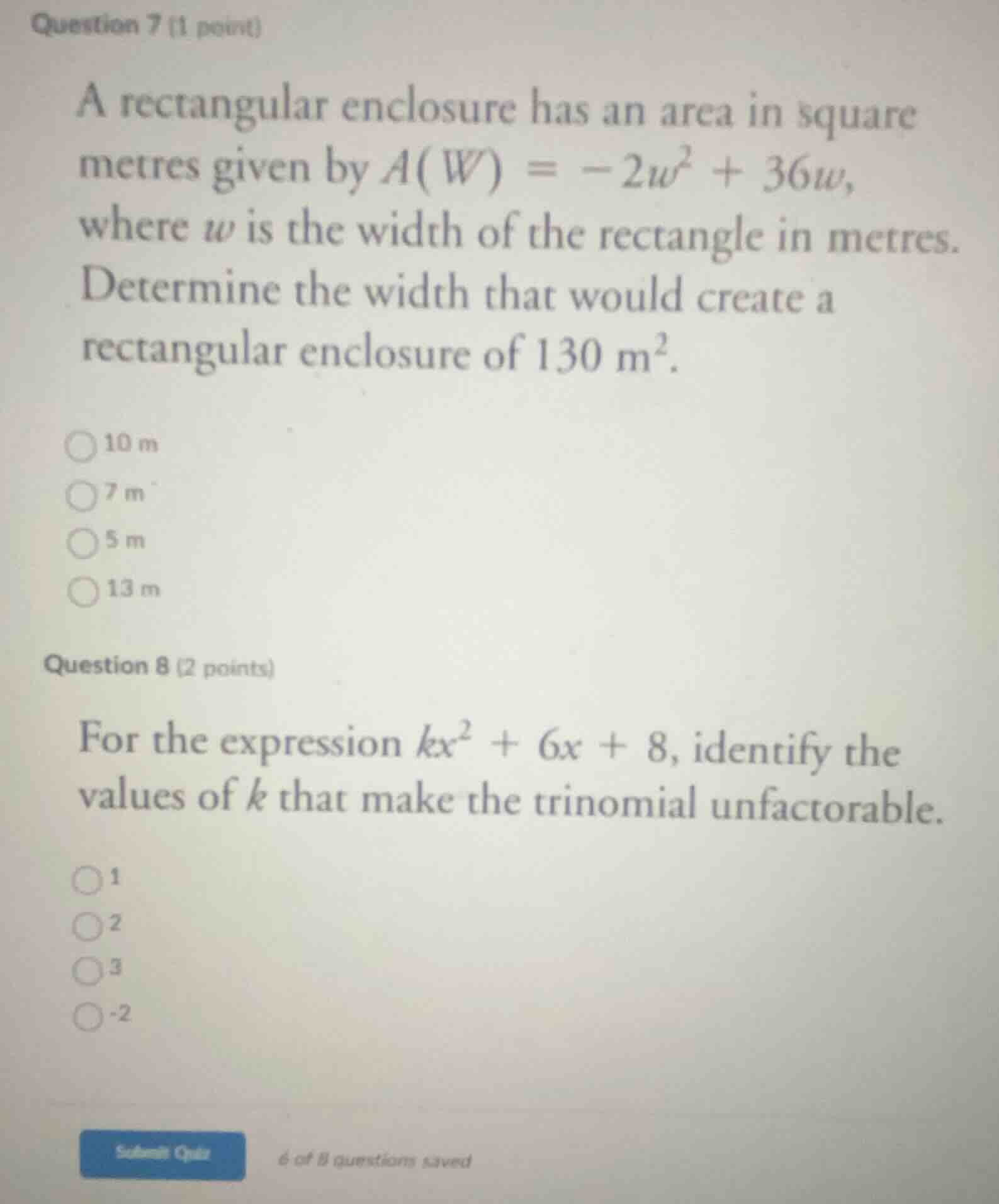
a rectangular enclosure has an area in square metres given by (a(w) = -2w^2 + 36w), where (w) is the width of the rectangle in metres. determine the width that would create a rectangular enclosure of (130\text{ m}^2).
10 m
7 m
5 m
13 m
question 8 (2 points)
for the expression (kx^2 + 6x + 8), identify the values of (k) that make the trinomial unfactorable.
1
2
3
-2
Set up the area equation
Using the Quadratic Relations knowledge point
Solve the quadratic equation for width
Using the Quadratic Relations knowledge point
Looking at the options for Question 7, both \(5\text{ m}\) and \(13\text{ m}\) are listed. Since this is a single-choice question, we check if there are physical constraints. Usually, the width is the shorter dimension.
If \(w = 5\), length \(l = \frac{130}{5} = 26\).
If \(w = 13\), length \(l = \frac{130}{13} = 10\).
By standard convention, width is the shorter side, so \(w = 5\text{ m}\).
Analyze factorability of the trinomial
Using the Polynomial Factoring knowledge point
Test the given options for k
Using the Polynomial Factoring knowledge point
Both \(k=2\) and \(k=3\) make the trinomial unfactorable over integers. Let's check factorability over real numbers using the discriminant:
For the trinomial to be factorable over real numbers, we need \(D \ge 0\):
If \(k = 2\) or \(k = 3\), then \(D < 0\), which means the trinomial has no real roots and is completely unfactorable over the real numbers.
Comparing the options, \(k = 2\) is the smallest positive integer option that makes it unfactorable.

Snap & solve any problem in the app
Get step-by-step solutions on Sovi AI
Photo-based solutions with guided steps
Explore more problems and detailed explanations
Question 7
- (A) 10 m
- (B) 7 m
- (C) 5 m (Correct answer)
- (D) 13 m
Question 8
- (A) 1
- (B) 2 (Correct answer)
- (C) 3
- (D) -2