QUESTION IMAGE
Question
question 9
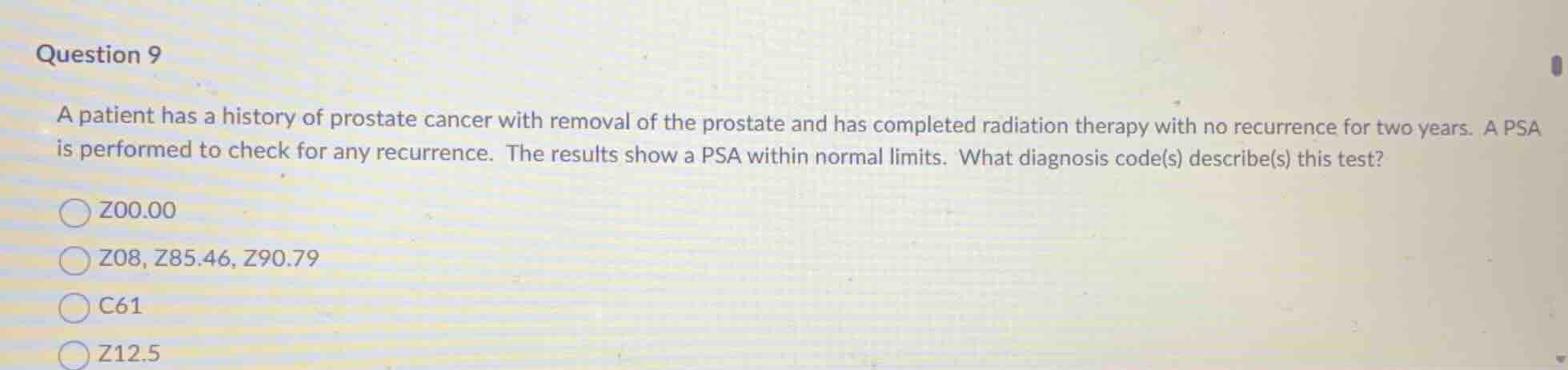
a patient has a history of prostate cancer with removal of the prostate and has completed radiation therapy with no recurrence for two years. a psa is performed to check for any recurrence. the results show a psa within normal limits. what diagnosis code(s) describe(s) this test?
z00.00
z08, z85.46, z90.79
c61
z12.5
Analyze the clinical scenario and coding guidelines
The patient has a history of prostate cancer, has undergone surgical removal (prostatectomy), and completed radiation therapy with no recurrence for two years. A Prostate-Specific Antigen (PSA) test is performed to check for recurrence, and the results are normal.
According to ICD-10-CM guidelines for follow-up care after completed treatment for a malignancy:
- A follow-up code (category Z08) is used as the primary diagnosis when a patient is being monitored after completed treatment for a malignant neoplasm, and there is no evidence of recurrence.
- A personal history of malignant neoplasm code (category Z85) is assigned as a secondary code to indicate the site of the previously treated cancer (Z85.46 for personal history of malignant neoplasm of prostate).
- An acquired absence of organ code (category Z90) is assigned as an additional secondary code to indicate the surgical removal of the organ (Z90.79 for acquired absence of other male genital organs, which includes the prostate).
Evaluate the given options
- Z00.00: Encounter for general adult medical examination without abnormal findings. This is incorrect because the encounter is specifically for post-treatment cancer surveillance.
- Z08, Z85.46, Z90.79: Correctly sequences the follow-up examination code (Z08) first, followed by the history of prostate cancer (Z85.46) and the surgical absence of the prostate (Z90.79).
- C61: Malignant neoplasm of prostate. This is incorrect because the patient's cancer has been fully treated and removed, with no current active recurrence.
- Z12.5: Encounter for screening for malignant neoplasm of prostate. This is incorrect because screening is for patients without a known history of the disease; this patient has a established history of prostate cancer and is undergoing follow-up surveillance.

Snap & solve any problem in the app
Get step-by-step solutions on Sovi AI
Photo-based solutions with guided steps
Explore more problems and detailed explanations
- Z00.00
- Z08, Z85.46, Z90.79 (Correct answer)
- C61
- Z12.5