QUESTION IMAGE
Question
question 3
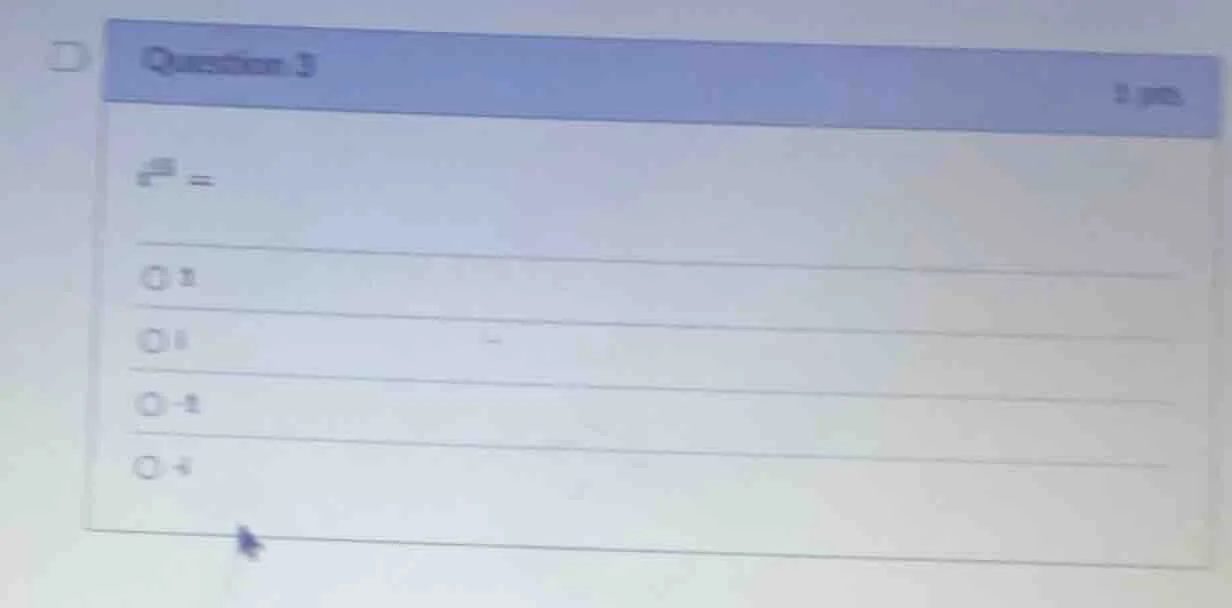
$e^{ipi} = $
options:
$i$
$1$
$-1$
$-i$
Step1: Recall Euler's formula
Euler's formula is \( e^{i\theta}=\cos\theta + i\sin\theta \). For \( \theta=\pi \), we substitute into the formula.
Step2: Substitute \( \theta = \pi \)
We know that \( \cos\pi=- 1 \) and \( \sin\pi = 0 \). So \( e^{i\pi}=\cos\pi+i\sin\pi=-1 + i\times0=-1 \). Wait, no, wait, maybe the original problem is \( e^{i\pi} \)? But the options have - 1? Wait, maybe the problem is \( e^{i\pi} \), let's check again. Wait, Euler's formula: \( e^{i\theta}=\cos\theta+i\sin\theta \). When \( \theta = \pi \), \( \cos\pi=-1 \), \( \sin\pi = 0 \), so \( e^{i\pi}=-1 + 0i=-1 \). But wait, the options: if the problem is \( e^{i\pi} \), then the answer is - 1. But let's check the options. The options are: let's see the image, the options are (probably) \( \pi \), \( i \), \( - 1 \), \( -i \)? Wait, maybe the problem is \( e^{i\pi} \). So according to Euler's formula, \( e^{i\pi}=\cos(\pi)+i\sin(\pi)=- 1+0i = - 1 \).

Snap & solve any problem in the app
Get step-by-step solutions on Sovi AI
Photo-based solutions with guided steps
Explore more problems and detailed explanations
\(-1\) (assuming the problem is \(e^{i\pi}\))