QUESTION IMAGE
Question
question 7 (multiple choice worth 1 points)
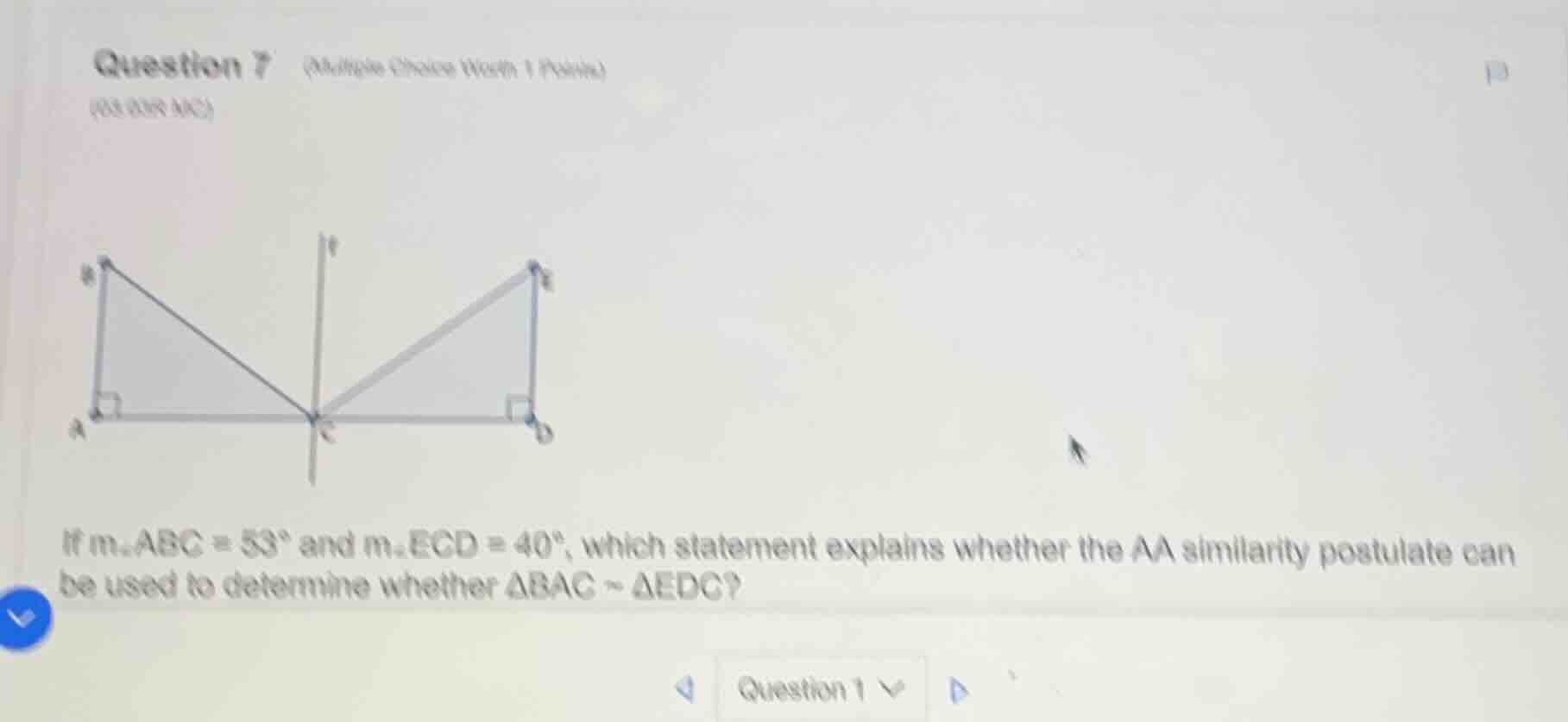
if \\(m\angle abc = 53^{\circ}\\) and \\(m\angle ecd = 40^{\circ}\\), which statement explains whether the aa similarity postulate can be used to determine whether \\(\delta bac \sim \delta edc\\)?
Identify given angles and target triangles
Using the AA Similarity Postulate knowledge point
Calculate the remaining angle in the first triangle
We use the Triangle Angle Sum Theorem to find the measure of \(\angle BCA\):
Calculate the remaining angle in the second triangle
We use the Triangle Angle Sum Theorem to find the measure of \(\angle DEC\):
Compare corresponding angles for similarity
We compare the sets of interior angles for both triangles:
Since the acute angles are not equal (\(53^\circ
eq 50^\circ\) and \(37^\circ
eq 40^\circ\)), the triangles do not have two pairs of congruent angles. Thus, the AA similarity postulate cannot be used because the triangles are not similar.

Snap & solve any problem in the app
Get step-by-step solutions on Sovi AI
Photo-based solutions with guided steps
Explore more problems and detailed explanations
- (A) Yes, because \(\text{m}\angle BCA = 37^\circ\) and \(\text{m}\angle DEC = 37^\circ\).
- (B) Yes, because \(\text{m}\angle BCA = 40^\circ\) and \(\text{m}\angle DEC = 53^\circ\).
- (C) No, because \(\text{m}\angle BCA = 53^\circ\) and \(\text{m}\angle DEC = 40^\circ\).
- (D) No, because \(\text{m}\angle BCA = 37^\circ\) and \(\text{m}\angle DEC = 50^\circ\). (Correct answer)