QUESTION IMAGE
Question
question 8 (multiple choice worth 4 points)
(06.05 mc)
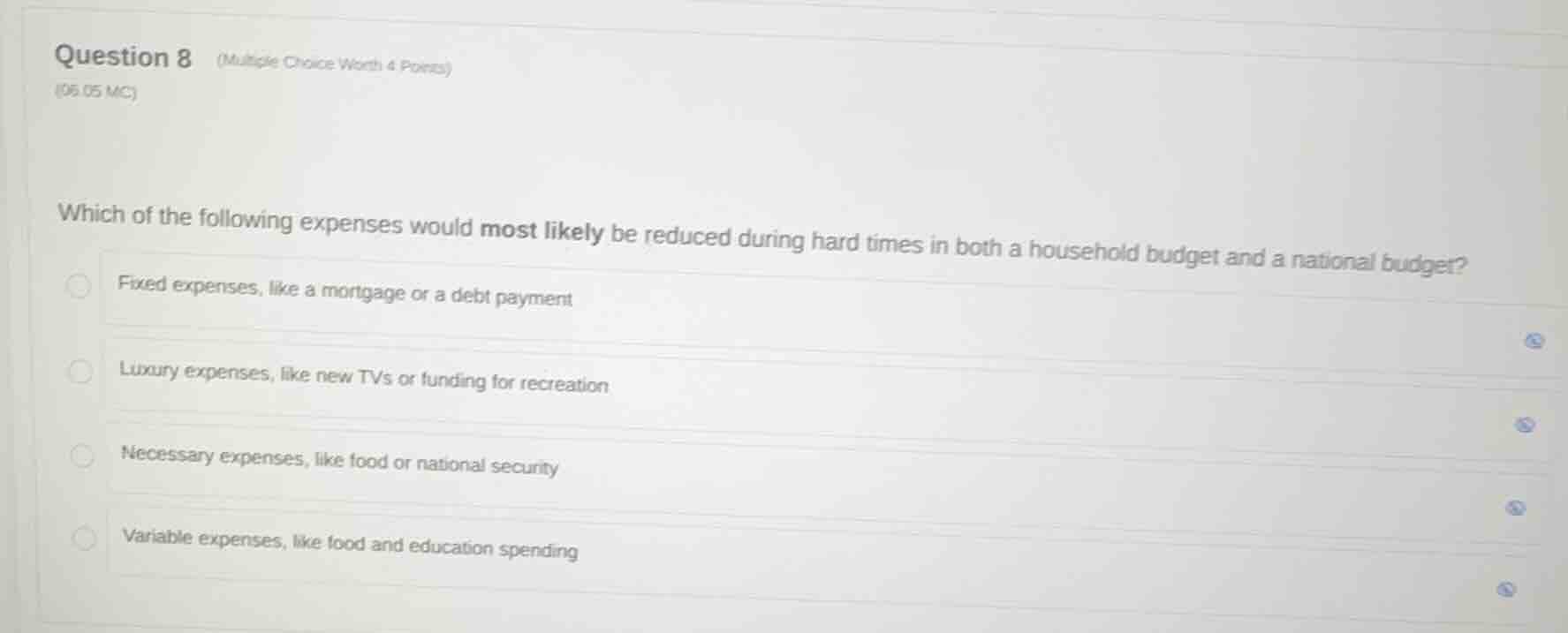
which of the following expenses would most likely be reduced during hard times in both a household budget and a national budget?
fixed expenses, like a mortgage or a debt payment
luxury expenses, like new tvs or funding for recreation
necessary expenses, like food or national security
variable expenses, like food and education spending
<pre_analysis>
{
"quality": "clear",
"question_count": 1,
"skills_matched": [
"direct_cot",
"multiple_choice_formatter",
"explain_then_answer",
"tutor"
],
"needs_drawing": false,
"concepts_used": [],
"new_concepts": [
"Budgeting Categories",
"Discretionary Spending"
],
"current_concepts": [
"Budgeting Categories",
"Discretionary Spending",
"Personal Finance"
]
}
</pre_analysis>
<reasoning>
Analyze the question requirements
The question asks which type of expenses would most likely be reduced during difficult economic times (hard times) in both a household budget and a national budget.
Evaluate the expense categories
- Fixed expenses (e.g., mortgage, debt payments): These are legally binding obligations that cannot be easily or quickly reduced without severe consequences like foreclosure or default.
- Luxury/Discretionary expenses (e.g., new TVs, recreation funding): These are non-essential items. When facing financial constraints, both households and governments prioritize cutting non-essential, luxury, or recreational spending first to save money.
- Necessary expenses (e.g., food, national security): These are essential for survival and basic functioning, making them extremely difficult to cut even during hard times.
- Variable expenses (e.g., food, education): While some variable expenses can be adjusted, essential variable needs like food cannot be easily reduced below a survival threshold.
Determine the best option
Luxury expenses represent discretionary spending. In both personal finance and public finance, discretionary luxury spending is the most flexible and is the first category to be cut when facing a budget deficit or economic hardship.
</reasoning>
<answer>
<mcq-option>Fixed expenses, like a mortgage or a debt payment</mcq-option>
<mcq-correct>Luxury expenses, like new TVs or funding for recreation</mcq-correct>
<mcq-option>Necessary expenses, like food or national security</mcq-option>
<mcq-option>Variable expenses, like food and education spending</mcq-option>
</answer>
<post_analysis>
{
"subject": "Business",
"question_type": "Multiple Choice",
"knowledge_point": [
"Business",
"Finance",
"Budgeting Categories"
]
}
</post_analysis>
Snap & solve any problem in the app
Get step-by-step solutions on Sovi AI
Photo-based solutions with guided steps
Explore more problems and detailed explanations
<pre_analysis>
{
"quality": "clear",
"question_count": 1,
"skills_matched": [
"direct_cot",
"multiple_choice_formatter",
"explain_then_answer",
"tutor"
],
"needs_drawing": false,
"concepts_used": [],
"new_concepts": [
"Budgeting Categories",
"Discretionary Spending"
],
"current_concepts": [
"Budgeting Categories",
"Discretionary Spending",
"Personal Finance"
]
}
</pre_analysis>
<reasoning>
Analyze the question requirements
The question asks which type of expenses would most likely be reduced during difficult economic times (hard times) in both a household budget and a national budget.
Evaluate the expense categories
- Fixed expenses (e.g., mortgage, debt payments): These are legally binding obligations that cannot be easily or quickly reduced without severe consequences like foreclosure or default.
- Luxury/Discretionary expenses (e.g., new TVs, recreation funding): These are non-essential items. When facing financial constraints, both households and governments prioritize cutting non-essential, luxury, or recreational spending first to save money.
- Necessary expenses (e.g., food, national security): These are essential for survival and basic functioning, making them extremely difficult to cut even during hard times.
- Variable expenses (e.g., food, education): While some variable expenses can be adjusted, essential variable needs like food cannot be easily reduced below a survival threshold.
Determine the best option
Luxury expenses represent discretionary spending. In both personal finance and public finance, discretionary luxury spending is the most flexible and is the first category to be cut when facing a budget deficit or economic hardship.
</reasoning>
<answer>
<mcq-option>Fixed expenses, like a mortgage or a debt payment</mcq-option>
<mcq-correct>Luxury expenses, like new TVs or funding for recreation</mcq-correct>
<mcq-option>Necessary expenses, like food or national security</mcq-option>
<mcq-option>Variable expenses, like food and education spending</mcq-option>
</answer>
<post_analysis>
{
"subject": "Business",
"question_type": "Multiple Choice",
"knowledge_point": [
"Business",
"Finance",
"Budgeting Categories"
]
}
</post_analysis>