QUESTION IMAGE
Question
question
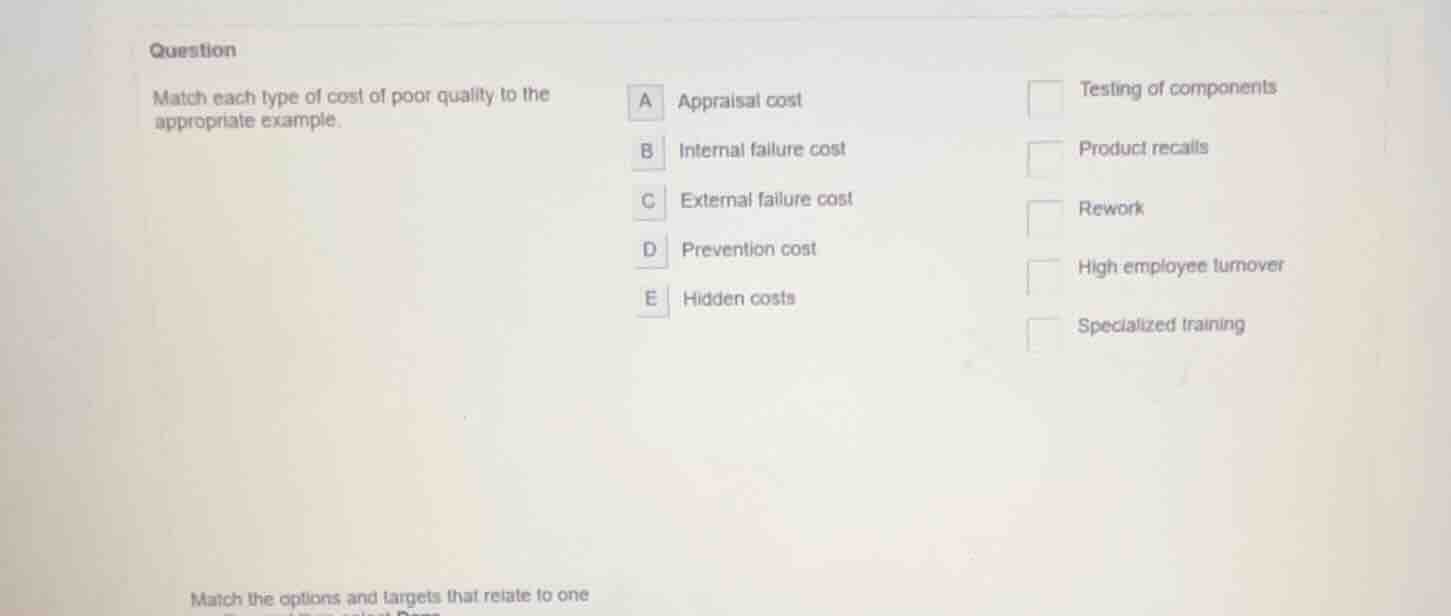
match each type of cost of poor quality to the appropriate example.
a appraisal cost
b internal failure cost
c external failure cost
d prevention cost
e hidden costs
testing of components
product recalls
rework
high employee turnover
specialized training
Define the categories of Cost of Quality
The Cost of Quality (COQ) is divided into Cost of Good Quality (Prevention and Appraisal) and Cost of Poor Quality (Internal Failure, External Failure, and Hidden Costs). Let's define each category:
- Prevention cost: Costs incurred to prevent defects from occurring in the first place.
- Appraisal cost: Costs associated with measuring, evaluating, or auditing products or services to assure conformance to quality standards.
- Internal failure cost: Costs associated with defects found before the customer receives the product or service.
- External failure cost: Costs associated with defects found after the customer receives the product or service.
- Hidden costs: Indirect costs that are not easily tracked by traditional accounting systems, such as lost customer goodwill or employee morale issues.
Match each example to its category
Let's analyze each example on the right and match it to the correct category:
- Testing of components: This is an evaluation activity to check if components meet quality standards before assembly. This is an Appraisal cost (A).
- Product recalls: This occurs after the product has reached the customer and a defect is discovered, requiring a recall. This is an External failure cost (C).
- Rework: This is correcting a defect found during production before shipping to the customer. This is an Internal failure cost (B).
- High employee turnover: This is an indirect, hard-to-measure consequence of poor processes, stress, or bad quality culture. This is a Hidden cost (E).
- Specialized training: This is an investment made to train employees to perform tasks correctly and prevent errors. This is a Prevention cost (D).

Snap & solve any problem in the app
Get step-by-step solutions on Sovi AI
Photo-based solutions with guided steps
Explore more problems and detailed explanations
| Example | Cost Category |
|---|---|
| Product recalls | C (External failure cost) |
| Rework | B (Internal failure cost) |
| High employee turnover | E (Hidden costs) |
| Specialized training | D (Prevention cost) |