QUESTION IMAGE
Question
question 9
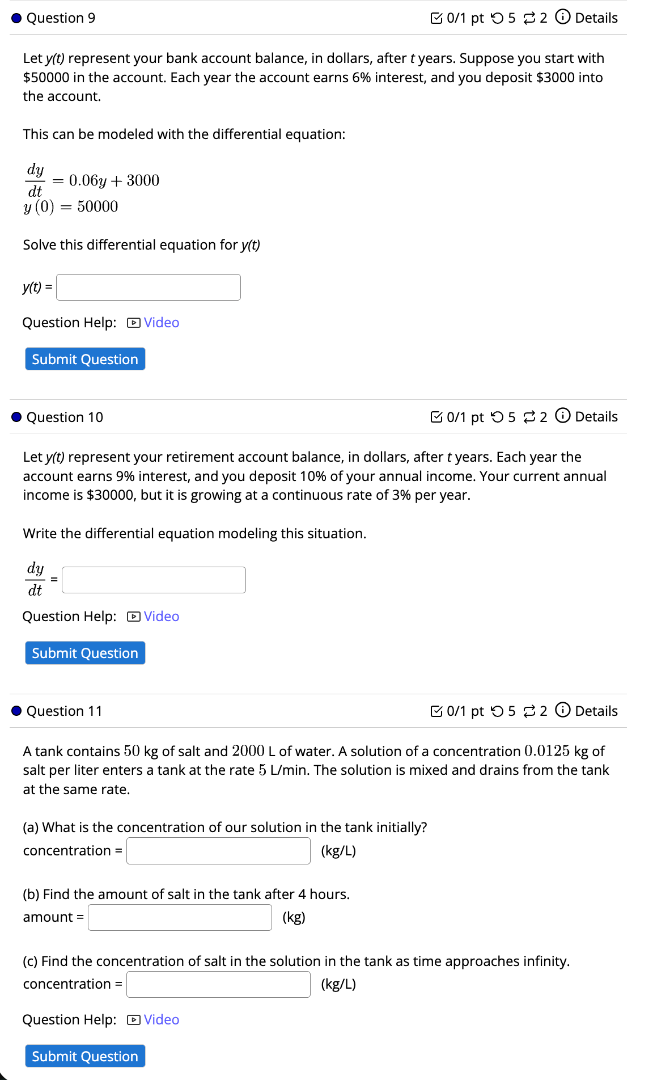
let (y(t)) represent your bank account balance, in dollars, after (t) years. suppose you start with $50000 in the account. each year the account earns 6% interest, and you deposit $3000 into the account.
this can be modeled with the differential equation:
\\\frac{dy}{dt} = 0.06y + 3000\\
\\y(0) = 50000\\
solve this differential equation for (y(t))
(y(t) =)
question 10
let (y(t)) represent your retirement account balance, in dollars, after (t) years. each year the account earns 9% interest, and you deposit 10% of your annual income. your current annual income is $30000, but it is growing at a continuous rate of 3% per year.
write the differential equation modeling this situation.
\\\frac{dy}{dt} =\\
question 11
a tank contains (50\text{ kg}) of salt and (2000\text{ l}) of water. a solution of a concentration (0.0125\text{ kg}) of salt per liter enters a tank at the rate (5\text{ l/min}). the solution is mixed and drains from the tank at the same rate.
(a) what is the concentration of our solution in the tank initially?
concentration = (kg/l)
(b) find the amount of salt in the tank after 4 hours.
amount = (kg)
(c) find the concentration of salt in the solution in the tank as time approaches infinity.
concentration = (kg/l)
🆕 New Concept Discovered: Separable Differential Equations & Mixing Models
Solving first-order differential equations and setting up rate-of-change models.
---
Question 9
Step 1: Separate the variables
We start with the given differential equation:
To solve this, we group all terms involving \( y \) on one side and terms involving \( t \) on the other:
We can factor out \( 0.06 \) from the denominator to make integration simpler:
Step 2: Integrate both sides
Integrate both sides of the equation:
Exponentiate both sides to solve for \( y \):
Step 3: Apply the initial condition
We are given the initial condition \( y(0) = 50000 \):
Thus, the solution is:
---
Question 10
Step 1: Identify the rate of change components
The rate of change of the retirement account balance, \(\frac{dy}{dt}\), is determined by two factors:
- Interest earned: The account earns \( 9\% \) interest continuously on its current balance \( y \):
- Deposits: You deposit \( 10\% \) of your annual income. Your current annual income is \(\$30000\), but it grows continuously at a rate of \( 3\% \) per year. This means your income at time \( t \) is modeled by \( 30000e^{0.03t} \).
Step 2: Write the differential equation
Combining both components gives:
---
Question 11
Step 1: Find the initial concentration
Initially, the tank contains \( 50 \text{ kg} \) of salt in \( 2000 \text{ L} \) of water.
The concentration is:
Step 2: Set up and solve the differential equation for salt amount
Let \( S(t) \) be the amount of salt (in kg) in the tank at time \( t \) (in minutes).
The rate of change of salt is:
- Rate in: \( 0.0125 \text{ kg/L} \times 5 \text{ L/min} = 0.0625 \text{ kg/min} \)
- Rate out: Since the volume remains constant at \( 2000 \text{ L} \), the concentration leaving is \( \frac{S(t)}{2000} \text{ kg/L} \).
Thus, the differential equation is:
Separate variables and integrate:
Apply the initial condition \( S(0) = 50 \):
Step 3: Calculate the salt amount after 4 hours
Note that \( t \) is in minutes. Convert \( 4 \text{ hours} \) to minutes:
Substitute \( t = 240 \) into the equation:
Step 4: Find th…

Snap & solve any problem in the app
Get step-by-step solutions on Sovi AI
Photo-based solutions with guided steps
Explore more problems and detailed explanations
Question 9
\( y(t) = 100000e^{0.06t} - 50000 \)
Question 10
\( \frac{dy}{dt} = 0.09y + 3000e^{0.03t} \)
Question 11
(a) \( 0.025 \)
(b) \( 38.72 \)
(c) \( 0.0125 \)