QUESTION IMAGE
Question
question 2
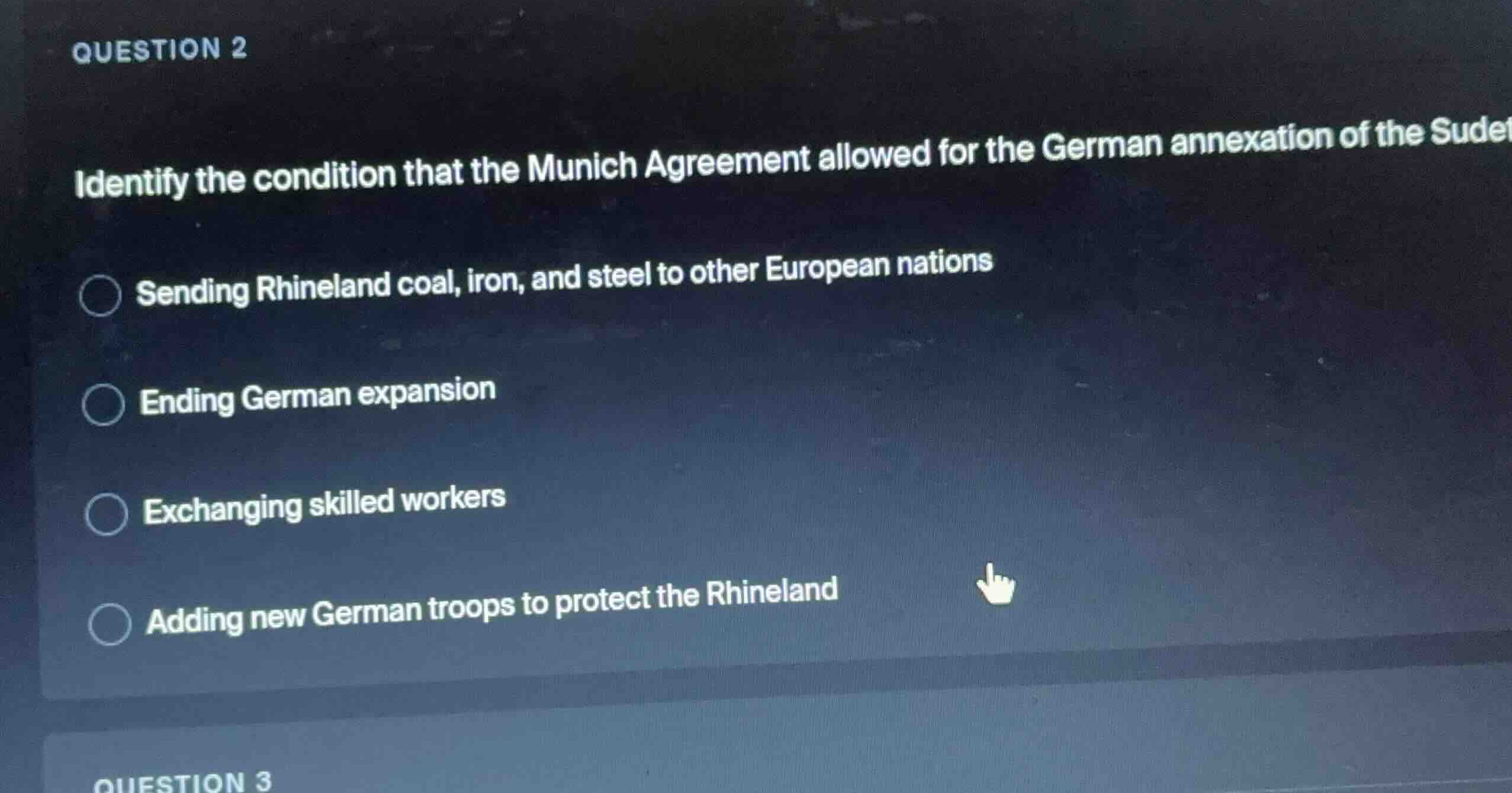
identify the condition that the munich agreement allowed for the german annexation of the sudet
sending rhineland coal, iron, and steel to other european nations
ending german expansion
exchanging skilled workers
adding new german troops to protect the rhineland
Analyze the Munich Agreement context
The question asks to identify the condition that the Munich Agreement allowed for the German annexation of the Sudetenland. This relates directly to the Sudetenland Crisis and the Appeasement Policy of 1938.
Evaluate the options
- Sending Rhineland coal, iron, and steel to other European nations: This is historically inaccurate and unrelated to the Munich Agreement's terms.
- Ending German expansion: The core premise of the Munich Agreement, under the British and French Appeasement Policy, was that allowing Hitler to annex the Sudetenland would satisfy his territorial demands and thus end further German expansion in Europe.
- Exchanging skilled workers: This was not a condition or a primary focus of the Munich Agreement.
- Adding new German troops to protect the Rhineland: The remilitarization of the Rhineland occurred earlier in 1936 and was not a condition of the 1938 Munich Agreement.
Determine the correct choice
The Munich Agreement was signed by Germany, Great Britain, France, and Italy. It permitted German annexation of Czechoslovakia's Sudetenland in exchange for Adolf Hitler's promise to end further German territorial expansion.

Snap & solve any problem in the app
Get step-by-step solutions on Sovi AI
Photo-based solutions with guided steps
Explore more problems and detailed explanations
- Sending Rhineland coal, iron, and steel to other European nations
- Ending German expansion (Correct answer)
- Exchanging skilled workers
- Adding new German troops to protect the Rhineland