QUESTION IMAGE
Question
question 8
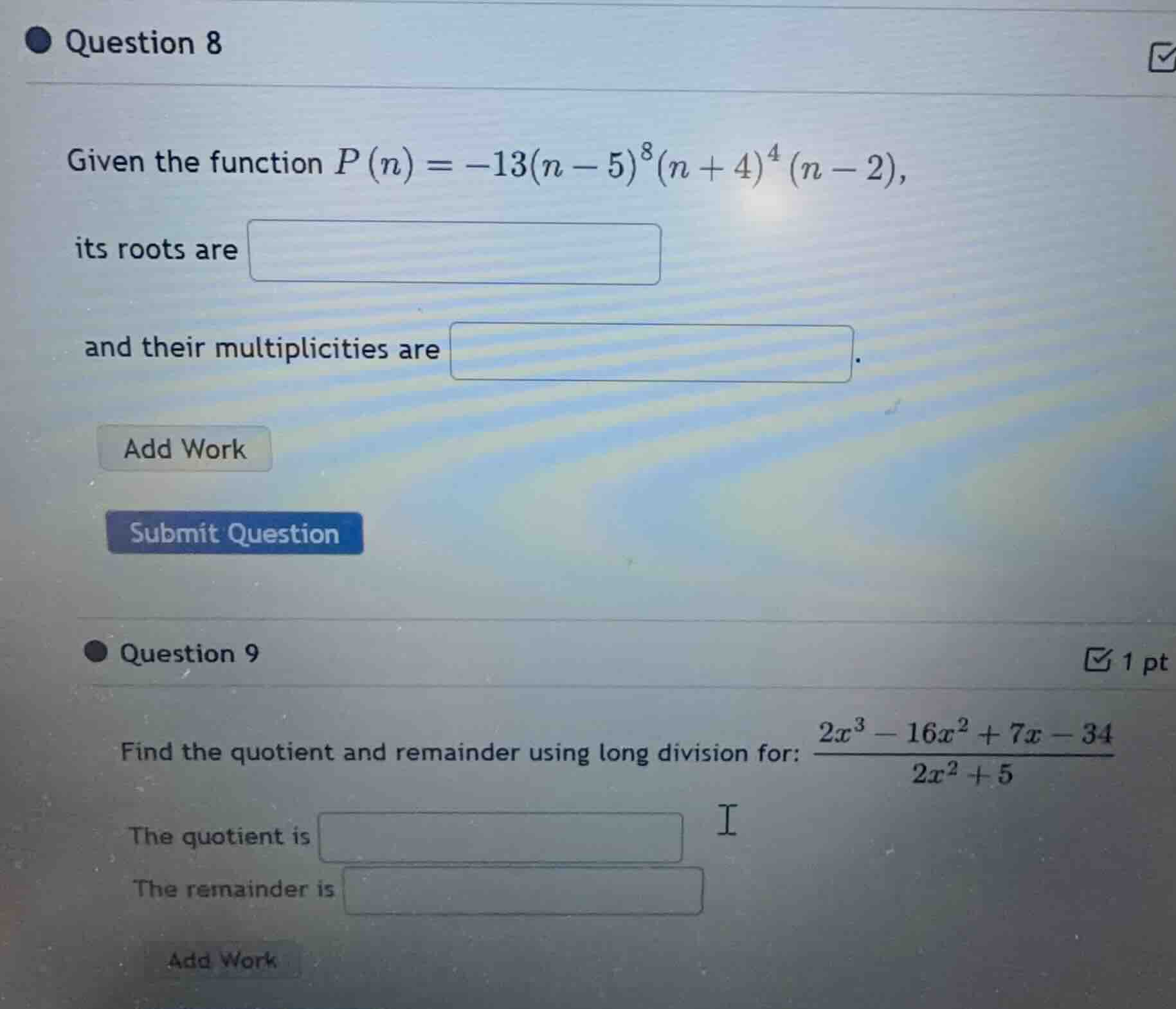
given the function (p(n) = -13(n - 5)^8(n + 4)^4(n - 2)),
its roots are
and their multiplicities are .
question 9
find the quotient and remainder using long division for: (\frac{2x^3 - 16x^2 + 7x - 34}{2x^2 + 5})
the quotient is
the remainder is
⚡ Using: Understanding Polynomial Functions · dividing polynomials
Step 1: Solve Question 8 (Roots and Multiplicities)
To find the roots of the polynomial function \( P(n) = -13(n - 5)^8(n + 4)^4(n - 2) \), set each factor equal to zero:
- \( n - 5 = 0 \implies n = 5 \)
- \( n + 4 = 0 \implies n = -4 \)
- \( n - 2 = 0 \implies n = 2 \)
The multiplicity of each root is the exponent of its corresponding factor:
- The root \( n = 5 \) has a multiplicity of \( 8 \).
- The root \( n = -4 \) has a multiplicity of \( 4 \).
- The root \( n = 2 \) has a multiplicity of \( 1 \).
Listing the roots and their corresponding multiplicities in order (e.g., from smallest to largest root):
- Roots: \( -4, 2, 5 \)
- Multiplicities: \( 4, 1, 8 \)
---
Step 2: Solve Question 9 (Polynomial Long Division)
Divide \( 2x^3 - 16x^2 + 7x - 34 \) by \( 2x^2 + 5 \):
- Divide the leading terms:
Multiply \( x \) by the divisor:
Subtract this from the dividend:
- Divide the new leading term:
Multiply \( -8 \) by the divisor:
Subtract this from the remaining polynomial:
Since the degree of \( 2x + 6 \) is less than the degree of \( 2x^2 + 5 \), the division is complete.
- Quotient: \( x - 8 \)
- Remainder: \( 2x + 6 \)

Snap & solve any problem in the app
Get step-by-step solutions on Sovi AI
Photo-based solutions with guided steps
Explore more problems and detailed explanations
Question 8
- its roots are: \( -4, 2, 5 \) (or in any order: \( 5, -4, 2 \))
- and their multiplicities are: \( 4, 1, 8 \) (corresponding to the order of roots: \( 8, 4, 1 \) for \( 5, -4, 2 \))
Question 9
- The quotient is: \( x - 8 \)
- The remainder is: \( 2x + 6 \)