QUESTION IMAGE
Question
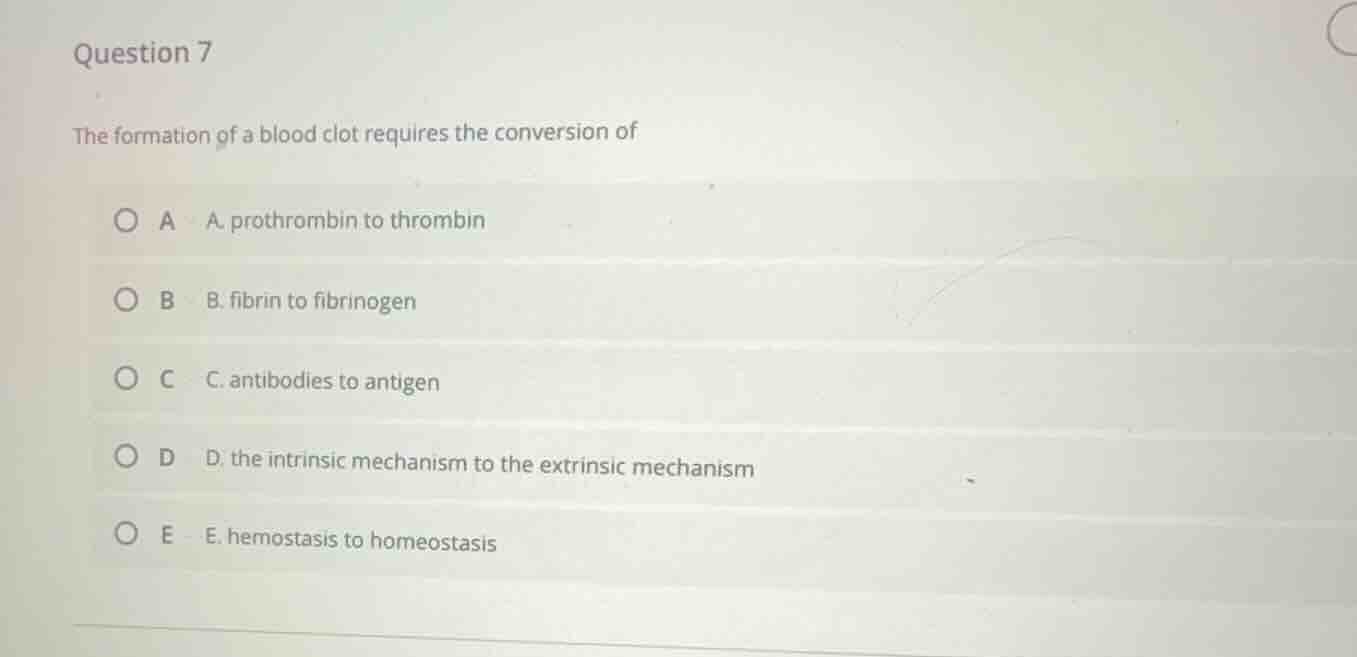
question 7
the formation of a blood clot requires the conversion of
a a. prothrombin to thrombin
b b. fibrin to fibrinogen
c c. antibodies to antigen
d d. the intrinsic mechanism to the extrinsic mechanism
e e. hemostasis to homeostasis
Analyze the blood clotting process
Blood clotting (coagulation) is a complex cascade of enzymatic reactions. The final steps are crucial for forming a stable clot.
Evaluate the conversion of prothrombin
Inactive prothrombin is converted into active thrombin by prothrombinase. Thrombin then acts as an enzyme to catalyze the next step.
Evaluate the conversion of fibrinogen
Thrombin converts soluble fibrinogen into insoluble fibrin threads. These threads form the structural mesh of the blood clot.
Analyze the given options
- Option A states "prothrombin to thrombin", which is a necessary step in the clotting cascade.
- Option B states "fibrin to fibrinogen", which is the reverse of the actual process (fibrinogen is converted to fibrin).
- Option C, D, and E do not describe the biochemical conversions required for clot formation.
Determine the correct choice
Since the conversion of prothrombin to thrombin is a key requirement for clot formation, Option A is the correct answer.

Snap & solve any problem in the app
Get step-by-step solutions on Sovi AI
Photo-based solutions with guided steps
Explore more problems and detailed explanations
- (A) A. prothrombin to thrombin (Correct answer)
- (B) B. fibrin to fibrinogen
- (C) C. antibodies to antigen
- (D) D. the intrinsic mechanism to the extrinsic mechanism
- (E) E. hemostasis to homeostasis