QUESTION IMAGE
Question
question 8
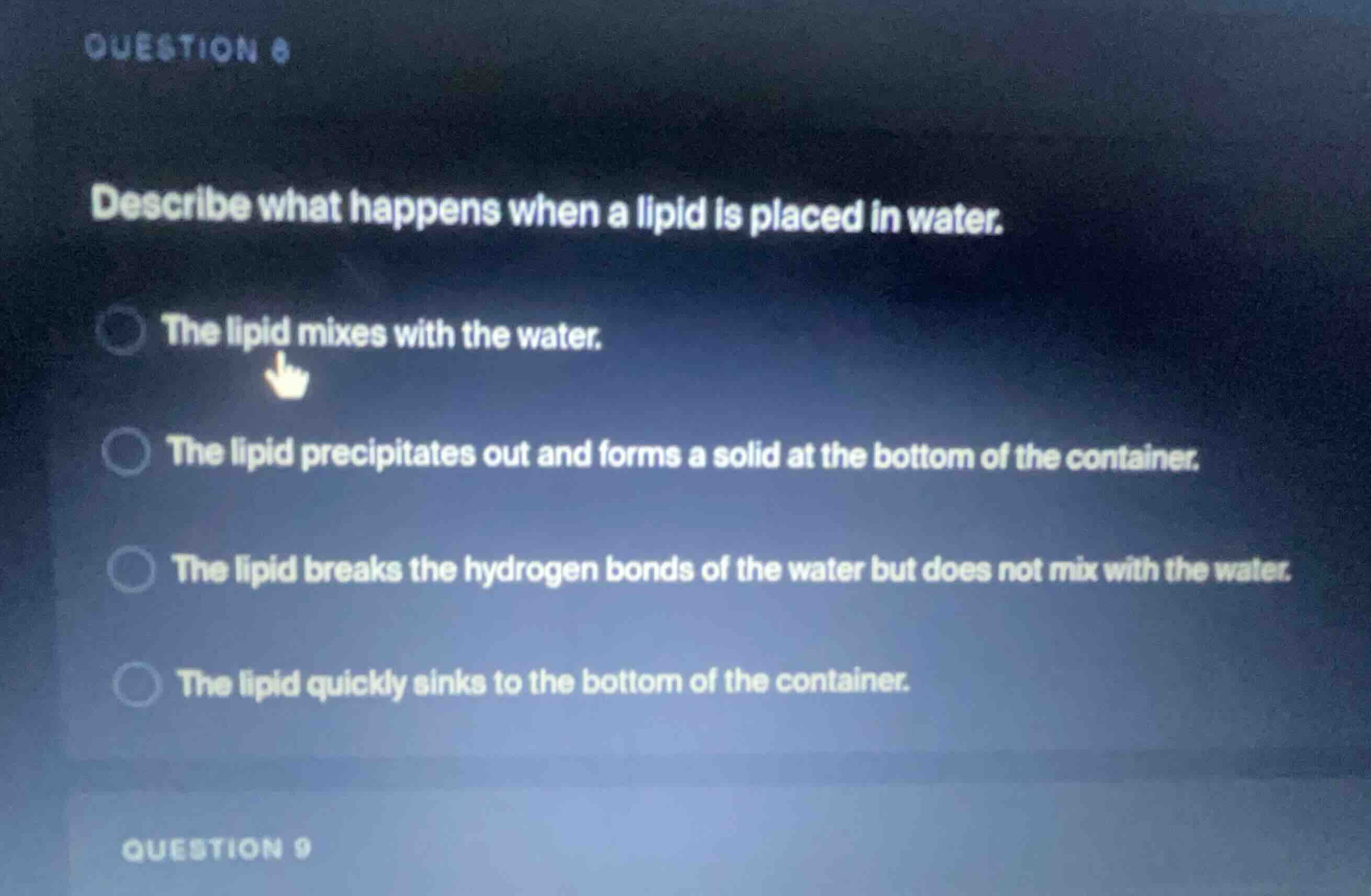
describe what happens when a lipid is placed in water.
- the lipid mixes with the water.
- the lipid precipitates out and forms a solid at the bottom of the container.
- the lipid breaks the hydrogen bonds of the water but does not mix with the water.
- the lipid quickly sinks to the bottom of the container.
Analyze lipid and water properties
Using the Water Polarity and Polar Molecules knowledge points, water is a highly polar solvent. Water molecules form a dynamic network held together by Hydrogen Bonding. Conversely, lipids (such as Dietary Fats) are primarily nonpolar hydrocarbons.
Evaluate molecular interactions
Nonpolar molecules cannot form favorable interactions with polar water molecules. To accommodate a nonpolar lipid, water molecules would have to organize in a highly ordered, thermodynamically unfavorable cage-like structure around the lipid.
Determine the physical outcome
Because lipids cannot disrupt the strong cohesive hydrogen bonds between water molecules to form new solute-solvent attractions, they do not dissolve. Instead, the water molecules exclude the nonpolar lipid molecules, keeping their own hydrogen-bonded network intact. Thus, the lipid does not mix with the water, and it cannot break the water's hydrogen bonds.

Snap & solve any problem in the app
Get step-by-step solutions on Sovi AI
Photo-based solutions with guided steps
Explore more problems and detailed explanations
- (A) The lipid mixes with the water.
- (B) The lipid precipitates out and forms a solid at the bottom of the container.
- (C) The lipid breaks the hydrogen bonds of the water but does not mix with the water. (Correct answer)
- (D) The lipid quickly sinks to the bottom of the container.