QUESTION IMAGE
Question
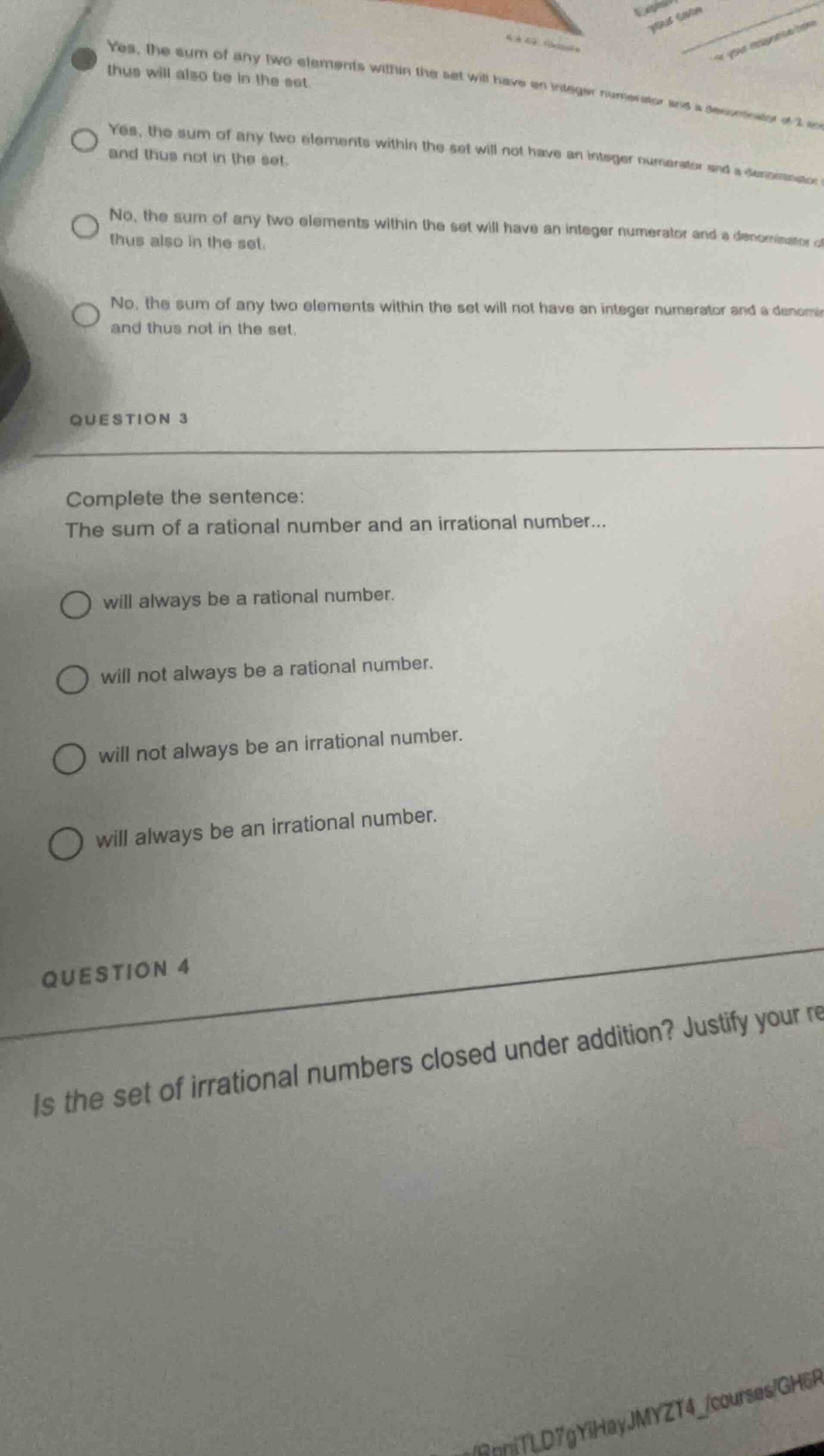
question 3
complete the sentence:
the sum of a rational number and an irrational number...
will always be a rational number.
will not always be a rational number.
will not always be an irrational number.
will always be an irrational number.
question 4
is the set of irrational numbers closed under addition? justify your response.
Analyze Question 3
Using the Rational Numbers and Irrational Numbers knowledge points.
Let \(r\) be a rational number and \(i\) be an irrational number.
Assume their sum is rational, so \(r + i = q\) where \(q\) is rational.
Then \(i = q - r\).
Since the difference of two rational numbers is always rational, \(i\) must be rational.
This contradicts the fact that \(i\) is irrational.
Therefore, the sum of a rational number and an irrational number must always be irrational.
Analyze Question 4
Using the Closure Under Addition and Irrational Numbers knowledge points.
A set is closed under addition if the sum of any two elements in the set is also in the set.
Consider two irrational numbers: \(\sqrt{2}\) and \(-\sqrt{2}\).
Their sum is:
Since \(0\) is a rational number, it is not in the set of irrational numbers.
Thus, the set of irrational numbers is not closed under addition.

Snap & solve any problem in the app
Get step-by-step solutions on Sovi AI
Photo-based solutions with guided steps
Explore more problems and detailed explanations
Question 3
- will always be a rational number.
- will not always be a rational number.
- will not always be an irrational number.
- will always be an irrational number. (Correct answer)
Question 4
No, the set of irrational numbers is not closed under addition. For example, the sum of the irrational numbers \(\sqrt{2}\) and \(-\sqrt{2}\) is \(0\), which is a rational number.