QUESTION IMAGE
Question
question 64
1 point
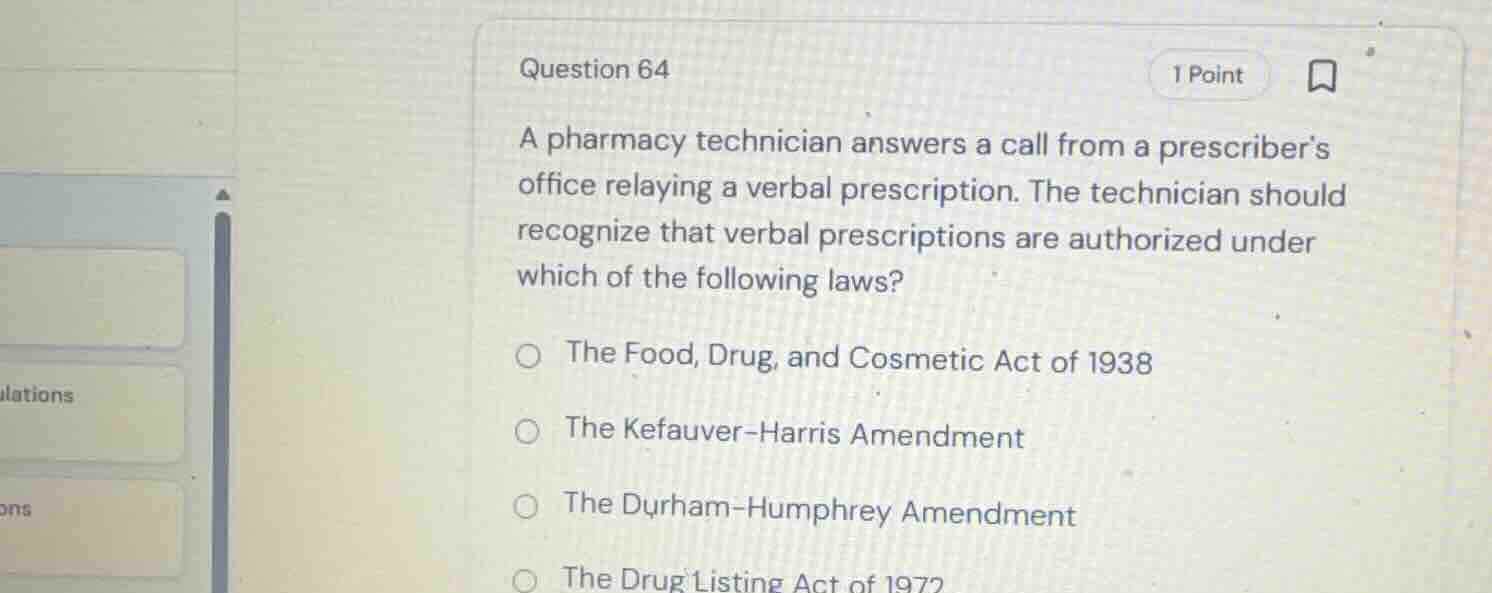
a pharmacy technician answers a call from a prescribers office relaying a verbal prescription. the technician should recognize that verbal prescriptions are authorized under which of the following laws?
- the food, drug, and cosmetic act of 1938
- the kefauver-harris amendment
- the durham-humphrey amendment
- the drug listing act of 1972
Identify the core legal issue
Using the Durham-Humphrey Amendment and Kefauver-Harris Amendment knowledge points
- The question asks which federal law authorized verbal (oral) prescriptions.
- The Durham-Humphrey Amendment of 1951 established two distinct classes of drugs: prescription (legend) and over-the-counter (OTC).
- Crucially, this amendment authorized oral (verbal) prescriptions and prescription refills.
Evaluate the options
Using the Durham-Humphrey Amendment knowledge point
- The Food, Drug, and Cosmetic Act of 1938: Established the FDA's authority to monitor safety, but did not formally separate OTC/prescription classes or authorize verbal transmissions.
- The Kefauver-Harris Amendment: Focused on drug efficacy and safety reporting following the thalidomide tragedy.
- The Durham-Humphrey Amendment: Explicitly legalized verbal transmissions of prescriptions and refills.
- The Drug Listing Act of 1972: Created the National Drug Code (NDC) system.

Snap & solve any problem in the app
Get step-by-step solutions on Sovi AI
Photo-based solutions with guided steps
Explore more problems and detailed explanations
- The Food, Drug, and Cosmetic Act of 1938
- The Kefauver-Harris Amendment
- The Durham-Humphrey Amendment (Correct answer)
- The Drug Listing Act of 1972