QUESTION IMAGE
Question
question 49
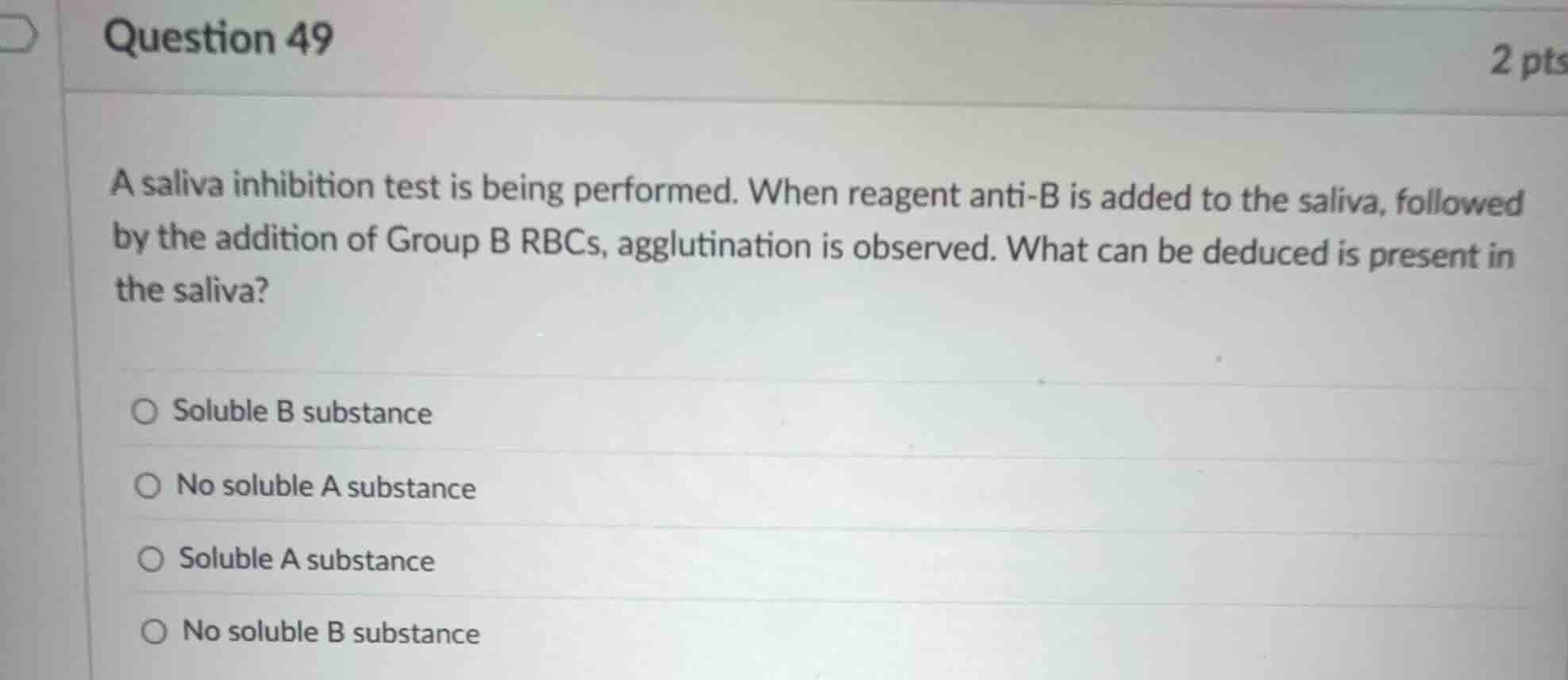
a saliva inhibition test is being performed. when reagent anti-b is added to the saliva, followed by the addition of group b rbcs, agglutination is observed. what can be deduced is present in the saliva?
soluble b substance
no soluble a substance
soluble a substance
no soluble b substance
Understand the saliva inhibition test principle
The saliva inhibition test is used to determine if a person is a secretor of ABH blood group substances. In this test, saliva is mixed with a known commercial antibody (reagent). If the corresponding soluble blood group substance is present in the saliva, it will bind to and neutralize (inhibit) the reagent antibody.
Analyze the reaction steps
In this specific scenario, the test is performed as follows:
- Reagent anti-B is added to the patient's saliva.
- Indicator Group B red blood cells (RBCs) are added to the mixture.
- Agglutination is observed.
Interpret the observed agglutination
Agglutination of the indicator Group B RBCs requires active, unblocked anti-B antibodies to bind to the B antigens on the RBC surface. Because agglutination occurred, the reagent anti-B was not neutralized or inhibited by the saliva.
Deduce the saliva contents
Since the reagent anti-B was not neutralized, there was no soluble B substance in the saliva to bind to it. Therefore, we can deduce that there is no soluble B substance present in the saliva.

Snap & solve any problem in the app
Get step-by-step solutions on Sovi AI
Photo-based solutions with guided steps
Explore more problems and detailed explanations
- Soluble B substance
- No soluble A substance
- Soluble A substance
- No soluble B substance (Correct answer)