Sovi.AI - AI Math Tutor

Scan to solve math questions

QUESTION IMAGE

question 46 munchausen syndrome by proxy is which of the following? a. …

Question

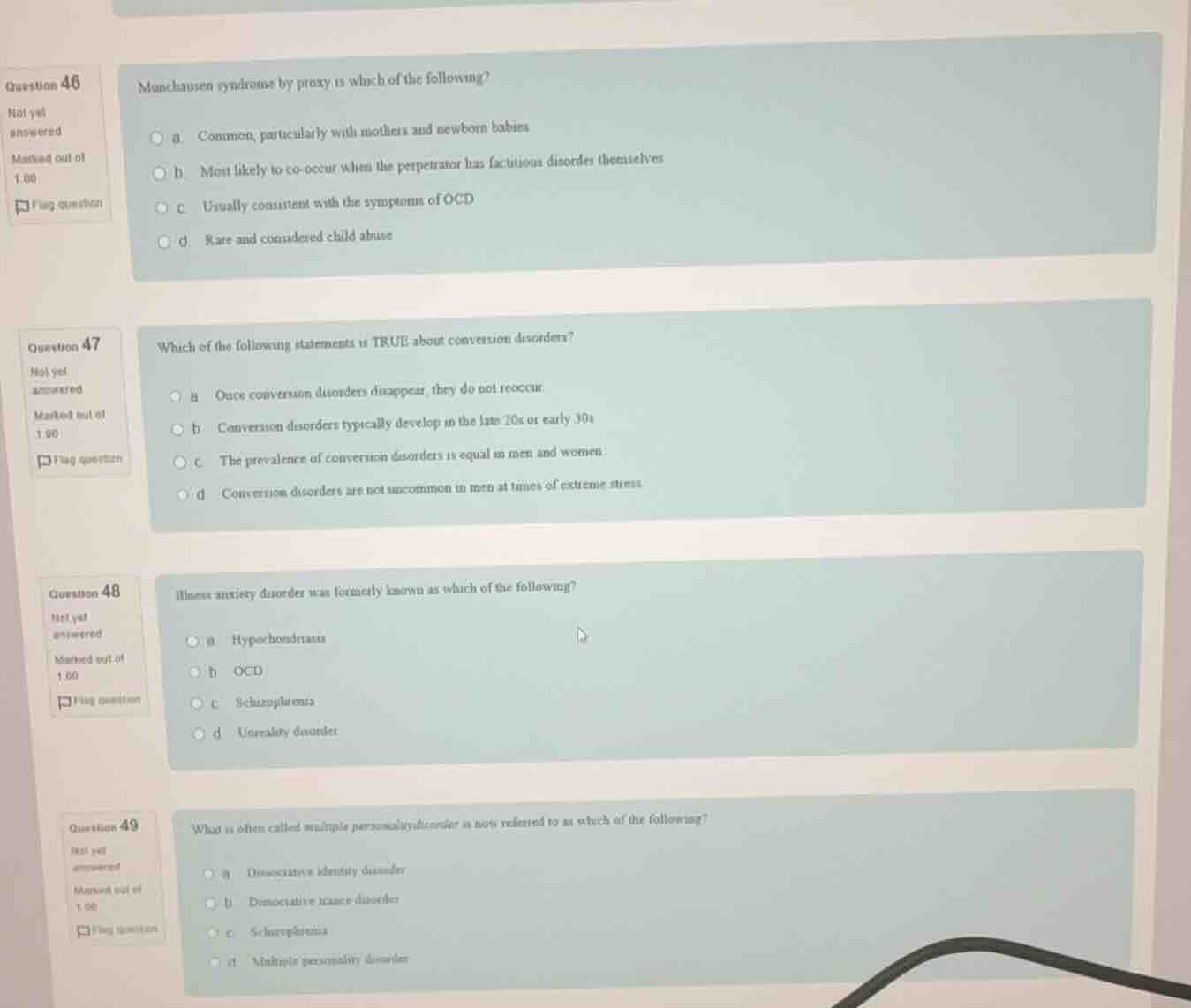
question 46
munchausen syndrome by proxy is which of the following?
a. common, particularly with mothers and newborn babies
b. most likely to co-occur when the perpetrator has factitious disorder themselves
c. usually consistent with the symptoms of ocd
d. rare and considered child abuse

question 47
which of the following statements is true about conversion disorders?
a. once conversion disorders disappear, they do not reoccur.
b. conversion disorders typically develop in the late 20s or early 30s.
c. the prevalence of conversion disorders is equal in men and women.
d. conversion disorders are not uncommon in men at times of extreme stress.

question 48
illness anxiety disorder was formerly known as which of the following?
a. hypochondriasis
b. ocd
c. schizophrenia
d. unreality disorder

question 49
what is often called multiple personality disorder is now referred to as which of the following?
a. dissociative identity disorder
b. dissociative trance disorder
c. schizophrenia
d. multiple personality disorder

Explanation:

Response

<pre_analysis>
{
"quality": "clear",
"question_count": 4,
"skills_matched": [
"direct_cot",
"multiple_choice_formatter",
"explain_then_answer",
"quick"
],
"needs_drawing": false,
"concepts_used": [
"Factitious Disorder",
"Somatic Symptom Disorder",
"Dissociative Identity Disorder"
],
"new_concepts": [
"Conversion Disorder Features"
],
"current_concepts": [
"Factitious Disorder",
"Conversion Disorder Features",
"Somatic Symptom Disorder",
"Dissociative Identity Disorder"
]
}
</pre_analysis><reasoning>

Analyze Munchausen syndrome by proxy (Question 46)

Munchausen syndrome by proxy (factitious disorder imposed on another) is a rare condition where a caregiver deliberately falsifies, exaggerates, or induces physical or psychological symptoms in another person under their care. It is legally and clinically classified as a form of child abuse.

Analyze Conversion Disorders (Question 47)

Conversion disorder (functional neurological symptom disorder) involves unexplained neurological symptoms. While more common in women, it is known to occur in men under conditions of extreme physical or psychological stress (such as combat or severe trauma).

Analyze Illness Anxiety Disorder and Multiple Personality Disorder (Questions 48 & 49)

Illness anxiety disorder was historically and commonly known as hypochondriasis in previous editions of the DSM. Multiple personality disorder is the former clinical term for what is now classified as dissociative identity disorder (DID).
</reasoning>
<answer>

Question 46

<mcq-option>a. Common, particularly with mothers and newborn babies</mcq-option>
<mcq-option>b. Most likely to co-occur when the perpetrator has factitious disorder themselves</mcq-option>
<mcq-option>c. Usually consistent with the symptoms of OCD</mcq-option>
<mcq-correct>d. Rare and considered child abuse</mcq-correct>

Question 47

<mcq-option>a. Once conversion disorders disappear, they do not reoccur.</mcq-option>
<mcq-option>b. Conversion disorders typically develop in the late 20s or early 30s.</mcq-option>
<mcq-option>c. The prevalence of conversion disorders is equal in men and women.</mcq-option>
<mcq-correct>d. Conversion disorders are not uncommon in men at times of extreme stress.</mcq-correct>

Question 48

<mcq-correct>a. Hypochondriasis</mcq-correct>
<mcq-option>b. OCD</mcq-option>
<mcq-option>c. Schizophrenia</mcq-option>
<mcq-option>d. Unreality disorder</mcq-option>

Question 49

<mcq-correct>a. Dissociative identity disorder</mcq-correct>
<mcq-option>b. Dissociative trance disorder</mcq-option>
<mcq-option>c. Schizophrenia</mcq-option>
<mcq-option>d. Multiple personality disorder</mcq-option>
</answer><post_analysis>
{
"subject": "Natural Science",
"question_type": "Multiple Choice",
"knowledge_point": [
"Natural Science",
"Psychiatry",
"Somatic Symptom and Dissociative Disorders"
]
}
</post_analysis>

Answer:

<pre_analysis>
{
"quality": "clear",
"question_count": 4,
"skills_matched": [
"direct_cot",
"multiple_choice_formatter",
"explain_then_answer",
"quick"
],
"needs_drawing": false,
"concepts_used": [
"Factitious Disorder",
"Somatic Symptom Disorder",
"Dissociative Identity Disorder"
],
"new_concepts": [
"Conversion Disorder Features"
],
"current_concepts": [
"Factitious Disorder",
"Conversion Disorder Features",
"Somatic Symptom Disorder",
"Dissociative Identity Disorder"
]
}
</pre_analysis><reasoning>

Analyze Munchausen syndrome by proxy (Question 46)

Munchausen syndrome by proxy (factitious disorder imposed on another) is a rare condition where a caregiver deliberately falsifies, exaggerates, or induces physical or psychological symptoms in another person under their care. It is legally and clinically classified as a form of child abuse.

Analyze Conversion Disorders (Question 47)

Conversion disorder (functional neurological symptom disorder) involves unexplained neurological symptoms. While more common in women, it is known to occur in men under conditions of extreme physical or psychological stress (such as combat or severe trauma).

Analyze Illness Anxiety Disorder and Multiple Personality Disorder (Questions 48 & 49)

Illness anxiety disorder was historically and commonly known as hypochondriasis in previous editions of the DSM. Multiple personality disorder is the former clinical term for what is now classified as dissociative identity disorder (DID).
</reasoning>
<answer>

Question 46

<mcq-option>a. Common, particularly with mothers and newborn babies</mcq-option>
<mcq-option>b. Most likely to co-occur when the perpetrator has factitious disorder themselves</mcq-option>
<mcq-option>c. Usually consistent with the symptoms of OCD</mcq-option>
<mcq-correct>d. Rare and considered child abuse</mcq-correct>

Question 47

<mcq-option>a. Once conversion disorders disappear, they do not reoccur.</mcq-option>
<mcq-option>b. Conversion disorders typically develop in the late 20s or early 30s.</mcq-option>
<mcq-option>c. The prevalence of conversion disorders is equal in men and women.</mcq-option>
<mcq-correct>d. Conversion disorders are not uncommon in men at times of extreme stress.</mcq-correct>

Question 48

<mcq-correct>a. Hypochondriasis</mcq-correct>
<mcq-option>b. OCD</mcq-option>
<mcq-option>c. Schizophrenia</mcq-option>
<mcq-option>d. Unreality disorder</mcq-option>

Question 49

<mcq-correct>a. Dissociative identity disorder</mcq-correct>
<mcq-option>b. Dissociative trance disorder</mcq-option>
<mcq-option>c. Schizophrenia</mcq-option>
<mcq-option>d. Multiple personality disorder</mcq-option>
</answer><post_analysis>
{
"subject": "Natural Science",
"question_type": "Multiple Choice",
"knowledge_point": [
"Natural Science",
"Psychiatry",
"Somatic Symptom and Dissociative Disorders"
]
}
</post_analysis>