Sovi.AI - AI Math Tutor

Scan to solve math questions

QUESTION IMAGE

question 29 maria-christina finds that her thoughts seem to jump from o…

Question

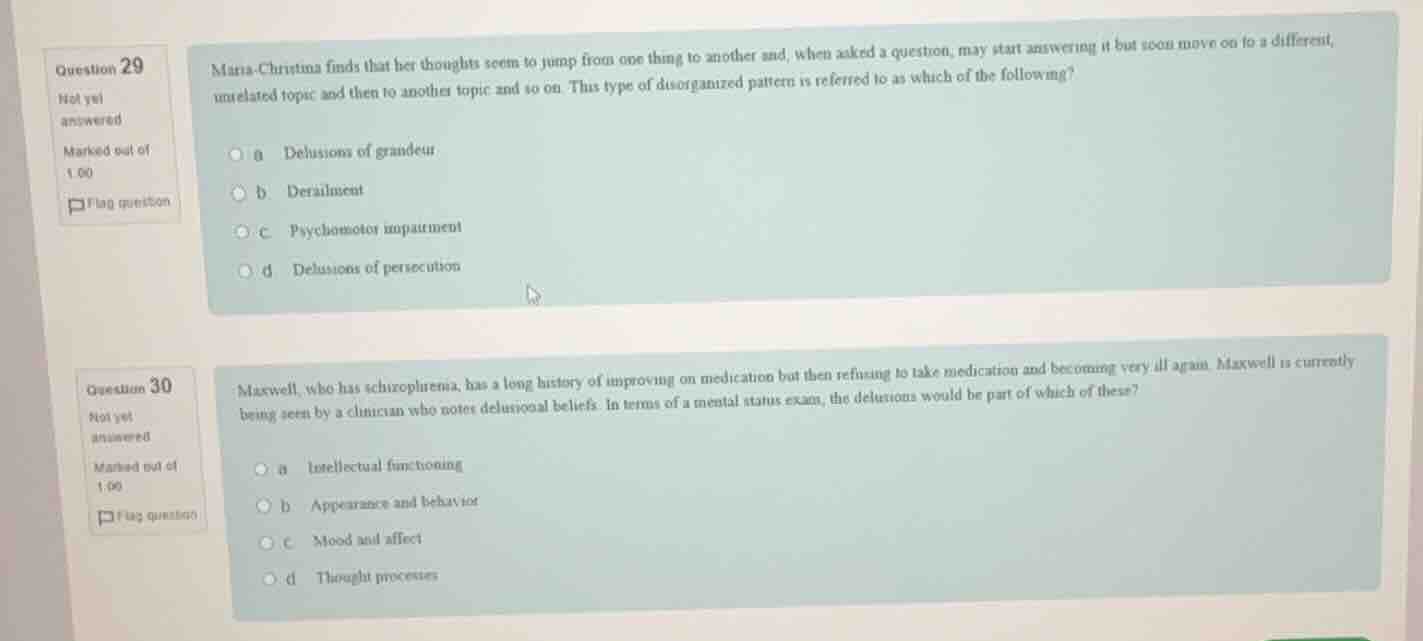
question 29
maria-christina finds that her thoughts seem to jump from one thing to another and, when asked a question, may start answering it but soon move on to a different, unrelated topic and then to another topic and so on. this type of disorganized pattern is referred to as which of the following?
a. delusions of grandeur
b. derailment
c. psychomotor impairment
d. delusions of persecution

question 30
maxwell, who has schizophrenia, has a long history of improving on medication but then refusing to take medication and becoming very ill again. maxwell is currently being seen by a clinician who notes delusional beliefs. in terms of a mental status exam, the delusions would be part of which of these?
a. intellectual functioning
b. appearance and behavior
c. mood and affect
d. thought processes

Explanation:

Response

<pre_analysis>
{
"quality": "clear",
"question_count": 2,
"skills_matched": [
"direct_cot",
"multiple_choice_formatter",
"explain_then_answer",
"quick"
],
"needs_drawing": false,
"concepts_used": [
"Mental Status Exam"
],
"new_concepts": [
"Schizophrenia Symptoms",
"Formal Thought Disorder"
],
"current_concepts": [
"Mental Status Exam",
"Schizophrenia Symptoms",
"Formal Thought Disorder"
]
}
</pre_analysis>

<reasoning>

Analyze Question 29

The description of thoughts jumping from one topic to another, leading to answers that drift to unrelated topics, defines derailment (also known as loose associations), a common formal thought disorder symptom in schizophrenia.

  • Option a (Delusions of grandeur) refers to false beliefs of inflated power or importance.
  • Option b (Derailment) matches the disorganized speech/thought pattern described.
  • Option c (Psychomotor impairment) refers to slowed physical movements.
  • Option d (Delusions of persecution) refers to false beliefs of being harmed or harassed.

Analyze Question 30

Delusions represent abnormal beliefs and are assessed under the "thought processes" (specifically thought content) component of a Mental Status Exam (MSE).

  • Option a (Intellectual functioning) assesses general cognitive ability and knowledge.
  • Option b (Appearance and behavior) covers physical presentation and motor activity.
  • Option c (Mood and affect) covers emotional state.
  • Option d (Thought processes) covers how a person thinks, including the content of their thoughts (such as delusions).

</reasoning>

<answer>

Question 29

<mcq-option>a. Delusions of grandeur</mcq-option>
<mcq-correct>b. Derailment</mcq-correct>
<mcq-option>c. Psychomotor impairment</mcq-option>
<mcq-option>d. Delusions of persecution</mcq-option>

Question 30

<mcq-option>a. Intellectual functioning</mcq-option>
<mcq-option>b. Appearance and behavior</mcq-option>
<mcq-option>c. Mood and affect</mcq-option>
<mcq-correct>d. Thought processes</mcq-correct>
</answer>

<post_analysis>
{
"subject": "Natural Science",
"question_type": "Multiple Choice",
"knowledge_point": [
"Natural Science",
"Psychiatry",
"Mental Status Exam"
]
}
</post_analysis>

Answer:

<pre_analysis>
{
"quality": "clear",
"question_count": 2,
"skills_matched": [
"direct_cot",
"multiple_choice_formatter",
"explain_then_answer",
"quick"
],
"needs_drawing": false,
"concepts_used": [
"Mental Status Exam"
],
"new_concepts": [
"Schizophrenia Symptoms",
"Formal Thought Disorder"
],
"current_concepts": [
"Mental Status Exam",
"Schizophrenia Symptoms",
"Formal Thought Disorder"
]
}
</pre_analysis>

<reasoning>

Analyze Question 29

The description of thoughts jumping from one topic to another, leading to answers that drift to unrelated topics, defines derailment (also known as loose associations), a common formal thought disorder symptom in schizophrenia.

  • Option a (Delusions of grandeur) refers to false beliefs of inflated power or importance.
  • Option b (Derailment) matches the disorganized speech/thought pattern described.
  • Option c (Psychomotor impairment) refers to slowed physical movements.
  • Option d (Delusions of persecution) refers to false beliefs of being harmed or harassed.

Analyze Question 30

Delusions represent abnormal beliefs and are assessed under the "thought processes" (specifically thought content) component of a Mental Status Exam (MSE).

  • Option a (Intellectual functioning) assesses general cognitive ability and knowledge.
  • Option b (Appearance and behavior) covers physical presentation and motor activity.
  • Option c (Mood and affect) covers emotional state.
  • Option d (Thought processes) covers how a person thinks, including the content of their thoughts (such as delusions).

</reasoning>

<answer>

Question 29

<mcq-option>a. Delusions of grandeur</mcq-option>
<mcq-correct>b. Derailment</mcq-correct>
<mcq-option>c. Psychomotor impairment</mcq-option>
<mcq-option>d. Delusions of persecution</mcq-option>

Question 30

<mcq-option>a. Intellectual functioning</mcq-option>
<mcq-option>b. Appearance and behavior</mcq-option>
<mcq-option>c. Mood and affect</mcq-option>
<mcq-correct>d. Thought processes</mcq-correct>
</answer>

<post_analysis>
{
"subject": "Natural Science",
"question_type": "Multiple Choice",
"knowledge_point": [
"Natural Science",
"Psychiatry",
"Mental Status Exam"
]
}
</post_analysis>