QUESTION IMAGE
Question
question 26
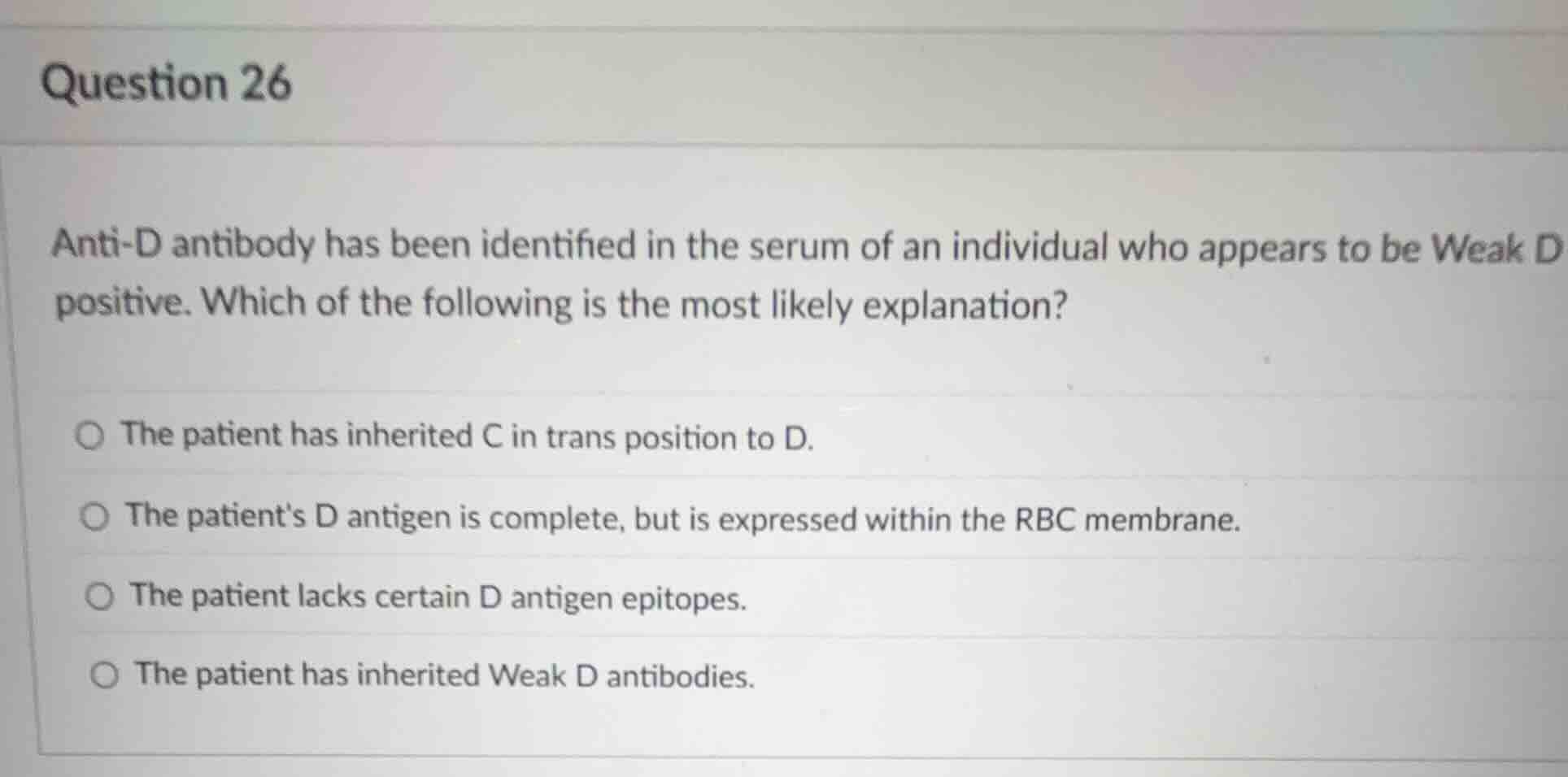
anti-d antibody has been identified in the serum of an individual who appears to be weak d positive. which of the following is the most likely explanation?
- the patient has inherited c in trans position to d.
- the patients d antigen is complete, but is expressed within the rbc membrane.
- the patient lacks certain d antigen epitopes.
- the patient has inherited weak d antibodies.
Analyze the clinical scenario
Using the Weak D Testing knowledge point
An individual who types as "Weak D positive" but has developed an alloantibody against the D antigen (anti-D) is typically a partial D (formerly called D variant) individual. In these cases, the D antigen is not merely quantitatively reduced, but qualitatively altered because it lacks one or more of the normal D antigen epitopes. When exposed to complete D-positive red blood cells (which possess all epitopes), the individual's immune system recognizes the missing epitopes as foreign and produces an alloantibody (anti-D) directed against those missing parts.
Evaluate the options
- Option 1: The patient has inherited C in trans position to D. This describes a position effect (e.g., Ce inherited in trans to D, as in Dce/dCe), which causes a quantitative reduction in D antigen expression (weak D). However, these individuals possess a complete D antigen with all its normal epitopes and do not make anti-D when exposed to normal D-positive blood.
- Option 2: The patient's D antigen is complete, but is expressed within the RBC membrane. This does not describe a mechanism that leads to allo-anti-D production, as a complete antigen would not trigger an immune response against itself.
- Option 3: The patient lacks certain D antigen epitopes. This is the definition of a partial D phenotype. Because they lack specific epitopes of the D macromolecule, they can produce allo-anti-D against the missing epitopes when exposed to complete D-positive red blood cells.
- Option 4: The patient has inherited Weak D antibodies. Antibodies are not inherited in this manner; they are produced as an immune response to foreign antigens.
Formulate the final conclusion
The most likely explanation for a Weak D positive individual developing anti-D is that they possess a partial D phenotype, meaning they lack certain D antigen epitopes.

Snap & solve any problem in the app
Get step-by-step solutions on Sovi AI
Photo-based solutions with guided steps
Explore more problems and detailed explanations
- The patient has inherited C in trans position to D.
- The patient's D antigen is complete, but is expressed within the RBC membrane.
- The patient lacks certain D antigen epitopes. (Correct answer)
- The patient has inherited Weak D antibodies.