QUESTION IMAGE
Question
question 9 of 25
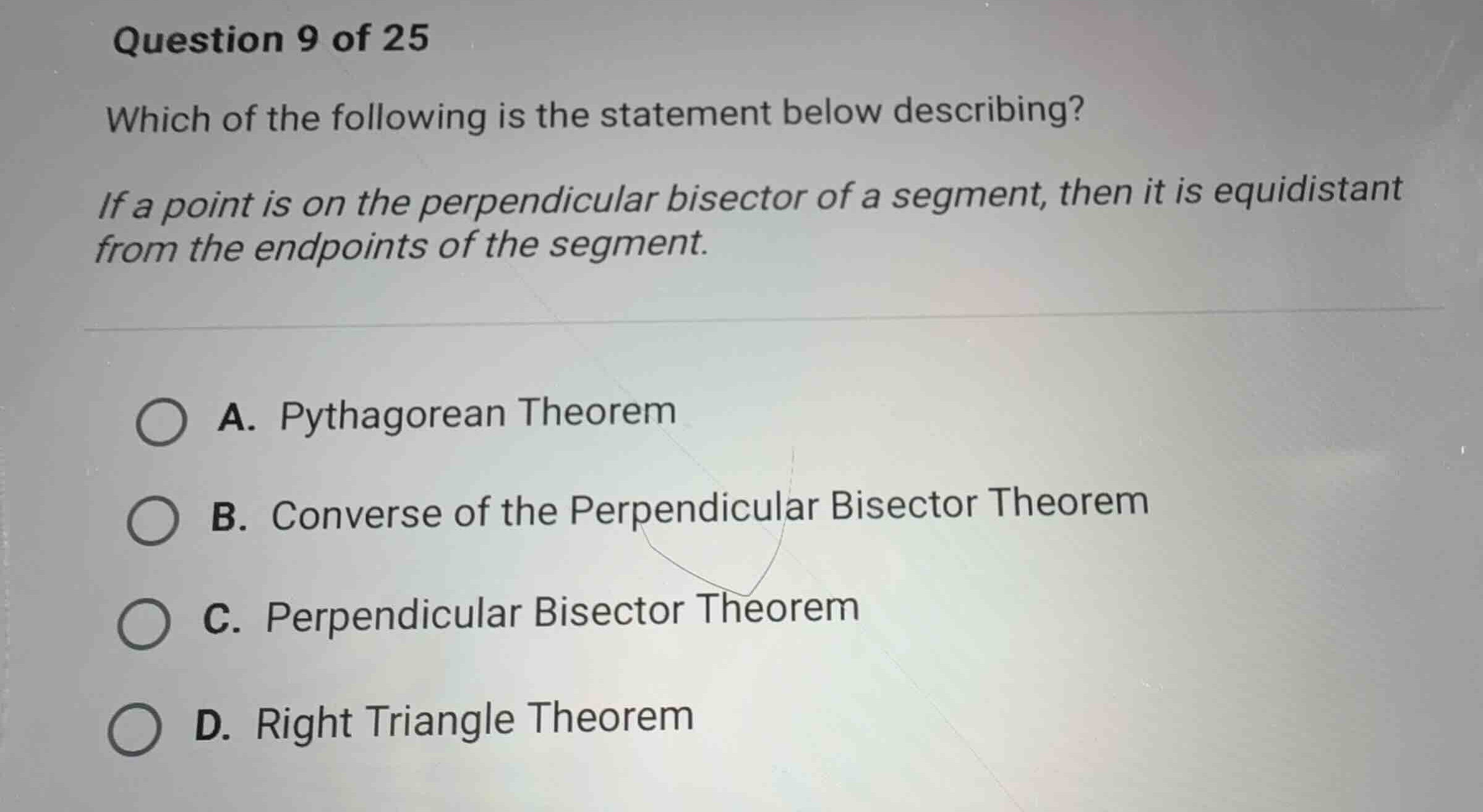
which of the following is the statement below describing?
if a point is on the perpendicular bisector of a segment, then it is equidistant from the endpoints of the segment.
a. pythagorean theorem
b. converse of the perpendicular bisector theorem
c. perpendicular bisector theorem
d. right triangle theorem
Analyze the given statement
The statement provided is: "If a point is on the perpendicular bisector of a segment, then it is equidistant from the endpoints of the segment."
This statement establishes a direct relationship:
- Hypothesis (If): A point lies on the perpendicular bisector of a segment.
- Conclusion (Then): The point is equidistant from the endpoints of that segment.
Compare with known geometric theorems
Let's evaluate the given options to see which theorem matches this description:
- Perpendicular Bisector Theorem: This theorem states that if a point lies on the perpendicular bisector of a segment, then it is equidistant from the endpoints of the segment. This is a direct match to our statement.
- Converse of the Perpendicular Bisector Theorem: This theorem states the reverse: if a point is equidistant from the endpoints of a segment, then it lies on the perpendicular bisector of the segment.
- Pythagorean Theorem: This relates the lengths of the sides of a right triangle (\(a^2 + b^2 = c^2\)), which is unrelated to this statement.
- Right Triangle Theorem: This is a general term and does not define this specific property of perpendicular bisectors.
Determine the correct option
Since the statement starts with the point being on the perpendicular bisector and concludes with it being equidistant, it represents the direct Perpendicular Bisector Theorem.

Snap & solve any problem in the app
Get step-by-step solutions on Sovi AI
Photo-based solutions with guided steps
Explore more problems and detailed explanations
- (A) Pythagorean Theorem
- (B) Converse of the Perpendicular Bisector Theorem
- (C) Perpendicular Bisector Theorem (Correct answer)
- (D) Right Triangle Theorem